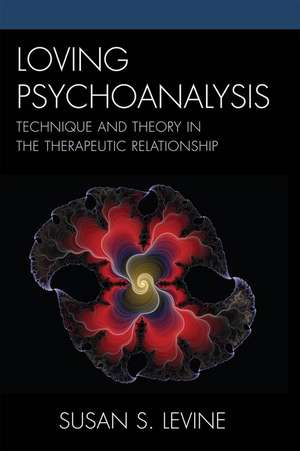
Loving Psychoanalysis: Technique and Theory in the Therapeutic Relationship
Autor Susan S. Levineen Limba Engleză Hardback – 12 dec 2008
The chapters explore overlapping interdisciplinary themes, each chapter addressing elements of both theory and technique. How do the analyst's and patient's wishes to create and to be (re)created affect the treatment? What is the role of courage in the clinical endeavor for both analyst and patient? Why do analysts love doing psychoanalysis and why can psychoanalysis be thought of as aesthetic? What is the "self" of the analyst in self-revelation and self-disclosure, and how can we think about this technical issue in a fresh way? Levine addresses these and many other relevant questions in Loving Psychoanalysis.
Preț: 568.24 lei
Preț vechi: 825.71 lei
-31%
Puncte Express: 852
Carte tipărită la comandă
Livrare economică 20 noiembrie-04 decembrie
Livrare prin curier în România Termenul estimat este afișat lângă disponibilitate.
Transport gratuit pentru acest produs Plată online sau ramburs, în funcție de opțiunile comenzii.
Retur gratuit în 14 zile Comandă securizată și suport în română.
Specificații
ISBN-13: 9780765706249
ISBN-10: 0765706245
Pagini: 155
Dimensiuni: 152 x 232 x 16 mm
Greutate: 0.4 kg
Editura: Bloomsbury Publishing
Colecția Jason Aronson Inc
Locul publicării:New York, United States
ISBN-10: 0765706245
Pagini: 155
Dimensiuni: 152 x 232 x 16 mm
Greutate: 0.4 kg
Editura: Bloomsbury Publishing
Colecția Jason Aronson Inc
Locul publicării:New York, United States
Cuprins
Chapter 1 Introduction
Chapter 2 Chapter 1. On the Mirror Stage with Henry and Eliza or Play-ing with Pygmalion in Five Acts
Chapter 3 Chapter 2. Catching the Wrong Leopard: Courage and Masochism in the Psychoanalytic Situation
Chapter 4 Chapter 3. Beauty Treatment: The Aesthetics of the Psychoanalytic Process
Chapter 5 Chapter 4. To Have and to Hold: On the Experience of Having an Other
Chapter 6 Chapter 5. Nothing but the Truth: Self-disclosure, Self-revelation, and the Persona of the Analyst
Chapter 7 Chapter 6. In the Mind's Eye: or, You Can't Spell "Psychoanalysis" Without C-H-A-O-S
Chapter 2 Chapter 1. On the Mirror Stage with Henry and Eliza or Play-ing with Pygmalion in Five Acts
Chapter 3 Chapter 2. Catching the Wrong Leopard: Courage and Masochism in the Psychoanalytic Situation
Chapter 4 Chapter 3. Beauty Treatment: The Aesthetics of the Psychoanalytic Process
Chapter 5 Chapter 4. To Have and to Hold: On the Experience of Having an Other
Chapter 6 Chapter 5. Nothing but the Truth: Self-disclosure, Self-revelation, and the Persona of the Analyst
Chapter 7 Chapter 6. In the Mind's Eye: or, You Can't Spell "Psychoanalysis" Without C-H-A-O-S
Recenzii
Playful, yet profound, Susan Levine's book, Loving Psychoanalysis, makes the too-often forbidding world of psychoanalysis accessible to everyone by her unique writing style. She writes evocatively and artistically on topics ranging from My Fair Lady and leopards to courage and fractals. As she candidly describes her own experiences with her analysands, she conveys the essence of the analytic relationship. In her writing the reader feels the personal touch of Montaigne blending with the bright colors of Chagall. Levine's insightful and original view of analysis leaps from the pages-a view embodying an experience which is authentic, aesthetic, loving, and deeply helpful. Her enthusiasm is contagious. This alone recommends this book for her analytic colleagues as well as for all potential analysands who will appreciate Levine's insights into the essential humanity of today's analysts.
It is a pleasure to read this collection of Susan Levine's papers. She brings a deep scholarship and a subtle, discerning clinical eye to a number of important problems in contemporary psychoanalysis. She writes in the venerable tradition of Loewald, the object relational, and the relational world. Character and integrity matter deeply to Levine even as she inhabits a postmodern clinical world filled with uncertainty, enactment, and complex mutual influences of analyst and analysand. Her writing and her clinical work combine playfulness and surprise, alongside meticulous, self-reflective judgment. Free to find her own authorities, use many ancestors and modes of work and thought, Levine is very much of the new generation of psychoanalysts, less hobbled by sectarian conflicts, but always committed to thinking with rigor and complexity.
'A terrible beauty is born' [W. B. Yeats]-the evolving, instructive story about Susan Levine's love of her patients and psychoanalysis in both its clinical and theoretical reaches.
Throughout this book, Levine describes cases that help to illuminate the topics she is explores.... Overall, I found this work to be thought provoking and thoughtful, a book that gives us pause to think about our participation in the clinical process.
One of Levine's contributions in this collection of essays is the conviction of her love for psychoanalysis. It lifts the experience of enjoying psychoanalytic work out of the realm of narcissistic pathology and into the arena of aesthetics, aspiration, ideals and even ethics. This is a gift to the readers. . . . It forces each reader to examine his or her own biases, prejudices, defenses or inhibitions about acknowledging the potential beauty and lovingness involved in a profession as psychoanalysis.
Deftly interweaving clinical observations with ideas from theatre, movies, aesthetics of communication, and chaos theory, Levine offers us a rich and tightly argued discourse on the nature of the psychoanalytic relationship. Her writing is elegant and her themes, when all is said and done, are fundamentally clinical. The dialectics of compliance versus authenticity, masochism versus courage, alienation versus belonging, and restraint versus abandon inform her theoretical orientation and her clinical approach. This is a book to be read slowly and carefully and the rewards for doing so are indeed plentiful.
It is a pleasure to read this collection of Susan Levine's papers. She brings a deep scholarship and a subtle, discerning clinical eye to a number of important problems in contemporary psychoanalysis. She writes in the venerable tradition of Loewald, the object relational, and the relational world. Character and integrity matter deeply to Levine even as she inhabits a postmodern clinical world filled with uncertainty, enactment, and complex mutual influences of analyst and analysand. Her writing and her clinical work combine playfulness and surprise, alongside meticulous, self-reflective judgment. Free to find her own authorities, use many ancestors and modes of work and thought, Levine is very much of the new generation of psychoanalysts, less hobbled by sectarian conflicts, but always committed to thinking with rigor and complexity.
'A terrible beauty is born' [W. B. Yeats]-the evolving, instructive story about Susan Levine's love of her patients and psychoanalysis in both its clinical and theoretical reaches.
Throughout this book, Levine describes cases that help to illuminate the topics she is explores.... Overall, I found this work to be thought provoking and thoughtful, a book that gives us pause to think about our participation in the clinical process.
One of Levine's contributions in this collection of essays is the conviction of her love for psychoanalysis. It lifts the experience of enjoying psychoanalytic work out of the realm of narcissistic pathology and into the arena of aesthetics, aspiration, ideals and even ethics. This is a gift to the readers. . . . It forces each reader to examine his or her own biases, prejudices, defenses or inhibitions about acknowledging the potential beauty and lovingness involved in a profession as psychoanalysis.
Deftly interweaving clinical observations with ideas from theatre, movies, aesthetics of communication, and chaos theory, Levine offers us a rich and tightly argued discourse on the nature of the psychoanalytic relationship. Her writing is elegant and her themes, when all is said and done, are fundamentally clinical. The dialectics of compliance versus authenticity, masochism versus courage, alienation versus belonging, and restraint versus abandon inform her theoretical orientation and her clinical approach. This is a book to be read slowly and carefully and the rewards for doing so are indeed plentiful.