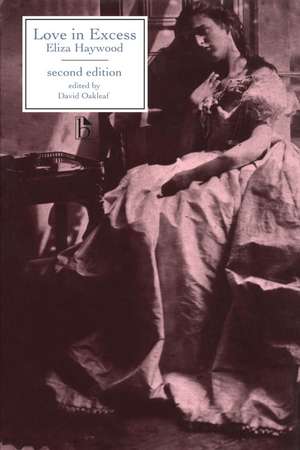
Love in Excess - Second Edition
Autor Eliza Haywood Editat de David Oakleafen Limba Engleză Paperback – 12 iun 2000
Haywood’s frankness about female sexuality may explain the later neglect of Love in Excess. (In contrast, her accomplished domestic novel, The History of Miss Betsy Thoughtless, has remained available.) Love in Excess and its reception provide a lively and valuable record of the challenge that female desire posed to social decorum.
For the second Broadview edition, the appendix of eighteenth-century responses to Haywood has been considerably expanded.
Preț: 157.65 lei
Preț vechi: 187.27 lei
-16%
Puncte Express: 236
Carte disponibilă
Livrare economică 06-20 noiembrie
Livrare prin curier în România Termenul estimat este afișat lângă disponibilitate.
Transport gratuit de la 400.00 lei Plată online sau ramburs, în funcție de opțiunile comenzii.
Retur gratuit în 14 zile Comandă securizată și suport în română.
Specificații
ISBN-13: 9781551113678
ISBN-10: 1551113678
Pagini: 296
Dimensiuni: 140 x 216 x 14 mm
Greutate: 0.38 kg
Ediția:2
Editura: BROADVIEW PR
Colecția Broadview Press
Locul publicării:Peterborough, Canada
ISBN-10: 1551113678
Pagini: 296
Dimensiuni: 140 x 216 x 14 mm
Greutate: 0.38 kg
Ediția:2
Editura: BROADVIEW PR
Colecția Broadview Press
Locul publicării:Peterborough, Canada
V-ar putea interesa
-
 Selected Fiction and Drama of Eliza HaywoodEliza Haywood-21%Preț: 385.57 lei490.13 lei
 -
 Selections from The Female SpectatorEliza Haywood-21%Preț: 510.91 lei650.77 lei
 -
 The Rash Resolve and Life's Progress: by Eliza HaywoodCarol Stewart-15%Preț: 430.96 lei507.00 lei
 -
 A Political Biography of Jonathan SwiftDavid Oakleaf-15%Preț: 437.28 lei514.45 lei
 -
 In Full UniformAnthony CarnovalePreț: 89.69 lei
 -
 Amor de PerdicaoCamilo Castelo BrancoPreț: 68.28 lei
 -
 The Life of Merlin, Vita MerliniGeoffrey MonmouthPreț: 51.45 lei
 -
 Who Cares? a Story of AdolescenceCosmo HamiltonPreț: 46.55 lei
 -
 And So She WaitedShakuita JohnsonPreț: 73.30 lei
 -
 Jin Ping Mei, Vol. 2 of 2Lan-Ling Xiao-Xiao ShengPreț: 94.95 lei
 -
 My Bondage and My FreedomFrederick DouglassPreț: 62.52 lei
 -
 The History of Miss Betsy ThoughtlessEliza Haywood-21%Preț: 233.18 lei294.37 lei
 -
 MarcellaMary Augusta Ward-21%Preț: 240.54 lei305.73 lei
 -
 The Adventures of EovaaiEliza Haywood-21%Preț: 208.25 lei263.63 lei
 -
 The Clever Woman of the FamilyCharlotte Mary Yonge-11%Preț: 240.36 lei269.00 lei
 -
 -23%Preț: 188.46 lei244.38 lei
 -
 Zastrozzi and St. IrvynePercy Bysshe Shelley-22%Preț: 239.33 lei306.96 lei
 -
 DesmondCharlotte Smith-22%Preț: 239.45 lei305.05 lei
 -
 The Rebel of the FamilyEliza Lynn Linton-21%Preț: 240.98 lei305.99 lei
 -
 Phoebe JuniorMargaret Oliphant-13%Preț: 239.88 lei276.66 lei
 -
 Anti-Pamela and ShamelaEliza Haywood-17%Preț: 156.59 lei188.24 lei
 -
 VilletteCharlotte Brontë-21%Preț: 182.07 lei229.36 lei
 -
 Fantomina and Other WorksEliza Haywood-16%Preț: 148.57 lei177.87 lei
 -
 A Political Biography of Jonathan SwiftDavid Oakleaf-18%Preț: 1290.90 lei1574.26 lei
Recenzii
Eliza Haywood (1693-1756) was one of the most successful writers of her time; indeed, the two most popular English novels in the early eighteenth-century were Robinson Crusoe and Haywood’s first novel, Love in Excess. As this edition enables modern readers to discover, its enormous success is easy to understand. Love in Excess is a well crafted novel in which the claims of love and ambition are pursued through multiple storylines until the heroine engineers a melodramatic conclusion.
Haywood’s frankness about female sexuality may explain the later neglect of Love in Excess. (In contrast, her accomplished domestic novel, The History of Miss Betsy Thoughtless, has remained available.) Love in Excess and its reception provide a lively and valuable record of the challenge that female desire posed to social decorum.
For the second Broadview edition, the appendix of eighteenth-century responses to Haywood has been considerably expanded.
“This readable edition of Haywood’s blockbuster novel (with Oakleaf’s lively, highly informed introduction and clear judicious textual notes) is an important addition to our understanding of the history of the English novel.” — Paula Backscheider, Auburn University
Haywood’s frankness about female sexuality may explain the later neglect of Love in Excess. (In contrast, her accomplished domestic novel, The History of Miss Betsy Thoughtless, has remained available.) Love in Excess and its reception provide a lively and valuable record of the challenge that female desire posed to social decorum.
For the second Broadview edition, the appendix of eighteenth-century responses to Haywood has been considerably expanded.
“This readable edition of Haywood’s blockbuster novel (with Oakleaf’s lively, highly informed introduction and clear judicious textual notes) is an important addition to our understanding of the history of the English novel.” — Paula Backscheider, Auburn University
Cuprins
Introduction
A Note on the Text
Eliza Haywood: A Brief Chronology
Love in Excess; or, The Fatal Enquiry
A Note on the Text
Eliza Haywood: A Brief Chronology
Love in Excess; or, The Fatal Enquiry
- Bookseller’s Dedication
- Part the First
- Part the Second
- The Third and Last Part
- Anonymous
Verses Wrote in the Blank Leaf of Mrs. Haywood’s Novel (1722) - Richard Savage
- To Mrs. Eliza Haywood, on Her Novel, called The Rash Resolve (1724)
- From The Authors of the Town; A Satire (1725)
- Anonymous letter from The Ladies Journal
(Dublin, 1727) - Jonathan Swift
Corinna (1728) - Alexander Pope
From The Dunciad, Variorum. With the Prolegomena of Scriblerus (1729) - James Sterling
To Mrs. Eliza Haywood on Her Writings (1732) - William Rufus Chetwood
From A General History of the Stage; (More Particularlythe Irish Theatre) From its Origin in Greece down to thePresent Time. With the Memoirs of the Principal Performers,that have appeared on the Dublin Stage in the Last Fifty Years(Dublin, 1749) - David Erskine Baker
From Biographica Dramatica; or, A Companion to thePlayhouse (1764) - Clara Reeve
From The Progress of Romance, through Times, Countries,Manners; with Remarks on the Good and Bad Effects of It,on Them Respectively; in a Course of EveningConversations, “Evening VII”