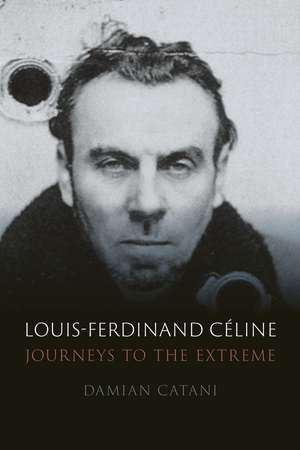
Louis-Ferdinand Céline
Autor Damian Catanien Limba Engleză Hardback – 26 noi 2021
Considerăm această lucrare o dramatizare riguroasă a uneia dintre cele mai fracturate existențe din literatura secolului XX. Scena se deschide nu într-un salon literar, ci în tensiunea dintre inovația lingvistică radicală și abisul moral al unui autor care a redefinit limba franceză. Damian Catani reușește să navigheze prin paradoxul Louis-Ferdinand Céline: geniul care a scris Journey to the End of the Night și omul a cărui reputație a fost aproape distrusă de viziunile sale politice incendiare. Analiza sa ne poartă de la începuturile modeste ale lui Céline până la exilul și dizgrația care au urmat celui de-al Doilea Război Mondial, oferind o perspectivă proaspătă asupra modului în care experiențele personale traumatizante s-au transformat în proză subversivă. Abordarea biografică evocă rigoarea din Celine the Crippled Giant, dar perspectiva lui Catani este mult mai nuanțată de accesul la materiale inedite apărute în ultimele două decenii, reușind să integreze atât valoarea estetică a operei, cât și caracterul problematic al omului. Reținem fluiditatea cu care autorul explică tranziția de la medicul săracilor la pamfletarul virulent, fără a scuza derapajele acestuia, ci oferind contextul necesar pentru a înțelege de ce Céline rămâne o figură centrală, deși profund divizivă, în panteonul modern. Este o explorare a modului în care arta supraviețuiește, sau nu, în fața autodistrugerii morale a creatorului său.
Preț: 213.40 lei
Preț vechi: 248.47 lei
-14%
Carte disponibilă
Livrare economică 18-25 septembrie
Livrare express 04-10 septembrie pentru 87.41 lei
Specificații
ISBN-10: 1789144671
Pagini: 400
Ilustrații: 26 halftones
Dimensiuni: 159 x 239 x 39 mm
Greutate: 0.75 kg
Editura: REAKTION BOOKS
V-ar putea interesa
-
 -29%Preț: 217.87 lei305.37 lei
 -
 Stripping Down: A MemoirSheila HagemanPreț: 89.63 lei
 -
 Un Uomo a PerdereFracesco ColucciPreț: 63.92 lei
 -
 Preț: 83.05 lei
 -
 When Grandpa Was a BoyLisa CareyPreț: 60.73 lei
 -
 The Polly Parker StoryJr. Joshua JonesPreț: 95.35 lei
 -
 A Tale of Two MasksJessica B. KellyPreț: 54.43 lei
 -
 An Ancient Egyptian in TexasFred NashedPreț: 243.58 lei
 -
 In the Footsteps of George LansburyJoy S. J. EdwardsPreț: 274.68 lei
 -
 Greenwich PumasMatias RtunoPreț: 238.52 lei
 -
 I Wanted to FlyDonald E. RondaPreț: 79.00 lei
 -
 Preț: 115.14 lei
 -
 Ambushed in Church?Denny HarrisPreț: 128.93 lei
 -
 Light Amid DarknessDaphne RandallPreț: 134.34 lei
 -
 Undeniable ConnectionsLinda BeggsPreț: 78.28 lei
 -
 Mama's GirlVeronica ChambersPreț: 128.74 lei
 -
 Black White and JewishRebecca WalkerPreț: 149.22 lei
 -
 Preț: 112.50 lei
 -
 London BridgeLouis-Ferdinand CélinePreț: 95.58 lei
 -
 Trifles for a MassacreLouis Ferdinand CelinePreț: 183.11 lei
 -
 Condição Macroeconômica e Estrutura de CapitalKaren GavioliPreț: 331.39 lei
De ce să citești această carte
Recomandăm această biografie cititorilor interesați de istoria literară a secolului XX și de relația complexă dintre etică și estetică. Veți câștiga o înțelegere profundă a contextului în care au fost scrise capodoperele modernismului francez, beneficiind de prima cercetare majoră în limba engleză din ultimele decenii. Este un instrument esențial pentru a decoda mecanismele unei minți geniale, dar profund tulburate.
Despre autor
Damian Catani este un specialist recunoscut în literatura și cultura franceză, cu o expertiză vastă în studiul modernismului. Abordarea sa îmbină rigoarea academică cu o capacitate narativă de excepție, fiind capabil să extragă esența din arhive complexe pentru a o prezenta publicului larg. În această biografie publicată de REAKTION BOOKS, Catani reușește să echilibreze analiza critică a textelor lui Céline cu detaliile biografice adesea obscure, oferind o imagine completă a scriitorului francez la mai bine de șase decenii de la moartea acestuia.
Descriere scurtă
Louis-Ferdinand Céline was one of the most innovative novelists of the twentieth century, and his influence both in his native France and beyond remains huge. This book sheds light on Céline’s groundbreaking novels, which drew extensively on his complex life: he rose from humble beginnings to worldwide literary fame, then dramatically fell from grace only to return, belatedly, to the limelight. Céline’s subversive writing remains fresh and urgent today, despite his controversial political views and inflammatory pamphlets that threatened to ruin his reputation. The first English-language biography of Céline in more than two decades, this book explores new material and reminds us why the author belongs in the pantheon of modern greats.
Notă biografică
Extras
This powerlessness is especially felt by those at the bottom of the social ladder, with whose dire circumstances Céline became all too familiar. His life, in many ways, was a moral education on the plight of the underdog. As a soldier who was badly injured in the trenches, a supervisor in the colonial plantations of Africa and, later, a doctor who did his daily rounds in Paris slums at the height of the Depression, he saw ordinary people systematically being trampled underfoot, as the indifferent authorities stood idly by. His works seethe with anger and exasperation at this cynical exploitation of the little man. Yet as with life itself, they catch us by surprise by salvaging unexpected nuggets of comedy gold from even the most hopeless situations. At its best, Céline’s prose is charged with an almost unbearable tension, like a finely tuned violin whose strings threaten to break at any given moment. It excels in walking that tightrope between the tragic and the comic, by employing a style that repels us with its visceral, hard-hitting depiction of reality, while at the same time drawing us in with a coruscating black humour that generates outrageous moments of unexpected hilarity at the sheer absurdity of man’s fate.
By striking the right balance between despair and happiness, Céline’s novels succeed where his life often failed. They can be considered journeys to the extreme in their willingness to tackle taboo subjects and push stylistic boundaries to the limit with their satirical use of slang and disruption of narrative flow, which, even today, still irk some traditionalists. From Death on Credit onwards, Céline’s boldest and most contentious stylistic departure was his increasing use of ellipsis, which he referred to as ‘les trois points’ (‘three dots’). In this book, where three dots appear
in quotations from Céline’s novels and letters, these are his own, unless they are in square brackets, in which case they indicate a deliberate elision on my part.
But the moral and aesthetic risks of Céline’s journeys are handsomely rewarded by their destination: few can match Céline’s searingly honest account of the injustice of war and social oppression. In the early 1930s, he was heralded as the voice of the people. But from 1937 onwards, the anti-war stance of his fiction that had earned him such praise and admiration began to take him in a more sinister direction. The laudable pacifism of his novels became distorted by the hateful bigotry of his pamphlets. What was previously a justified satire of military and institutional authority turned into an irrational zealous crusade against the Jews, whom he wrongly blamed for trying to wage another war on Hitler. Céline was in grave danger of trading his humane literary transgressiveness for a hateful political extremism. He foolishly took his eye off the ball by cutting off the supply line that had made him such a great writer: his own inner life. Instead of mining the rich seam of his personal experiences to delve deep into the human condition, he succumbed to the external distractions of fascism, by advocating a French alliance with Hitler as the only way to avoid a new war. It would be a long road back for Céline to regain the trust and esteem of the public and critics who had once embraced him. He spent the 1950s clawing his way back into their affections by turning inwards once again and making himself – and not politics – the primary source of his writing.
It is not as if Céline’s life was dull and lacking in incident. He had no shortage of exciting raw material on which to draw. Born Louis Ferdinand Auguste Destouches in the Paris suburb of Courbevoie, on 27 May 1894, he would become a jeweller’s apprentice, soldier in a cavalry regiment, war invalid, trader on an African cocoa plantation, doctor, globetrotting head of the hygiene section in the League of Nations, acclaimed novelist, polemicist, fugitive, political prisoner, social pariah and eccentric recluse. As an adolescent, he already felt different from the herd. Acutely self-conscious about his limited schooling, he was driven by an insatiable desire to expand his intellectual horizons. His rebellious streak emanated, in part, from his social unease at coming from a lower-middle-class background. His sympathies naturally lay with the working-class poor, rather than the bourgeoisie, in whose presence he never felt entirely comfortable. This resentment can partly be attributed to his disgust at the moral hypocrisy of his own parents’ bourgeois pretensions. Nothing was more galling to Céline than phoniness and ‘keeping up appearances’. Time and again, his novels deploy his exceptional powers of observation to peel away the multiple layers of man’s duplicity and self-righteousness.