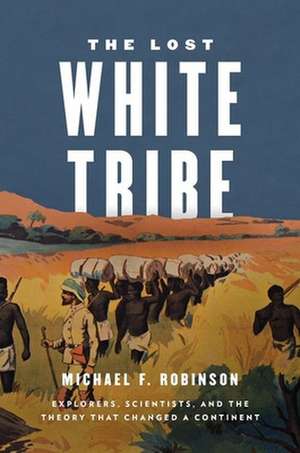
Lost White Tribe
Autor Michael F Robinsonen Limba Engleză Hardback – apr 2016
Structura volumului Lost White Tribe este concepută ca o investigație istorică și sociologică riguroasă, care urmărește ascensiunea și declinul unei idei periculoase: „Ipoteza Hamitică”. Metodologia autorului Michael F Robinson se bazează pe o sinteză vastă a cercetărilor de arhivă, reușind să conecteze interpretări biblice arhaice cu realități geopolitice moderne. Putem afirma că lucrarea nu se limitează la o simplă cronică a explorărilor lui Henry Morton Stanley, ci analizează modul în care credința în originea biblică a raselor a modelat structurile coloniale și ierarhiile sociale globale. Ne-a atras atenția modul în care Michael F Robinson demonstrează universalitatea acestui mit. De la „eschimoșii blonzi” din Arctica până la „indienii albi” din Panama, volumul dezvăluie cum exploratorii europeni au căutat obsesiv confirmări ale superiorității rasei albe în cele mai izolate colțuri ale lumii. Considerăm esențială perspectiva oferită asupra impactului cultural: ipoteza nu a influențat doar știința, ci a dat naștere unui întreg subgen literar și a fundamentat teorii psihanalitice. Cititorii familiarizați cu The Myth of Ham in Nineteenth-Century American Christianity de S. Johnson vor aprecia modul în care Michael F Robinson extinde dezbaterea de la contextul teologic american la o scară globală, incluzând arheologia și politicile coloniale europene. Spre deosebire de Exterminate All the Brutes de Sven Lindqvist, care se concentrează pe rădăcinile genocidului prin prisma literaturii și a călătoriilor personale, Lost White Tribe oferă un cadru teoretic mai larg, explicând cum o eroare de interpretare biblică a condus direct la catastrofe umanitare, inclusiv la genocidul din Rwanda. Este un studiu dens, publicat de Oxford University Press, care invită la o reflecție critică asupra modului în care prejudecățile intelectuale pot deveni instrumente de opresiune.
Preț: 198.01 lei
Carte disponibilă
Livrare economică 12-26 iunie
Specificații
ISBN-10: 0199978484
Pagini: 320
Dimensiuni: 164 x 244 x 32 mm
Greutate: 0.58 kg
Editura: Oxford University Press
V-ar putea interesa
-
 Waugh in AbyssiniaEvelyn Waugh-33%Preț: 60.22 lei90.45 lei
 -
 -24%Preț: 391.21 lei512.78 lei
 -
 -7%Preț: 598.28 lei642.89 lei
 -
 -14%Preț: 718.03 lei834.91 lei
 -
 Integration and Peace in East AfricaT. Etefa-15%Preț: 624.89 lei735.16 lei
 -
 A Legacy of LiberationMark GevisserPreț: 147.17 lei
 -
 Preț: 223.74 lei
 -
 -28%Preț: 66.73 lei92.17 lei
 -
 Nelson MandelaRichard Stengel-22%Preț: 82.27 lei104.81 lei
 -
 The Masters RevealedK. Paul JohnsonPreț: 256.32 lei
 -
 -19%Preț: 563.42 lei695.58 lei
 -
 -23%Preț: 496.66 lei645.01 lei
 -
 The Rise and Fall of Ancient EgyptToby Wilkinson-25%Preț: 93.02 lei124.04 lei
 -
 Diplomacy and Nation-Building in Africa: Franco-British relations and Cameroon at the End of EmpireProfessor Mélanie Torrent-38%Preț: 798.81 lei1297.69 lei
 -
 AfricaTom YoungPreț: 68.63 lei
De ce să citești această carte
Recomandăm această carte cititorilor interesați de istoria ideilor și de rădăcinile rasismului sistemic. Veți câștiga o înțelegere profundă a modului în care miturile biblice au fost transformate în „știință” pentru a justifica colonialismul. Este o lectură esențială pentru a descifra mecanismele din spatele unor conflicte moderne, oferind o perspectivă istorică documentată asupra modului în care teoriile despre „triburile albe pierdute” au influențat lumea contemporană.
Despre autor
Michael F Robinson este un istoric specializat în istoria explorărilor și a științei, cunoscut pentru capacitatea sa de a analiza intersecția dintre cultură, religie și descoperirile geografice. În lucrările sale, Robinson explorează adesea modul în care percepțiile occidentale asupra lumii au fost modelate de prejudecăți intelectuale și mituri de lungă durată. Prin volumul de față, publicat la prestigioasa editură Oxford University Press, el își confirmă expertiza în deconstruirea teoriilor rasiale și a impactului acestora asupra istoriei moderne.
Descriere scurtă
In The Lost White Tribe, Michael Robinson traces the rise and fall of the Hamitic Hypothesis. In addition to recounting Stanley's "discovery," Robinson shows how it influenced encounters with the Ainu in Japan; Vilhjalmur Stefansson's tribe of "blond Eskimos" in the Arctic; and the "white Indians" of Panama. As Robinson shows, race theory stemming originally from the Bible only not only guided exploration but archeology, including Charles Mauch's discovery of the Grand Zimbabwe site in 1872, and literature, such as H. Rider Haggard's King Solomon's Mines, whose publication launched an entire literary subgenre ded icated to white tribes in remote places. The Hamitic Hypothesis would shape the theories of Carl Jung and guide psychological and anthropological notions of the primitive.
The Hypothesis also formed the foundation for the European colonial system, which was premised on assumptions about racial hierarchy, at whose top were the white races, the purest and oldest of them all. It was a small step from the Hypothesis to theories of Aryan superiority, which served as the basis of the race laws in Nazi Germany and had horrific and catastrophic consequences. Though racial thinking changed profoundly after World War Two, a version of Hamitic validation of the "whiter" tribes laid the groundwork for conflict within Africa itself after decolonization, including the Rwandan genocide.
Based on painstaking archival research, The Lost White Tribe is a fascinating, immersive, and wide-ranging work of synthesis, revealing the roots of racial thinking and the legacies that continue to exert their influence to this day.
Notă biografică
Michael F. Robinson is an Associate Professor of History at the University of Hartford. He is the author of The Coldest Crucible: Arctic Exploration and American Culture, which won the Forum for the History of Science in America Prize in 2008.