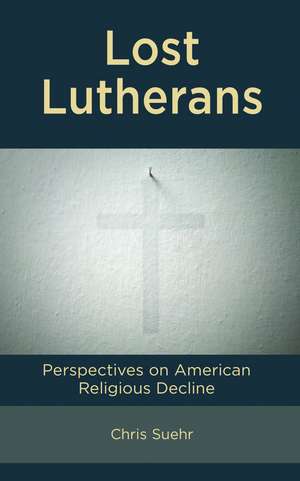
Lost Lutherans: Perspectives on American Religious Decline
Autor Chris Suehren Limba Engleză Hardback – 29 ian 2025
Preț: 524.36 lei
Preț vechi: 777.56 lei
-33%
Puncte Express: 787
Carte tipărită la comandă
Livrare economică 20 noiembrie-04 decembrie
Livrare prin curier în România Termenul estimat este afișat lângă disponibilitate.
Transport gratuit pentru acest produs Plată online sau ramburs, în funcție de opțiunile comenzii.
Retur gratuit în 14 zile Comandă securizată și suport în română.
Specificații
ISBN-13: 9781666947489
ISBN-10: 1666947482
Pagini: 186
Ilustrații: 9 Tables, 12 BW Illustrations
Dimensiuni: 152 x 229 x 15 mm
Greutate: 0.42 kg
Editura: Bloomsbury Publishing
Colecția Lexington Books
Locul publicării:New York, United States
ISBN-10: 1666947482
Pagini: 186
Ilustrații: 9 Tables, 12 BW Illustrations
Dimensiuni: 152 x 229 x 15 mm
Greutate: 0.42 kg
Editura: Bloomsbury Publishing
Colecția Lexington Books
Locul publicării:New York, United States
Cuprins
Introduction
Chapter 1: Introducing Lutheranism and the American Mainline
Chapter 2: Remarks on the Fate of All Religion
Chapter 3: The End of the Silver Age
Chapter 4: Age of Decline: A Changing World
Chapter 5: Age of Decline: Mainline Transformations
Chapter 6: Enter: The Evangelical Lutheran Church in America
Chapter 7: Measuring Change in the ELCA
Chapter 8: Finding Lost Voices
Chapter 9: Naming Lost Voices
Chapter 10: Understanding Lost Voices
Chapter 11: Diagnosing Decline
Chapter 12: Prognosis and Treatments
Chapter 1: Introducing Lutheranism and the American Mainline
Chapter 2: Remarks on the Fate of All Religion
Chapter 3: The End of the Silver Age
Chapter 4: Age of Decline: A Changing World
Chapter 5: Age of Decline: Mainline Transformations
Chapter 6: Enter: The Evangelical Lutheran Church in America
Chapter 7: Measuring Change in the ELCA
Chapter 8: Finding Lost Voices
Chapter 9: Naming Lost Voices
Chapter 10: Understanding Lost Voices
Chapter 11: Diagnosing Decline
Chapter 12: Prognosis and Treatments
Recenzii
This book offers a sober, honest, and candid assessment of the changing realities that a "mainline" church denomination has been facing and addressing in the last few decades, and more so, in the last few years, when "mainline decline" resulted in all kinds of reality checks - dwindling church attendance and the concomitant decline in church revenue; an aging congregation and hand-wringing about bringing in younger members; the reality of how "monochromatically" white the church was despite all kinds of efforts to increase "diversity"; clergy retirements and "burn out"; challenges that feeder seminaries were facing; negotiating complex rules of procedure within a large bureaucratic structure of the national church that was reflected at the regional and synodical levels. This book offers a lot to consider for those interested in the sociology of religion and religious institutions since there is a forward thrust that draws from the realities of the past and present in indicating implications for the future while "there is still life."
The Rev. Dr. Suehr is an experienced pastor and is acquainted with life in a congregation. His perspective brings a well-reasoned look into the decline we are experiencing in the mainline churches. This work offers helpful insight into the reasons behind the changes in our denomination through in-depth interview and analysis. It brings clarity to a vexing problem.
Chris Suehr gets inside the experience of decline by asking questions that can help scholars, pastors and local church leaders to understand the modern decline in church affiliation. Addressing the overall denominational shrinking that has happened in the ELCA, Suehr helps us see the choices made by individuals. Their narratives spring from a distinct geographical and cultural region, but the intimate focus on their life choices and orientation towards religion will help leaders identify a framework for understanding how to engage a largely disengaged population of individuals with wiser and warmer counsel. This book does not expect a revival but does understand that there is work ahead: a focus on "Relationships, Rudiments, Rituals, and Rethinking decline" will be necessary to strengthen an important Mainline Lutheran witness in a time of polarization.
Investigating the mystery of how to account for those who have been dropping from the rolls of ELCA membership in recent years, Chris Suehr, like a good detective, carefully sifts through the available evidence, consulting an abundance of social scientific data, the insights of leading scholars of religion and, most importantly, his own trove of richly informative interviews. His judicious conclusions shed light not only on the present dynamics of disaffiliation among Lutherans, but more broadly on the process of "Mainline decline" in America. Methodologically innovative, analytically astute and constructive in its recommendations, Lost Lutherans is a strong contribution to the study of religion and culture.
The Rev. Dr. Suehr is an experienced pastor and is acquainted with life in a congregation. His perspective brings a well-reasoned look into the decline we are experiencing in the mainline churches. This work offers helpful insight into the reasons behind the changes in our denomination through in-depth interview and analysis. It brings clarity to a vexing problem.
Chris Suehr gets inside the experience of decline by asking questions that can help scholars, pastors and local church leaders to understand the modern decline in church affiliation. Addressing the overall denominational shrinking that has happened in the ELCA, Suehr helps us see the choices made by individuals. Their narratives spring from a distinct geographical and cultural region, but the intimate focus on their life choices and orientation towards religion will help leaders identify a framework for understanding how to engage a largely disengaged population of individuals with wiser and warmer counsel. This book does not expect a revival but does understand that there is work ahead: a focus on "Relationships, Rudiments, Rituals, and Rethinking decline" will be necessary to strengthen an important Mainline Lutheran witness in a time of polarization.
Investigating the mystery of how to account for those who have been dropping from the rolls of ELCA membership in recent years, Chris Suehr, like a good detective, carefully sifts through the available evidence, consulting an abundance of social scientific data, the insights of leading scholars of religion and, most importantly, his own trove of richly informative interviews. His judicious conclusions shed light not only on the present dynamics of disaffiliation among Lutherans, but more broadly on the process of "Mainline decline" in America. Methodologically innovative, analytically astute and constructive in its recommendations, Lost Lutherans is a strong contribution to the study of religion and culture.