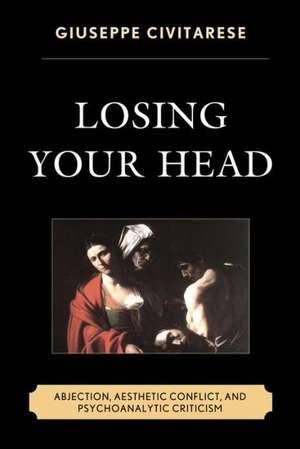
Losing Your Head: Abjection, Aesthetic Conflict, and Psychoanalytic Criticism
Autor Giuseppe Civitarese Contribuţii de Sara Boffito, Francesco Capelloen Limba Engleză Hardback – 10 feb 2015
Preț: 419.96 lei
Preț vechi: 597.58 lei
-30%
Puncte Express: 630
Carte tipărită la comandă
Livrare economică 03-17 decembrie
Livrare prin curier în România Termenul estimat este afișat lângă disponibilitate.
Transport gratuit pentru acest produs Plată online sau ramburs, în funcție de opțiunile comenzii.
Retur gratuit în 14 zile Comandă securizată și suport în română.
Specificații
ISBN-13: 9781442239487
ISBN-10: 1442239484
Pagini: 134
Dimensiuni: 164 x 239 x 15 mm
Greutate: 0.35 kg
Editura: Bloomsbury Publishing
Colecția Rowman & Littlefield
Locul publicării:New York, United States
ISBN-10: 1442239484
Pagini: 134
Dimensiuni: 164 x 239 x 15 mm
Greutate: 0.35 kg
Editura: Bloomsbury Publishing
Colecția Rowman & Littlefield
Locul publicării:New York, United States
V-ar putea interesa
-
 Camera Lucida: Reflections on PhotographyRoland Barthes-20%Preț: 62.68 lei78.02 lei
 -
 Ways of SeeingJohn BergerPreț: 78.02 lei
 -
 Reclaiming Art in the Age of ArtificeJ. F. Martel-26%Preț: 100.29 lei136.33 lei
 -
 PoeticsAristotle-19%Preț: 20.09 lei24.92 lei
 -
 Totem and TabooSigmund Freud-19%Preț: 36.96 lei45.85 lei
 -
 The Dehumanization of Art and Other Essays on Art, Culture, and LiteratureJosé Ortega Y. GassetPreț: 90.47 lei
 -
 About LookingJohn Berger-27%Preț: 77.21 lei106.46 lei
 -
 Monstrosity and the Psychoanalytic Dimensions of the UncannyRodrigo GonsalvesPreț: 381.30 lei
 -
 Visual Narrative and Lacanian PsychoanalysisEfrat BibermanPreț: 313.49 lei
 -
 -8%Preț: 451.07 lei490.30 lei
 -
 -37%Preț: 847.40 lei1349.09 lei
 -
 The Age of InsightEric Kandel-18%Preț: 321.79 lei391.82 lei
 -
 Aesthetic TheoryTheodor W. Adorno-39%Preț: 168.51 lei278.06 lei
 -
 StudioloGiorgio AgambenPreț: 107.74 lei
 -
 -5%Preț: 336.10 lei353.79 lei
 -
 Crisis and AstonishmentDr. Eugenia RoldanPreț: 375.95 lei
 -
 The Brutality of ThingsLorena PretaPreț: 97.64 lei
 -
 Psychoanalysis and the Patriarchal TraditionPeter L. Rudnytsky-11%Preț: 159.88 lei179.30 lei
 -
 Art & Beauty: Drawings by R. CrumbR. Crumb-23%Preț: 161.35 lei209.20 lei
Cuprins
Chapter 1Towards a (New) Psychoanalytic Criticism
Giuseppe Civitarese, Sara Boffito and Francesco Capello
Chapter 2Aesthetic Conflict and Abjection in Boccaccio's (L)Isabetta
Chapter 3Changing Styles, Affective Continuities and Psychic Containers: Corrado Govoni's Early Poetry
Francesco Capello and Giuseppe Civitarese
Chapter 4Do Cyborgs Dream? Post-human Landscapes in Shinya Tsukamoto's Nightmare Detective
Chapter 5The Dream Screen and the Birth of the Psyche in Ingmar Bergman's Persona
Chapter 6What's Going to Happen to Us Without Barbarians? Guilt and Paranoia in Michael Haneke's Hidden
Chapter 7Joseph Losey's The Servant, the Shattered Life
Chapter 8The Last Riot and the Déjà Vu Decapitations of the AES+F Group
References
About the Author
Giuseppe Civitarese, Sara Boffito and Francesco Capello
Chapter 2Aesthetic Conflict and Abjection in Boccaccio's (L)Isabetta
Chapter 3Changing Styles, Affective Continuities and Psychic Containers: Corrado Govoni's Early Poetry
Francesco Capello and Giuseppe Civitarese
Chapter 4Do Cyborgs Dream? Post-human Landscapes in Shinya Tsukamoto's Nightmare Detective
Chapter 5The Dream Screen and the Birth of the Psyche in Ingmar Bergman's Persona
Chapter 6What's Going to Happen to Us Without Barbarians? Guilt and Paranoia in Michael Haneke's Hidden
Chapter 7Joseph Losey's The Servant, the Shattered Life
Chapter 8The Last Riot and the Déjà Vu Decapitations of the AES+F Group
References
About the Author
Recenzii
Giuseppe Civitarese has given us another thought provoking and wonderful new book to open our analytic minds to new ways of thinking about what we analysts do. This volume begins with a discussion of the meaning of 'beheading,' a topic that could not be more current as the destruction of the mind, and Civitarese beautifully examines how psychoanalytic theory and art criticism are related endeavors that each strengthen and build the mind. This erudite and aesthetically rich book continues Civitarese's exploration of psychoanalysis and aesthetics that he began in his previous publication, The Violence of Emotions: Bion and Post-Bionian Psychoanalysis. This present volume further establishes Civitarese as a leading creative thinker in contemporary psychoanalysis.
Focusing here on the unexpected theme of 'decapitation' (the real as well as the metaphorical losses of heads and minds), Giuseppe Civitarese's critical reflections upon such a variety of artistic creations as a Haneke's movie, a Boccaccio's short story, or a video installation from the Venice Biennale leave us intellectually stimulated and enriched. Civitarese's wide-ranging psychoanalytic scholarship on aesthetics, combined with his elegant writing style, will only surprise those readers not yet familiar with the depth and breadth of his contributions to psychoanalysis.
Civitarese's extensive clinical experience and knowledge of Freud, Klein, Meltzer, Kristeva, and especially Bion, is here deployed in analyses of the art object, film, installation, and poetry to illuminate the nature of aesthetic experience and its fundamental place in the space and relationships of the analytic encounter.
Focusing here on the unexpected theme of 'decapitation' (the real as well as the metaphorical losses of heads and minds), Giuseppe Civitarese's critical reflections upon such a variety of artistic creations as a Haneke's movie, a Boccaccio's short story, or a video installation from the Venice Biennale leave us intellectually stimulated and enriched. Civitarese's wide-ranging psychoanalytic scholarship on aesthetics, combined with his elegant writing style, will only surprise those readers not yet familiar with the depth and breadth of his contributions to psychoanalysis.
Civitarese's extensive clinical experience and knowledge of Freud, Klein, Meltzer, Kristeva, and especially Bion, is here deployed in analyses of the art object, film, installation, and poetry to illuminate the nature of aesthetic experience and its fundamental place in the space and relationships of the analytic encounter.