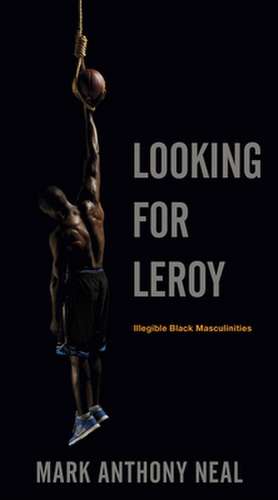
Looking for Leroy
Autor Mark Anthony Nealen Limba Engleză Paperback – 22 apr 2013
Preț: 247.94 lei
Puncte Express: 372
Carte tipărită la comandă
Livrare economică 28 noiembrie-12 decembrie
Livrare prin curier în România Termenul estimat este afișat lângă disponibilitate.
Transport gratuit de la 400.00 lei Plată online sau ramburs, în funcție de opțiunile comenzii.
Retur gratuit în 14 zile Comandă securizată și suport în română.
Specificații
ISBN-13: 9780814758366
ISBN-10: 0814758363
Pagini: 224
Ilustrații: black & white illustrations
Dimensiuni: 127 x 226 x 15 mm
Greutate: 0.3 kg
Editura: NEW YORK UNIVERSITY PRESS
ISBN-10: 0814758363
Pagini: 224
Ilustrații: black & white illustrations
Dimensiuni: 127 x 226 x 15 mm
Greutate: 0.3 kg
Editura: NEW YORK UNIVERSITY PRESS
V-ar putea interesa
-
 Narrative of the Life of Frederick Douglass, an American SlaveFrederick DouglassPreț: 64.70 lei
 -
 -12%Preț: 366.95 lei414.66 lei
 -
 -19%Preț: 323.09 lei399.19 lei
 -
 Black Ethnics: Race, Immigration, and the Pursuit of the American DreamChristina M. Greer-11%Preț: 351.24 lei396.87 lei
 -
 Preț: 250.78 lei
 -
 Black Star: Britain's Asian Youth MovementsAnandi RamamurthyPreț: 207.51 lei
 -
 Impossible WitnessesDwight McbridePreț: 248.48 lei
 -
 Black Gay ManRobert F Reid-PharrPreț: 249.24 lei
 -
 Once You Go BlackRobert F Reid-PharrPreț: 252.74 lei
 -
 -23%Preț: 607.71 lei789.23 lei
 -
 March: Book OneJohn Lewis-18%Preț: 82.41 lei101.00 lei
 -
 Biko: A LifeXolela Mangcu-19%Preț: 182.20 lei224.87 lei
 -
 Asian BritainFlorian StadtlerPreț: 151.70 lei
 -
 -11%Preț: 171.88 lei194.07 lei
 -
 The China Breakthrough: Whitlam in the Middle Kingdom, 1971Billy Griffiths-17%Preț: 115.17 lei138.92 lei
Recenzii
"Mark Anthony Neal takes us on a fantastic journey searching for the meaning of black masculinity in the USA. As we join him in Looking for Leroy, we find queer and feminist answers to questions about legibility and illegibility, visibility and invisibility, violation and vulnerability. No one writes with more passion, power and speculative brilliance about black masculinity than Neal and no one but Neal would manage to produce a theory of black masculinity capable of explaining the smoothness of Luther Vandross, the cosmopolitan genius of Jay-Z, the enigma of Leroy from Fame, and the sheer brute force of Snoop from The Wire. Genius." Jack Halberstam, author of Female Masculinity (1998) and Gaga Feminism (2012)"Mark Anthony Neal is one of our most consistently interesting and inspiring critics of contemporary black popular culture and music, to which Looking for Leroy is brilliant testament. It showcases Neal's masterful ability to take iconic figures of black masculinity, from Avery Brooks's neo-cool Hawk to Shawn Carter's neo-queer Jay-Z, and show them to us in an entirely new light. This is an incredibly powerful little book, and readers will never look at R. Kelly or Luther Vandross the same way again." John L. Jackson, Jr., author of Racial Paranoia: The Unintended Consequences of Political Correctness
Notă biografică
Mark Anthony Neal is the James B. Duke Distinguished Professor at Duke University. He is the founding director of the Center for Arts, Digital Culture and Entrepreneurship (CADC) at Duke, and co-directs the Duke Council on Race and Ethnicity. He is the author of Looking for Leroy: Illegible Black Masculinities, New Black Man, 2nd edition, Soul Babies: Black Popular Culture and the Post-Soul Aesthetic, and What the Music Said: Black Popular Music and Black Public Culture. He is co-editor of That's the Joint: The Hip Hop Studies Reader, Second edition. He is the host of the video webcast Left of Black.
Descriere
An engaging and provocative analysis of the complex ways in which black masculinity has been read and misread through contemporary American popular culture