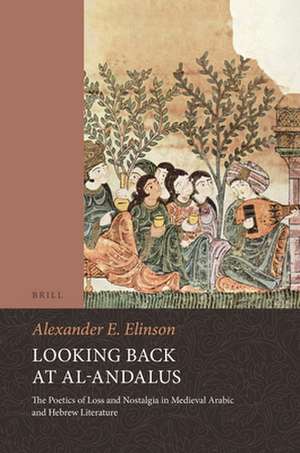
Looking Back at Al-Andalus
Autor Alexander Elinsonen Limba Engleză Paperback – 8 ian 2015
Preț: 449.61 lei
Preț vechi: 505.17 lei
-11%
Puncte Express: 674
Carte tipărită la comandă
Livrare economică 28 noiembrie-12 decembrie
Livrare prin curier în România Termenul estimat este afișat lângă disponibilitate.
Transport gratuit pentru acest produs Plată online sau ramburs, în funcție de opțiunile comenzii.
Retur gratuit în 14 zile Comandă securizată și suport în română.
Specificații
ISBN-13: 9789004290976
ISBN-10: 9004290974
Pagini: 186
Dimensiuni: 155 x 234 x 10 mm
Greutate: 0.32 kg
Editura: Brill
ISBN-10: 9004290974
Pagini: 186
Dimensiuni: 155 x 234 x 10 mm
Greutate: 0.32 kg
Editura: Brill
Notă biografică
Alexander E. Elinson, Ph.D. (2004) in Middle East and Asian Languages and Cultures, Columbia University, is Associate Professor of Arabic at Hunter College of the City University of New York. His research interests include medieval Arabic and Hebrew literature from Muslim Spain and North Africa, as well as contemporary Moroccan literature.
Recenzii
« Au croisement de l’étude littéraire et de l’histoire des mentalités, Looking back at al-Andalus propose une réflexion intéressante sur les notions « d’ andalusité » et « d’arabité », sur les rapports entre l’Andalus, le Masriq et le Magrib, sur les interférences littéraires entre rhétorique arabe et hébraïque, etc. Il est d’une lecture agréable et féconde, sans préjuger des points de désaccord qu’il ne manquera pas de susciter chez certains lecteurs »
Katia Zakharia in BCAI 26 (2010).
Katia Zakharia in BCAI 26 (2010).