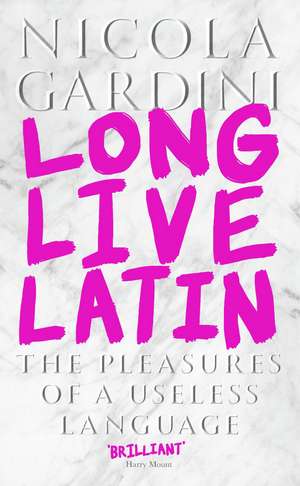
Long Live Latin: The Pleasures of a Useless Language
Autor Professor Nicola Gardinien Limba Engleză Paperback – sep 2021
Preț: 50.39 lei
Precomandă
Puncte Express: 76
Preț estimativ în valută:
8.92€ • 10.42$ • 7.74£
8.92€ • 10.42$ • 7.74£
Carte nepublicată încă
Doresc să fiu notificat când acest titlu va fi disponibil:
Se trimite...
Preluare comenzi: 021 569.72.76
Specificații
ISBN-13: 9781781259405
ISBN-10: 1781259402
Pagini: 256
Dimensiuni: 129 x 198 mm
Ediția:Main
Editura: Profile
Colecția Profile Books
Locul publicării:London, United Kingdom
ISBN-10: 1781259402
Pagini: 256
Dimensiuni: 129 x 198 mm
Ediția:Main
Editura: Profile
Colecția Profile Books
Locul publicării:London, United Kingdom
Notă biografică
Nicola Gardini fell in love with Latin as a child, through reading and listening to his mother sing Latin hymns. Following a lifetime of study, he now teaches Italian Literature at the University of Oxford and continues to pass on his love for the country's other 'dead' language. He also writes poetry and fiction, has published several collections of verse and three novels, of which The Lost Words of Amelia Lynd was awarded the Viareggio prize in 2012.
Recenzii
This love-letter to Latin enthrals, illuminates, and convinces. Nobody could possibly describe Latin as a dead or useless language after reading it.
Highlighting the particular charms in the styles and attitudes of Latin's greatest writers, this book will open many eyes to the unexpected pleasures of Latin
A brilliant reminder that the supposedly dead language is alive and kicking - and still the most influential language in the world.
A highly enjoyable, erudite book . . . Gardini knows his Latin inside out [and] is alive to the immense power of Latin to move the reader.
In this spirited linguistic jaunt, novelist Gardini (Lost Words) makes a strong argument for studying a supposedly "dead language" to unlock its beauty, history, and continued liveliness . . . Anyone who embarks on such a voyage will find this a helpful and contagiously enthusiastic companion.
A loving tribute to Latin as well as a compelling response to those who would call the language 'useless' . . . [Gardini's] enthusiasm is infectious. Whether new to the study or remembering Latin lessons from years ago, interested readers will appreciate his insights, both translational and social.
Fascinating . . . [Gardini's] precise, writerly descriptions of the texts are often exciting and infectious in themselves . . . For Gardini, the promise of Latin is that getting to the root of words, understanding what they meant before they got into Italian or English or any other Romance language, is getting at what underlies and defines our vexing Western culture
In Long Live Latin, Nicola Gardini argues that it is worth studying not for its utility but simply because "Latin is beautiful" . . . . The book emerges as an adoring "biography" of Latin as the greatest written language; maintaining throughout that the point of reading Latin authors is not to haul them into the present, under a banner of "relevance", but rather to venture ourselves into the linguistic world of the ancients that helped create so much of Western literature from the philosophy of More, Spinoza and Descartes to the poetry of Petrarch, Dante and Milton.
Gardini . . . crafts each chapter so that it feels like an encounter. Offering numerous personal anecdotes from his own life, Gardini's writing is warm and conversational yet scholarly.
Nicola Gardini's paean to Latin belongs on the shelf alongside Nabokov's Lectures on Literature. With a similar blend of erudition, reverence, and impeccable close reading, he connects the dots between etymology and poetry, between syntax and society. And he proves, in the process, that a mysterious and magnificent language, born in ancient Rome, is still relevant to each and every one of us.
Nicola Gardini's Long Live Latin is not only a learned crash course in the splendors of Latin literature, but also an inspiring demonstration on why Latin still matters. Passionate, wise, and, finally, ennobling, this is a must read for anyone with even a passing interest in the subject.
Meditative ... To learn a language because it was spoken by some brilliant people 2,000 years ago is to celebrate the world; not a way to optimise yourself, but to get over yourself.
Highlighting the particular charms in the styles and attitudes of Latin's greatest writers, this book will open many eyes to the unexpected pleasures of Latin
A brilliant reminder that the supposedly dead language is alive and kicking - and still the most influential language in the world.
A highly enjoyable, erudite book . . . Gardini knows his Latin inside out [and] is alive to the immense power of Latin to move the reader.
In this spirited linguistic jaunt, novelist Gardini (Lost Words) makes a strong argument for studying a supposedly "dead language" to unlock its beauty, history, and continued liveliness . . . Anyone who embarks on such a voyage will find this a helpful and contagiously enthusiastic companion.
A loving tribute to Latin as well as a compelling response to those who would call the language 'useless' . . . [Gardini's] enthusiasm is infectious. Whether new to the study or remembering Latin lessons from years ago, interested readers will appreciate his insights, both translational and social.
Fascinating . . . [Gardini's] precise, writerly descriptions of the texts are often exciting and infectious in themselves . . . For Gardini, the promise of Latin is that getting to the root of words, understanding what they meant before they got into Italian or English or any other Romance language, is getting at what underlies and defines our vexing Western culture
In Long Live Latin, Nicola Gardini argues that it is worth studying not for its utility but simply because "Latin is beautiful" . . . . The book emerges as an adoring "biography" of Latin as the greatest written language; maintaining throughout that the point of reading Latin authors is not to haul them into the present, under a banner of "relevance", but rather to venture ourselves into the linguistic world of the ancients that helped create so much of Western literature from the philosophy of More, Spinoza and Descartes to the poetry of Petrarch, Dante and Milton.
Gardini . . . crafts each chapter so that it feels like an encounter. Offering numerous personal anecdotes from his own life, Gardini's writing is warm and conversational yet scholarly.
Nicola Gardini's paean to Latin belongs on the shelf alongside Nabokov's Lectures on Literature. With a similar blend of erudition, reverence, and impeccable close reading, he connects the dots between etymology and poetry, between syntax and society. And he proves, in the process, that a mysterious and magnificent language, born in ancient Rome, is still relevant to each and every one of us.
Nicola Gardini's Long Live Latin is not only a learned crash course in the splendors of Latin literature, but also an inspiring demonstration on why Latin still matters. Passionate, wise, and, finally, ennobling, this is a must read for anyone with even a passing interest in the subject.
Meditative ... To learn a language because it was spoken by some brilliant people 2,000 years ago is to celebrate the world; not a way to optimise yourself, but to get over yourself.