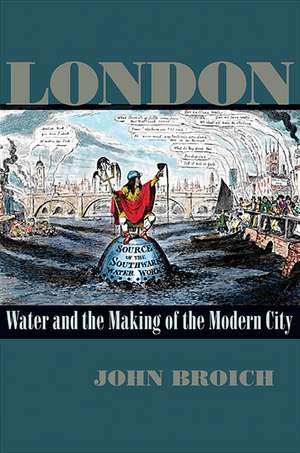
London: Water and the Making of the Modern City: Pittsburgh Hist Urban Environ
Autor John Broichen Limba Engleză Hardback – 15 apr 2013
În lucrarea London, autorul John Broich, istoric specializat în dinamica puterii și evoluția imperiului, propune o analiză riguroasă a modului în care infrastructura urbană a modelat societatea britanică modernă. Bazându-se pe cercetarea arhivelor administrative și politice, Broich demonstrează că alimentarea cu apă a Londrei nu a fost doar o problemă de inginerie sau igienă publică, ci un câmp de bătălie ideologic între viziuni divergente despre guvernare și comunitate.
Descoperim aici o perspectivă distinctă asupra epocii victoriene, unde apa devine un instrument de inginerie socială. Remarcăm modul în care autorul integrează presiunile de mediu și epidemiile recurente în discursul politic al unor figuri precum Bernard Shaw sau Lord Salisbury. Spre deosebire de alte studii tehnice, John Broich pune accent pe „mașinăria socială” și pe modul în care guvernul conservator a reușit să impună o structură administrativă ce a definit relația dintre putere și resurse pentru decenii întregi. Această abordare completează temele explorate de autor în White Supremacy, unde acesta urmărește evoluția structurilor de putere și a contradicțiilor sociale în context imperial.
Ca alternativă la Public Health and Social Justice in the Age of Chadwick de Christopher Hamlin pentru cursurile de istorie urbană sau politici publice, lucrarea lui Broich aduce avantajul unei focalizări stricte pe metropola londoneză și pe conflictul specific dintre municipalitate și statul central. Suntem de părere că această primă ediție, publicată de University of Pittsburgh Press, oferă o claritate conceptuală necesară pentru înțelegerea genezei serviciilor publice moderne, depășind simpla cronologie a epidemiilor pentru a expune mecanismele politice din spatele robinetului.
Din seria Pittsburgh Hist Urban Environ
-
 Preț: 430.37 lei
-
 Preț: 309.91 lei
-
 Preț: 362.00 lei
-
 Preț: 407.66 lei
-
 Preț: 310.72 lei
-
 Preț: 472.18 lei
-
 Preț: 406.97 lei
- 5%
 Preț: 387.91 lei
-
 Preț: 487.01 lei
-
 Preț: 434.29 lei
-
 Preț: 372.97 lei
-
 Preț: 441.40 lei
-
 Preț: 184.80 lei
-
 Preț: 372.52 lei
-
 Preț: 292.27 lei
-
 Preț: 446.38 lei
-
 Preț: 393.63 lei
-
 Preț: 452.58 lei
-
 Preț: 438.81 lei
-
 Preț: 441.79 lei
-
 Preț: 465.03 lei
-
 Preț: 294.80 lei
-
 Preț: 389.10 lei
-
 Preț: 392.29 lei
-
 Preț: 389.93 lei
-
 Preț: 428.07 lei
-
 Preț: 430.77 lei
-
 Preț: 428.47 lei
-
 Preț: 462.53 lei
-
 Preț: 423.22 lei
-
 Preț: 388.81 lei
-
 Preț: 436.39 lei
-
 Preț: 391.13 lei
-
 Preț: 426.92 lei
-
 Preț: 388.79 lei
-
 Preț: 350.68 lei
-
 Preț: 387.43 lei
-
 Preț: 392.29 lei
-
 Preț: 423.61 lei
Preț: 404.37 lei
Carte disponibilă
Livrare economică 09-23 noiembrie
Specificații
ISBN-10: 0822944278
Pagini: 232
Ilustrații: 5 b&w illustrations
Dimensiuni: 156 x 235 x 20 mm
Greutate: 0.45 kg
Ediția:1
Editura: University of Pittsburgh Press
Colecția University of Pittsburgh Press
Seria Pittsburgh Hist Urban Environ
V-ar putea interesa
-
 The History of Liberalism in RussiaVictor LeontovitschPreț: 448.75 lei
-
 -15%Preț: 499.53 lei587.69 lei
-
 The Soviet Gulag: Evidence, Interpretation, and ComparisonMichael David-FoxPreț: 485.78 lei
-
 Preț: 408.15 lei
-
 A Monastery for the Ibex: Conservation, State, and Conflict on the Gran Paradiso, 1919-1949Wilko Graf von HardenbergPreț: 395.94 lei
-
 Preț: 426.92 lei
-
 Preț: 390.03 lei
-
 Preț: 392.29 lei
-
 Lectures on Early English HistoryStubbs, WilliamPreț: 212.50 lei
-
 Lettre de Polichinelle à ses compères du Comité des finances, offrant un moyen sûrLouis-Germain PetitainPreț: 79.18 lei
-
 Les Commentaires de Polybe. 10e Sér.Joseph ReinachPreț: 198.47 lei
-
 Les commentaires de Polybe. 13e sér.Joseph ReinachPreț: 192.97 lei
-
 Les commentaires de Polybe. 18e sér.Joseph ReinachPreț: 192.17 lei
-
 Les commentaires de Polybe. 19e sér.Joseph ReinachPreț: 185.51 lei
-
 Les commentaires de Polybe. 2e sér.Joseph ReinachPreț: 192.51 lei
-
 Les commentaires de Polybe. 4e sér.Joseph ReinachPreț: 200.08 lei
-
 Les commentaires de Polybe. 7e sér.Joseph ReinachPreț: 207.95 lei
-
 Les commentaires de Polybe. 8e sér.Joseph ReinachPreț: 208.54 lei
-
 Preț: 167.49 lei
-
 Lettres de Mme Swetchine. Tome 2Sophie SwetchinePreț: 239.36 lei
-
 Le Cambodge. Le royaume actuelÉtienne AymonierPreț: 230.72 lei
-
 Preț: 200.89 lei
-
 Histoire de la conquête de l'Inde par l'Angleterre. Tome 5Auguste Théodore H Barchou de PenhoënPreț: 222.85 lei
-
 Etude sur les chroniques de Froissart. Guerre de Guienne 1345-1346Martin Bertrandy-LacabanePreț: 200.12 lei
-
 Tableau des États-Unis de l'Amérique, au commencement du XIXe siècleJean-Esprit BonnetPreț: 123.58 lei
-
 Histoire statistique de la colonisation et de la population en AlgérieJean-Christian-Marc BoudinPreț: 79.76 lei
-
 Notre Empire colonialHenri BussonPreț: 161.62 lei
De ce să citești această carte
Această carte este esențială pentru cercetătorii în istorie urbană și studenții la științe politice. John Broich oferă o lecție fascinantă despre cum crizele de mediu și sanitare pot fi utilizate pentru a redefini contractul social. Cititorul va înțelege că infrastructura pe care o considerăm astăzi de la sine înțeleasă a fost rezultatul unor lupte politice intense între colectivism și intervenționismul de stat.
Despre autor
John Broich este un istoric recunoscut pentru analizele sale privind evoluția structurilor de putere britanice și impactul acestora asupra modernității. În lucrările sale, precum White Supremacy, el explorează rădăcinile ideologice ale politicilor contemporane, pornind de la fundamentele Imperiului Britanic. Expertiza sa se concentrează pe intersecția dintre istoria mediului, istoria urbană și dezvoltarea instituțională, oferind perspective critice asupra modului în care resursele și infrastructura sunt utilizate ca instrumente de control social și politic.
Descriere scurtă
The solution that prevailed was the novel idea that British towns must build public water supplies, replacing private companies. But the idea was not an obvious or inevitable one. Those who promoted new waterworks argued that they could use water to realize a new kind of British society—a productive social machine, a new moral community, and a modern civilization. They did not merely cite the dangers of epidemic or scarcity. Despite many debates and conflicts, this vision won out—in town after town, from Birmingham to Liverpool to Edinburgh, authorities gained new powers to execute municipal water systems.
But in London local government responded to environmental pressures with a plan intended to help remake the metropolis into a collectivist society. The Conservative national government, in turn, sought to impose a water administration over the region that would achieve its own competing political and social goals. The contestants over London’s water supply matched divergent strategies for administering London’s water with contending visions of modern society. And the matter was never pedestrian. The struggle over these visions was joined by some of the most colorful figures of the late Victorian period, including John Burns, Lord Salisbury, Bernard Shaw, and Sidney and Beatrice Webb.
As Broich demonstrates, the debate over how to supply London with water came to a head when the climate itself forced the endgame near the end of the nineteenth century. At that decisive moment, the Conservative party succeeded in dictating the relationship between water, power, and society in London for many decades to come.
Recenzii
—Christopher Hamlin, University of Notre Dame
—Choice
—Environmental Values