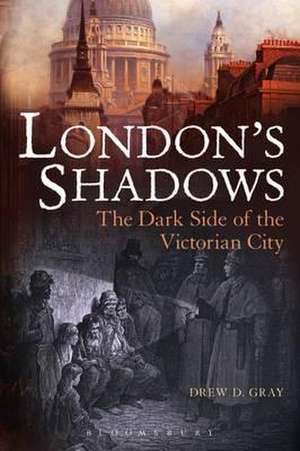
London's Shadows: The Dark Side of the Victorian City
Autor Dr Drew D. Grayen Limba Engleză Paperback – 14 mar 2013
Using the Whitechapel murders of Jack the Ripper as a focal point, this book explores prostitution, poverty, revolutionary politics, immigration, the creation of a criminal underclass and the development of policing. It also considers how the sensationalist 'new journalism' took the news of the Ripper murders to all corners of the Empire and to the United States. This is an important book for those interested in the history of Victorian Britain.
Preț: 179.56 lei
Puncte Express: 269
Carte tipărită la comandă
Livrare economică 07-21 decembrie
Livrare prin curier în România Termenul estimat este afișat lângă disponibilitate.
Transport gratuit de la 400.00 lei Plată online sau ramburs, în funcție de opțiunile comenzii.
Retur gratuit în 14 zile Comandă securizată și suport în română.
Specificații
ISBN-13: 9781441147202
ISBN-10: 1441147209
Pagini: 288
Ilustrații: 10
Dimensiuni: 156 x 234 x 18 mm
Greutate: 0.43 kg
Editura: Bloomsbury Publishing
Colecția Bloomsbury Academic
Locul publicării:London, United Kingdom
ISBN-10: 1441147209
Pagini: 288
Ilustrații: 10
Dimensiuni: 156 x 234 x 18 mm
Greutate: 0.43 kg
Editura: Bloomsbury Publishing
Colecția Bloomsbury Academic
Locul publicării:London, United Kingdom
V-ar putea interesa
-
 I Believe In YesterdayTim MoorePreț: 118.61 lei
 -
 -11%Preț: 345.12 lei386.92 lei
 -
 -15%Preț: 282.14 lei331.78 lei
 -
 The Invisible CollegeRobert LomasPreț: 125.43 lei
 -
 Twenty Chickens for a SaddleRobyn Scott-25%Preț: 70.86 lei94.17 lei
 -
 The Food History Reader: Primary SourcesKen Albala-21%Preț: 291.56 lei370.35 lei
 -
 Kennedy: A Cultural History of an American IconProfessor Mark White-26%Preț: 197.98 lei266.71 lei
 -
 -14%Preț: 237.51 lei274.65 lei
 -
 How to Be a Good HusbandBodleian LibraryPreț: 45.73 lei
Cuprins
1. Creating the 'Myth' of Jack the Ripper
2. Murder and Mayhem in Victorian London: The Whitechapel Murders of 1888 in Context
3. East Meets West: The Contrasting Nature of Victorian London and the Mixed Community of the East End
4. Read All About It! Ripper News and Sensation in Victorian Society
5. The Bitter Cry of Outcast London: Poverty, Charity and the Fear of Revolution
6. City of Dreadful Delights: Vice, Prostitution and Victorian Society
7. Crime and the Criminal Class in Late Victorian London
8. Watching the Detectives: The Police and the Hunt for Jack the Ripper
9. London's Shadows: The Darker Side of the Victorian Capital
Bibliography
Index
2. Murder and Mayhem in Victorian London: The Whitechapel Murders of 1888 in Context
3. East Meets West: The Contrasting Nature of Victorian London and the Mixed Community of the East End
4. Read All About It! Ripper News and Sensation in Victorian Society
5. The Bitter Cry of Outcast London: Poverty, Charity and the Fear of Revolution
6. City of Dreadful Delights: Vice, Prostitution and Victorian Society
7. Crime and the Criminal Class in Late Victorian London
8. Watching the Detectives: The Police and the Hunt for Jack the Ripper
9. London's Shadows: The Darker Side of the Victorian Capital
Bibliography
Index
Recenzii
Drew Gray's book is a fine addition to the literature on urban history at a time when we were learning to live in large communities and experimenting with different ways of doing so.
A scholarly work, drawing on a wide range of sources, but it's also very readable. It provides a welcome and sensible counterbalance to the endless titles about 'ripperology' with its focus on the grim realities of life in London's poorer quarters at the time.
Wisely, however, Gray does not attempt to solve this most famous of all cold cases. But he does illuminate the shadows of Victorian London by placing the murders into a fascinating historical context of sensationalist newspaper reporting, social problems and inadequate policing. The result exemplifies the best kind of academic publishing: authoritative, intelligent, and well-written.
[London's Shadows] is well-researched and accessible, making it a welcome addition to this existing historiography. Both Gray and Faber highlight the tremendous social cost of industry that contemporaries recognised but could not remedy. Though the streets of London may be cleaner and the slums replaced by modern redevelopments, the then-and-now approach of London's Shadows offers a stark reminder that poverty, deprivation and inequality are as problematic today as they were in the 1880s.
In this eminently readable book, Drew Gray casts light on the underworld of Victorian London . Gray tells a good story, covering much familiar territory but also introducing new evidence from court records.
A scholarly work, drawing on a wide range of sources, but it's also very readable. It provides a welcome and sensible counterbalance to the endless titles about 'ripperology' with its focus on the grim realities of life in London's poorer quarters at the time.
Wisely, however, Gray does not attempt to solve this most famous of all cold cases. But he does illuminate the shadows of Victorian London by placing the murders into a fascinating historical context of sensationalist newspaper reporting, social problems and inadequate policing. The result exemplifies the best kind of academic publishing: authoritative, intelligent, and well-written.
[London's Shadows] is well-researched and accessible, making it a welcome addition to this existing historiography. Both Gray and Faber highlight the tremendous social cost of industry that contemporaries recognised but could not remedy. Though the streets of London may be cleaner and the slums replaced by modern redevelopments, the then-and-now approach of London's Shadows offers a stark reminder that poverty, deprivation and inequality are as problematic today as they were in the 1880s.
In this eminently readable book, Drew Gray casts light on the underworld of Victorian London . Gray tells a good story, covering much familiar territory but also introducing new evidence from court records.