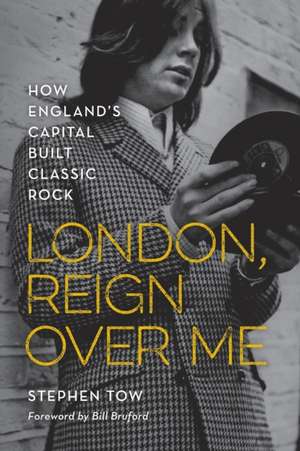
London, Reign Over Me: How England's Capital Built Classic Rock
Autor Stephen Tow Cuvânt înainte de Bill Bruforden Limba Engleză Paperback – 15 iul 2021
Preț: 116.61 lei
Preț vechi: 147.56 lei
-21%
Puncte Express: 175
Carte tipărită la comandă
Livrare economică 04-18 decembrie
Livrare prin curier în România Termenul estimat este afișat lângă disponibilitate.
Transport gratuit de la 400.00 lei Plată online sau ramburs, în funcție de opțiunile comenzii.
Retur gratuit în 14 zile Comandă securizată și suport în română.
Specificații
ISBN-13: 9781538153420
ISBN-10: 1538153424
Pagini: 224
Ilustrații: 15 b/w photos
Dimensiuni: 154 x 229 x 14 mm
Greutate: 0.31 kg
Editura: Bloomsbury Publishing
Colecția Rowman & Littlefield
Locul publicării:New York, United States
ISBN-10: 1538153424
Pagini: 224
Ilustrații: 15 b/w photos
Dimensiuni: 154 x 229 x 14 mm
Greutate: 0.31 kg
Editura: Bloomsbury Publishing
Colecția Rowman & Littlefield
Locul publicării:New York, United States
V-ar putea interesa
-
 The Listening Party Volume 2Tim Burgess-20%Preț: 161.52 lei201.47 lei
-
 The Beatles - All These Years: Volume One: Tune InMark LewisohnPreț: 321.52 lei
-
 Preț: 110.61 lei
-
 Preț: 170.16 lei
-
 Baby Boomer Rock 'n' Roll Fans: The Music Never EndsJoseph A. Kotarba-27%Preț: 275.77 lei377.74 lei
-
 Studying the Dead: The Grateful Dead Scholars Caucus, An Informal HistoryNicholas G. Meriwether-32%Preț: 615.87 lei912.02 lei
-
 Music of YesBill MartinPreț: 212.20 lei
-
 Alice in ChainsDavid De SolaPreț: 115.46 lei
-
 My Life with DethDavid EllefsonPreț: 105.16 lei
-
 Listening to the Unconscious: Adventures in Popular Music and PsychoanalysisProfessor or Dr. Kenneth Smith-21%Preț: 163.26 lei207.97 lei
-
 South African Popular MusicLior Phillips-32%Preț: 76.10 lei112.64 lei
-
 70s Teen PopLucretia Tye Jasmine-41%Preț: 77.22 lei131.41 lei
-
 Popular Music, Power and Play: Reframing Creative PracticeDr. Marshall Heiser-25%Preț: 211.84 lei283.52 lei
-
 Pearl Jam and PhilosophyProfessor or Dr. Stefano Marino-26%Preț: 207.53 lei278.99 lei
-
 London's BurningDave ThompsonPreț: 112.84 lei
-
 Sinister Urge: The Life and Times of Rob ZombieJoel McIver-44%Preț: 132.60 lei234.90 lei
-
 -33%Preț: 50.27 lei75.09 lei
-
 -17%Preț: 266.44 lei319.61 lei
-
 -17%Preț: 121.62 lei145.79 lei
-
 -19%Preț: 120.96 lei149.57 lei
-
 More Life With DethDavid Ellefson-17%Preț: 89.75 lei108.29 lei
-
 The Dark Cracks of Kemang: The Bajaj Boys in IndonesiaJeremy RobertsPreț: 166.70 lei
-
 The Beach Boys Official Coloring BookDavid CalcanoPreț: 112.78 lei
Descriere
It all started in London. More than fifty years ago, a generation of teens created something that would change the face of music forever.
London, Reign Over Me immerses us in the backroom clubs, basement record shops, and late-night faint radio signals of 1960s Britain, where young hopefuls like Peter Frampton, Dave Davies, and Mick Jagger built off American blues and jazz to form a whole new sound. Author Stephen Tow weaves together original interviews with over ninety musicians and movers-and-shakers of the time to uncover the uniquely British story of classic rock's birth.
Capturing the stark contrast of bursting artistic energy with the blitzkrieg landscape leftover from World War II, London, Reign Over Me reveals why classic rock 'n' roll could only have been born in London. A new sound from a new generation, this music helped spark the most important cultural transformation of the twentieth century.
Key interviews include:
.Jon Anderson (Yes)
.Ian Anderson (Jethro Tull)
.Rod Argent (The Zombies)
.Chris Barber (Chris Barber Jazz Band)
.Joe Boyd (Producer/manager)
.Arthur Brown (Crazy World of Arthur Brown)
.David Cousins (The Strawbs)
.Dave Davies (The Kinks)
.Spencer Davis (Spencer Davis Group)
.Judy Dyble (Fairport Convention)
.Ramblin' Jack Elliott (Solo folk/blues artist)
.Peter Frampton (Humble Pie, solo artist)
.Roger Glover (Deep Purple)
.Steve Howe (Yes)
.Neil Innes (Bonzo Dog Band; Monty Python)
.Kenney Jones (The Small Faces; The Who)
.Greg Lake (King Crimson; Emerson, Lake & Palmer)
.Manfred Mann (Manfred Mann)
.Terry Marshall (Marshall Amplification)
.Dave Mason (Traffic)
.Phil May (The Pretty Things)
.John Mayall (The Bluesbreakers)
.Jim McCarty (The Yardbirds)
.Ian McLagan (The Small Faces)
.Jacqui McShee (The Pentangle)
.Peter Noone (Herman's Hermits)
.Carl Palmer (Atomic Rooster; Emerson, Lake & Palmer)
.Jan Roberts (Eel Pie Island Documentary Project)
.Paul Rodgers (Free)
.Peggy Seeger (Solo folk artist)
.Hylda Sims (Club owner)
.Keith Skues (DJ: Radio Caroline, Radio London, Radio One)
.Jeremy Spencer (Fleetwood Mac)
.John Steel (The Animals)
.Al Stewart (Solo folk artist)
.Dick Taylor (The Pretty Things)
.Ray Thomas (The Moody Blues)
.Richard Thompson (Fairport Convention)
.Rick Wakeman (The Strawbs, Yes)
.Barrie Wentzell (Photographer: Melody Maker)
Cuprins
Foreword by Bill Bruford
Introduction
Chapter 1: Out of the Grey, Into the Blues
Chapter 2: R&B Boom!
Chapter 3: It Was Just Bloody Wednesday
Chapter 4: Discovering Prog Rock
Chapter 5: You Can All Join In (Progressive Folk)
Chapter 6: Blues Revisited
Epilogue
Introduction
Chapter 1: Out of the Grey, Into the Blues
Chapter 2: R&B Boom!
Chapter 3: It Was Just Bloody Wednesday
Chapter 4: Discovering Prog Rock
Chapter 5: You Can All Join In (Progressive Folk)
Chapter 6: Blues Revisited
Epilogue
Recenzii
This vibrant pop history makes a strong case for London being the true birthplace of modern rock. . . The book moves at rocket speed as it describes how the music pivoted and grew . . . What results is a passionate study of a unique moment in rock history.
Tow does a wonderful job of exploring American blues as a jumping off point for much of the London-based music. In the 1960s, London brought the world The Beatles, the Yardbirds, the Animals, the Who, the Small Faces, the Kinks, the Zombies, Deep Purple, the Rolling Stones, Pink Floyd, and Led Zeppelin, among others . . . Tow's knowledge and expertise coupled with extensive interviews elevate this book above the crowd.
[Tow] lays out just how British musicians of the 1960s discovered, internalized, covered, and then built upon the music of American blues musicians
Rather than regurgitating the research of others, [Tow] draws from many interviews with key musicians including artists Ian Anderson (Jethro Tull), Rod Argent (the Zombies), and JimMcCarty (the Yardbirds), as well as from memoirs and biographies. His writing is immediate and clearly paints a picture of 1960s London. VERDICT Covering dozens of bands in a variety of styles, Tow pens a sweeping look at a pivotal period of music history.
Tow has paired contemporary observations with direct recollections from over ninety musicians who helped foment the scene. Tow does an admirable job pulling apart the many threads that created a musical renaissance the likes of which have not been heard before or since . . . Tow has assembled a great blend of then-contemporary observations with latter day perspectives from those who were there in this delightful and edifying book.
An extensively-researched, historically-accurate, and uniquely British account of all the factors and circumstances that contributed to make London the ideal birthplace for classic rock during the post-war boom. . . . Tow has really done his homework on this one - the book is strewn with vivid imagery, many hilarious, interesting anecdotes, and numerous artist interviews. . . . Classic rock was, almost out of necessity, a new sound from a new generation, and Tow's book passionately explores how this music helped catalyze one of the most important cultural transformations of the 20th century.
[Tow]'s lyrical style keeps the history moving forward and accentuates the music so eloquently you can almost hear the opening chords of some of your favorite songs. . . London, Reign Over Me hits the high notes of a decade of brilliant music in fine fashion. It's more than a simple history, it's a snapshot of one of culture's most monumental - and fleeting - moments, told by the artists' who lived it and the people who listened.
. . . a colourfully flavoured look at 60s pop and rock in the UK written by a specialist .
Tow's picture of the British music scene from the early 1960s to 1969 is easy to digest, leaving the reader wanting more . . . an excellent study.
[Tow] takes readers on a fascinating, astute, and welcoming tour through the birth of the several genre offshoots-such as progressive rock and folk-to explore the remarkable circumstances that made London and its surroundings such a fertile and significant creative space. One of the strengths of this book is the inclusion of insights from important musicians, managers, producers, critics, and others of the time. . . London, Reign Over Me is a masterfully researched, spacious, and inviting survey of British rock music in the 1960s.
Stephen Tow is very insightful in his descriptions and historically on the button. He is an inspiring documenter of the period. Well done.
Through its clarity and apposite interviews, Tow's recreation of London's musical growth from the fifties onwards gives you a genuine feeling of being amongst it all and sharing the excitement that we all felt.
A must read for all you unfortunates who weren't around to be part of this seminal era.
Once again Stephen Tow takes us back to a great musical place in time. Every minute and every paragraph sparks the memory and a smile.
This is a must read on both sides of the Atlantic for any contemporary music buff. The influence of black American music on the British music scene is profound, and what the British did with it had a profound influence on turning American audiences on to their own musical heritage.
Stephen Tow's excellent and comprehensive book importantly positions London at the centre of 60s world culture, and shows the roots and consequences of that from the 50s to the present day. We thought it was normal then, but it has turned out to be something special.
Stephen Tow has accurately depicted post-war England in the fifties and sixties, when nobody understood what was happening in music until decades later. London, Reign Over Me took me back to what was an extraordinary time for music; a creative and cultural phenomenon that could never be replicated.
Stephen Tow is to be congratulated on his insightful commentary and understanding of the evolution of the rock music scene in London during the 60s. Tow's interpretation was fascinating reading and spot on.
Tow conjures up the period in the '60's when I and the Ram Jam Band had our biggest success alongside legendary artists Georgie Fame and Zoot Money. It was an amazing time and this very accurate and extremely well-written book brought back some fantastic memories. A must-read for anyone interested in the history of music.