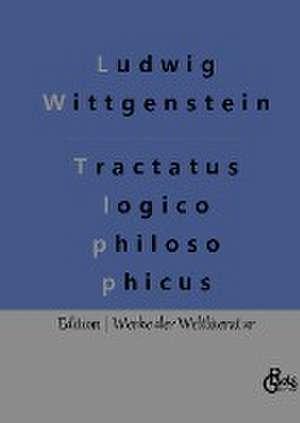
Logisch-philosophische Abhandlung
Autor Ludwig Wittgenstein Editat de Redaktion Gröls-Verlagde Limba Germană Hardback – 13 mar 2023
In the present disposition, instead, all horizontal and vertical references become directly manifest and any reader can enjoy the fine architecture and the elegant reasoning of Wittgenstein's work. Every page is an actual reading unit, perfectly coherent and complete. The Tractatus becomes comprehensible also to unskilled readers, of course at more or less deep levels, while a scholar or a more practised reader can detect suggestions and meanings that had remained, until now, completely hidden. A historical note shows in which manner the new structural perspective sheds new light also in the compositional manuscript we have, which "writing units" are very similar, actually, to the pages of the present edition. Besides, this allows to rebuild the list of "Supplements" (here in the Appendix) that Wittgenstein gathered after he roughly finished his manuscript, but that he used very little in the final book.
Printing the Tractatus following Wittgenstein's decimal prescriptions required meticulous philological care and some discretional conventions: for instance, at the top of each page the commented-upon proposition is printed again, to make the sight complete and self-sufficient. On the other hand, some forcing of the text by the translators in their sequential reading could be eliminated, restoring a more literal translation. Also the famous and intriguing picture of the eye and its visual field (5.6331) has been restored as Wittgenstein drafted it, making the entire page perfectly understandable and coherent. This documented and editorial work on one of the most referenced books of the last century was conceived to obtain, and in fact gained, a perspicuous and crystal clear text, philologically faithful and relaxingly readable at the same time.
Preț: 128.37 lei
Puncte Express: 193
Carte tipărită la comandă
Livrare economică 20-26 noiembrie
Livrare prin curier în România Termenul estimat este afișat lângă disponibilitate.
Transport gratuit de la 400.00 lei Plată online sau ramburs, în funcție de opțiunile comenzii.
Retur gratuit în 14 zile Comandă securizată și suport în română.
Specificații
ISBN-13: 9783988830302
ISBN-10: 3988830305
Pagini: 120
Dimensiuni: 175 x 226 x 13 mm
Greutate: 0.39 kg
Ediția:1. Auflage
Editura: Gröls Verlag
ISBN-10: 3988830305
Pagini: 120
Dimensiuni: 175 x 226 x 13 mm
Greutate: 0.39 kg
Ediția:1. Auflage
Editura: Gröls Verlag
V-ar putea interesa
-
 The Awakening of IntelligenceJiddu KrishnamurtiPreț: 127.91 lei
 -
 Being and TimeMartin HeideggerPreț: 144.10 lei
 -
 The Blank SlateSteven Pinker-28%Preț: 78.31 lei108.82 lei
 -
 Games People PlayEric Berne-26%Preț: 62.47 lei84.96 lei
 -
 Irrational ManWilliam BarrettPreț: 99.68 lei
 -
 The Language of ChangePaul WatzlawickPreț: 113.96 lei
 -
 -7%Preț: 358.82 lei384.90 lei
 -
 Hegel Freedom Truth History 2eStephen HoulgatePreț: 316.62 lei
 -
 Urban ShamanSerge Kahili King-19%Preț: 69.55 lei86.04 lei
 -
 Cracking the Coding InterviewGayle Laakmann Mcdowell-20%Preț: 342.69 lei428.36 lei
 -
 -20%Preț: 255.72 lei319.66 lei
 -
 Power Up Your BrainDavid PerlmutterPreț: 112.67 lei
 -
 Postautonomous Ego DevelopmentSusanne Cook-GreuterPreț: 168.69 lei
 -
 Javascript: The Definitive GuideDavid Flanagan-20%Preț: 412.94 lei516.18 lei
 -
 In an Unspoken VoicePeter A. Levine-22%Preț: 126.00 lei160.64 lei
 -
 Cutting Through Spiritual MaterialismChögyam Trungpa-18%Preț: 100.50 lei122.92 lei
 -
 Thinking in SystemsDonella MeadowsPreț: 122.73 lei
 -
 Scattered MindsGabor Maté-19%Preț: 75.42 lei93.34 lei
 -
 Full-Stack React Projects - Second EditionShama Hoque-20%Preț: 318.86 lei398.58 lei
Notă biografică
Ludwig Josef Johann Wittgenstein (26 April 1889 - 29 April 1951) was an Austrian-British philosopher who worked primarily in logic, the philosophy of mathematics, the philosophy of mind, and the philosophy of language.[12] From 1929 to 1947, Wittgenstein taught at the University of Cambridge.[13] During his lifetime he published just one slim book (the 75-page Tractatus Logico-Philosophicus, 1921), one article ("Some Remarks on Logical Form", 1929), one book review and a children's dictionary.[14][15] His voluminous manuscripts were edited and published posthumously. Philosophical Investigations appeared as a book in 1953. His teacher, Bertrand Russell, described Wittgenstein as "perhaps the most perfect example I have ever known of genius as traditionally conceived; passionate, profound, intense, and dominating".[16] Born in Vienna into one of Europe's richest families, he inherited a fortune from his father in 1913. He initially made some donations to artists and writers, and then, in a period of severe personal depression after the First World War, he gave away his entire fortune to his brothers and sisters.[17][18] Three of his four brothers committed suicide, which Wittgenstein had also contemplated. He left academia several times-serving as an officer on the front line during World War I, where he was decorated a number of times for his courage; teaching in schools in remote Austrian villages where he encountered controversy for hitting children when they made mistakes in mathematics; and working as a hospital porter during World War II in London, where he told patients not to take the drugs they were prescribed while largely managing to keep secret the fact that he was one of the world's most famous philosophers. His philosophy is often divided into an early period, exemplified by the Tractatus, and a later period, articulated in the Philosophical Investigations.[19] "Early Wittgenstein" was concerned with the logical relationship between propositions and the world and he believed that by providing an account of the logic underlying this relationship, he had solved all philosophical problems. "Late Wittgenstein", however, rejected many of the assumptions of the Tractatus, arguing that the meaning of words is best understood as their use within a given language-game.[20] A survey among American university and college teachers ranked the Investigations as the most important book of 20th-century philosophy, standing out as "the one crossover masterpiece in twentieth-century philosophy, appealing across diverse specializations and philosophical orientations".The Investigations also ranked 54th on a list of most influential twentieth-century works in cognitive science prepared by the University of Minnesota's Center for Cognitive Sciences.[21] However, in the words of his friend Georg Henrik von Wright, he believed that "his ideas were generally misunderstood and distorted even by those who professed to be his disciples. He doubted he would be better understood in the future. He once said he felt as though he "was writing for people who would think in a different way, breathe a different air of life, from that of present-day men
Cuprins
Vorwort von Luciano Bazzocchi; Introduction to This Edition by P. M. S. Hacker; Historical Note by Luciano Bazzocchi; Logisch- philosophische Abhandlung; Anhang A: Ergänzungen; Anhang B: "Späne und Sägemehl".