
LOGIC: Springer Undergraduate Texts in Philosophy
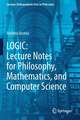
Autor Andrea Iaconaen Limba Engleză Hardback – 14 oct 2026


Preț: 524.79 lei
Preț vechi: 617.39 lei
-15% Precomandă
Puncte Express: 787
Carte nepublicată încă
Livrare prin curier în România Precomanda se expediază când titlul devine disponibil.
Transport gratuit pentru acest produs Plată online sau ramburs, în funcție de opțiunile comenzii.
Retur gratuit în 14 zile Comandă securizată și suport în română.
Doresc să fiu notificat când acest titlu va fi disponibil:
Se trimite...
Specificații
ISBN-13: 9783032256690
ISBN-10: 3032256690
Pagini: 290
Dimensiuni: 155 x 235 mm
Ediția:Second Edition 2026
Editura: Springer Nature Switzerland AG
Colecția Springer Undergraduate Texts in Philosophy
Seria Springer Undergraduate Texts in Philosophy
ISBN-10: 3032256690
Pagini: 290
Dimensiuni: 155 x 235 mm
Ediția:Second Edition 2026
Editura: Springer Nature Switzerland AG
Colecția Springer Undergraduate Texts in Philosophy
Seria Springer Undergraduate Texts in Philosophy
Notă biografică
Andrea Iacona is Professor of Logic at the University of Turin. His main research interests are in logic, epistemology, and philosophy of language. His publications include the books Propositions (Name 2002), Logical Form (Springer 2018), and numerous articles on topics including truth, vagueness, conditionals, and future contingents.
Cuprins
Preface.- Chapter 1. Elementary set-theoretical notions.- Chapter 2. What logic is about.- Chapter 3. Validity.- Chapter 4. Formality.- Chapter 5. The symbols of propositional logic.- Chapter 6. The language L: syntax.- Chapter 7. The language L: semantics.- Chapter 8. The system G.- Chapter 9. Derivability in G.- Chapter 10. The system S.- Chapter 11. Consistency, soundness, completeness.- Chapter 12. Computability.- Chapter 13. The symbols of predicate logic.- Chapter 14. The language Lq: syntax.- Chapter 15. The language Lq: semantics.- Chapter 16. The system Sq.- Chapter 17. Consistency, soundness, completeness.- Chapter 18. Identity.- Chapter 19. First-order theories.- Chapter 20. Theories and models.- Chapter 21. Gödel’s incompleteness theorems.- Chapter 22. Undecidability and related results.- Chapter 23. Modal propositional logic.- Chapter 24. Quantified modal logic.- Index.
Textul de pe ultima copertă
This textbook is a logic manual which includes an elementary course and an advanced course.
It covers more than most introductory logic textbooks, while maintaining a comfortable pace that students can follow. The technical exposition is clear, precise and follows a paced increase in complexity, allowing the reader to get comfortable with previous definitions and procedures before facing more difficult material. The book also presents an interesting overall balance between formal and philosophical discussion, making it suitable for both philosophy and more formal/science oriented students.
This textbook is of great use to undergraduate philosophy students, graduate philosophy students, logic teachers, undergraduates and graduates in mathematics, computer science or related fields in which logic is required.
Caracteristici
Suitable for undergraduate introductions to logic and early graduate courses on logic Presents both detailed technical aspects and philosophical aspects of logic Lays out the matter by following a paced increase in complexity