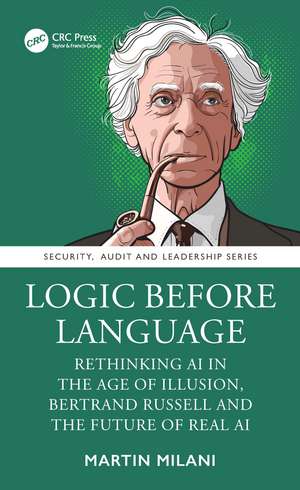
Logic Before Language: Rethinking AI in the Age of Illusion, Bertrand Russell and the Future of Real AI: Security, Audit and Leadership Series
Autor Martin Milanien Limba Engleză Hardback – 7 iun 2026
In an era dominated by language models that imitate thought without engaging in it, Logic Before Language makes a bold and urgent argument: if we want machines that truly understand, reason, and justify their conclusions, we must rebuild AI from its logical foundations.
Drawing from the intellectual lineage of Aristotle, Euclid, Russell, Gödel, Turing, McCarthy, and Minsky, Martin Milani exposes the core illusion beneath modern AI, the belief that eloquence and probability can substitute for meaning and reasoning. He shows how today’s systems generate speech without comprehension, confidence without justification, and predictions without any grounding in truth.
At the center of the book is Real-Time Reasoning (RTR), a new multi-layer architecture for AI that integrates perceptual learning with Bayesian inference, symbolic reasoning, fuzzy logic, logic-based explanation, and transparent decision pathways. RTR does not imitate intelligence; it constructs it. It reasons in real time, exposes every inference step, and produces conclusions that can be interrogated, audited, verified, and trusted.
This architecture is designed for epistemic integrity, with systems that not only produce outputs, but whose reasoning can be explained, justified, and challenged. It enables explainability and auditability by making knowledge dynamic, structured, traceable, and accountable, and it opens the door to a future of human–AI symbiosis, where machines serve as partners in reasoning rather than engines of imitation, and not as replacements for human judgment or creativity, but as collaborators in amplifying and extending both.
Bridging philosophy, mathematics, cognitive science, and computer science, Logic Before Language offers:
- A historical and epistemological critique of AI’s drift from logic to statistical mimicry.
- A reconstruction of intelligence grounded in causal reasoning, structure, and explanation.
- A practical, future-focused framework for building AI systems that reason deductively, inductively, and abductively, generating auditable and justified conclusions, meaningful explanations, and new knowledge.
- A roadmap for trustworthy, transparent, and symbiotic machine intelligence.
This is the case for AI that thinks and reasons. Not just one that talks.
Din seria Security, Audit and Leadership Series
-
 Preț: 418.53 lei
 - 8%
 Preț: 445.18 lei
 - 11%
 Preț: 635.66 lei
 -
 Preț: 414.87 lei
 -
 Preț: 430.76 lei
 - 8%
 Preț: 445.74 lei
 - 20%
 Preț: 405.06 lei
 - 20%
 Preț: 1197.18 lei
 -
 Preț: 326.44 lei
 -
 Preț: 415.48 lei
 - 20%
 Preț: 379.78 lei
 - 20%
 Preț: 685.25 lei
 - 20%
 Preț: 418.05 lei
 - 15%
 Preț: 472.42 lei
 - 20%
 Preț: 506.49 lei
 - 20%
 Preț: 535.60 lei
 - 20%
 Preț: 299.76 lei
 - 20%
 Preț: 1629.80 lei
 -
 Preț: 345.94 lei
 - 20%
 Preț: 526.36 lei
 -
 Preț: 384.37 lei
 -
 Preț: 219.16 lei
 - 20%
 Preț: 492.86 lei
 - 20%
 Preț: 527.83 lei
 - 20%
 Preț: 1308.63 lei
 - 20%
 Preț: 354.29 lei
 - 20%
 Preț: 374.75 lei
 - 20%
 Preț: 1030.95 lei
 - 20%
 Preț: 530.01 lei
 - 20%
 Preț: 573.71 lei
 - 20%
 Preț: 349.28 lei
 -
 Preț: 350.55 lei
 - 20%
 Preț: 311.00 lei
 - 20%
 Preț: 715.46 lei
 - 20%
 Preț: 488.00 lei
 -
 Preț: 297.38 lei
 -
 Preț: 391.02 lei
 - 20%
 Preț: 316.61 lei
 -
 Preț: 424.04 lei
 -
 Preț: 346.21 lei
 - 20%
 Preț: 327.92 lei
 - 20%
 Preț: 1112.87 lei
 - 20%
 Preț: 520.36 lei
Preț: 848.07 lei
Preț vechi: 1060.09 lei
-20%
Puncte Express: 1272
Carte tipărită la comandă
Livrare economică 30 noiembrie-14 decembrie
Livrare prin curier în România Termenul estimat este afișat lângă disponibilitate.
Transport gratuit pentru acest produs Plată online sau ramburs, în funcție de opțiunile comenzii.
Retur gratuit în 14 zile Comandă securizată și suport în română.
Specificații
ISBN-13: 9781041235668
ISBN-10: 1041235666
Pagini: 166
Dimensiuni: 156 x 234 mm
Greutate: 0.41 kg
Ediția:1
Editura: CRC Press
Colecția CRC Press
Seria Security, Audit and Leadership Series
ISBN-10: 1041235666
Pagini: 166
Dimensiuni: 156 x 234 mm
Greutate: 0.41 kg
Ediția:1
Editura: CRC Press
Colecția CRC Press
Seria Security, Audit and Leadership Series
Public țintă
Academic, Postgraduate, Professional Reference, and Undergraduate AdvancedCuprins
The book begins with Chapter One: The Illusion of Intelligence, followed by Chapter Two: The Rise of Language-Based AI, and Chapter Three: The Mirage of Meaning. Chapter Four: The Sloppiness of Speech explores the imperfections of language, while Chapter Five: Mathematics as Meaning and Chapter Six: Philosophia Mathematica delve into the mathematical foundations of reasoning. Chapter Seven: Reason Had to Be Invented examines the origins of logical thought, leading to Chapter Eight: Real-Time Reasoning and Chapter Nine: The Return of Reason, which discuss advancements in reasoning capabilities. Chapter Ten: Trustworthy Intelligence — From Black Box to Transparent Thinking addresses the need for transparency in AI systems. Chapter Eleven: From Reason to Revelation transitions into deeper insights, while Chapter Twelve: Unintelligent Intelligence critiques the limitations of current AI. Chapter Thirteen: Symbiotic Intelligence explores collaboration between humans and AI, culminating in Chapter Fourteen: The Shape of Thinking to Come, which envisions the future of intelligence and reasoning.
Notă biografică
Martin Milani is a technology entrepreneur, CEO, CTO, strategist, and systems architect whose work spans artificial intelligence, distributed systems, internet computing, and next-generation computing. Over the course of his career, he has built and led multiple technology companies, bringing advanced computing innovations from concept to large-scale commercial deployment.
Milani’s work sits at the intersection of the boardroom and the laboratory. He is recognized for his contributions to cloud and edge computing, distributed systems, and large-scale intelligent platforms, tracing the evolution of computing from early UNIX-based systems to modern cloud architectures, microservices, and AI-driven infrastructures.
His current work focuses on the foundations of artificial intelligence, developing architectures that integrate perceptual learning, Bayesian inference, symbolic reasoning, fuzzy logic, and epistemic systems to explore how AI can move beyond statistical prediction toward systems capable of structured reasoning, real understanding, and verifiable conclusions.
Milani holds a B.S. in Computer Science with a minor in Mathematics from the University of Pittsburgh.
Milani’s work sits at the intersection of the boardroom and the laboratory. He is recognized for his contributions to cloud and edge computing, distributed systems, and large-scale intelligent platforms, tracing the evolution of computing from early UNIX-based systems to modern cloud architectures, microservices, and AI-driven infrastructures.
His current work focuses on the foundations of artificial intelligence, developing architectures that integrate perceptual learning, Bayesian inference, symbolic reasoning, fuzzy logic, and epistemic systems to explore how AI can move beyond statistical prediction toward systems capable of structured reasoning, real understanding, and verifiable conclusions.
Milani holds a B.S. in Computer Science with a minor in Mathematics from the University of Pittsburgh.
Descriere
In an era dominated by language models that imitate thought without engaging in it, Logic Before Language makes a bold and urgent argument: if we want machines that truly understand, reason, and justify their conclusions, we must rebuild AI from its logical foundations.