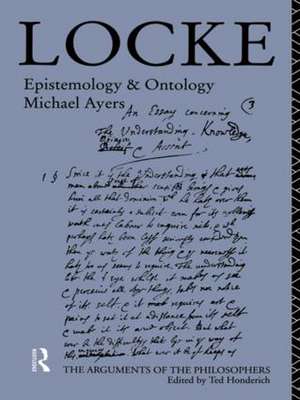
Locke: Arguments of the Philosophers
Autor Michael Ayersen Limba Engleză Paperback – 2 dec 1993
Locke was originally published in two volumes, Epistemology and Ontology. This paperback edition has within its covers the full text of both volumes.
Din seria Arguments of the Philosophers
-
 Preț: 465.03 lei
 -
 Preț: 477.18 lei
 -
 Preț: 438.85 lei
 -
 Preț: 475.47 lei
 -
 Preț: 347.30 lei
 - 15%
 Preț: 429.69 lei
 - 8%
 Preț: 476.94 lei
 -
 Preț: 391.79 lei
 -
 Preț: 426.98 lei
 - 18%
 Preț: 1251.35 lei
 - 15%
 Preț: 489.31 lei
 - 15%
 Preț: 483.17 lei
 -
 Preț: 486.25 lei
 - 15%
 Preț: 466.99 lei
 - 15%
 Preț: 487.50 lei
 -
 Preț: 477.60 lei
 - 14%
 Preț: 3269.70 lei
Preț: 410.29 lei
Preț vechi: 560.82 lei
-27%
Puncte Express: 615
Carte indisponibilă temporar
Doresc să fiu notificat când acest titlu va fi disponibil:
Se trimite...
Specificații
ISBN-13: 9780415100304
ISBN-10: 0415100305
Pagini: 700
Dimensiuni: 156 x 234 x 38 mm
Greutate: 1.3 kg
Ediția:1
Editura: Taylor & Francis
Colecția Routledge
Seria Arguments of the Philosophers
Locul publicării:Oxford, United Kingdom
ISBN-10: 0415100305
Pagini: 700
Dimensiuni: 156 x 234 x 38 mm
Greutate: 1.3 kg
Ediția:1
Editura: Taylor & Francis
Colecția Routledge
Seria Arguments of the Philosophers
Locul publicării:Oxford, United Kingdom
Recenzii
'Ayer's book is a fine tool for students ... The positions taken by Ayers are so little infected with Nineties commonplaces that this study of Locke will surely outlive this decade, and perhaps several to come.' - London Review of Books
'Michael Ayer's magisterial Locke is the philosophical work of the year and, no doubt, of the decade. It costs the price of a weekend to Brighton but is much more rewarding.' - Terry Eagleton, The Independent on Sunday
'This book is something of a tour de force ... the bare simplicity of its title belies its complexity and richness.' - Journal of Philosophy
'This is the most considerable book yet written on Locke's Essay Concerning Human Understanding; it reflects scholarship, intelligence and a good nose for a philosophical problem ... [it] is an absorbingly interesting book; I have had a good time wrestling with it.' - Times Literary Supplement
'A distinguished addition to Lockean studies, which will doubtless be widely used and discussed in coming years.' - Mind
'Anybody who dares to claim there is nothing to be learnt from philosophy's history will have to contend with these volumes.' - Times Higher Education Supplement
'It is enormously impressive - both a moving and a fascinating book.' - John Dunn, Political Studies
'Michael Ayer's magisterial Locke is the philosophical work of the year and, no doubt, of the decade. It costs the price of a weekend to Brighton but is much more rewarding.' - Terry Eagleton, The Independent on Sunday
'This book is something of a tour de force ... the bare simplicity of its title belies its complexity and richness.' - Journal of Philosophy
'This is the most considerable book yet written on Locke's Essay Concerning Human Understanding; it reflects scholarship, intelligence and a good nose for a philosophical problem ... [it] is an absorbingly interesting book; I have had a good time wrestling with it.' - Times Literary Supplement
'A distinguished addition to Lockean studies, which will doubtless be widely used and discussed in coming years.' - Mind
'Anybody who dares to claim there is nothing to be learnt from philosophy's history will have to contend with these volumes.' - Times Higher Education Supplement
'It is enormously impressive - both a moving and a fascinating book.' - John Dunn, Political Studies
Cuprins
Introduction PART I IDEAS Introduction to Part I; Ideas and compositionalism in traditional logic; Ideas and epistemology before Locke; Simple and complex ideas; Ideas as images; Ideas as intentional acts and ideas as intentional objects Ideas as natural signs; Ideas: a summary; Reflections on the structure of thought PART II KNOWLEDGE AND BELIEF Introduction to Part II The degrees of knowledge and the role of method Other divisions of knowledge; Probability and the nature of 'assent'; The grounds of probability; Reflections on the definition of knowledge; Belief and rationality; PART III PERCEPTUAL KNOWLEDGE Introduction to Part III The authority and limits of 'sensitive knowledge' Does perceptual knowledge have independent authority? Does perceptual knowledge have a firm boundary? The scope of perceptual knowledge; Two modern approaches to sensation; Private language and secondary qualities PART IV PARTICULARS, UNIVERSALS AND INTUITIVE KNOWLEDGE Introduction to Part IV Locke's arguments on space and time in context Thought about particulars; Locke's theory of universal knowledge in context Abstraction and the ideal of precision; Intuition and innate knowledge; Locke on meaning and some modern criticisms Reflections on understanding and imagination Necessity, reason and language; Conclusions of Volume I VOLUME II ONTOLOGY Introduction PART I SUBSTANCE AND MODE Introduction to Part I Substance, essence and accidents before Locke; Our complex ideas of substances and the idea of substance in general; Substance and real essence, matter and spirit, and the obscurity and confusion of the idea of substance; Substance, mode and the argument from language; Species and their names in the corpuscularian world; Are there real species? Locke on the difference between substances and modes Reflections on the notion of substance PART II GOD, NATURE AND THE LAW OF NATURE Introduction to Part II; Forms of mechanism before Locke; he form of Locke's mechanism; Reflections on rationalism, empiricism and mechanism The existence of God; The Law of Nature and human freedom; Reflections on Locke's ethics PART III IDENTITY Introduction to Part III ; Locke on 'masses of matter' ; Locke on living things ; Forms of material unity; Artificial and other problematic objects ; Personal identity before the Essay; Locke's theory of personal identity; Contemporary reactions to Locke's theory; Neo-Lockean and anti-Lockean theories of personal identity in analytic philosophy; Conclusions of Volume II
Notă biografică
Michael Ayers is a Fellow of Wadham College, Oxford, and a Lecturer in Philosophy at Oxford University.
Descriere
Locke was originally published in two volumes, Epistemology and Ontology. This paperback edition has within its covers the full text of both volumes.