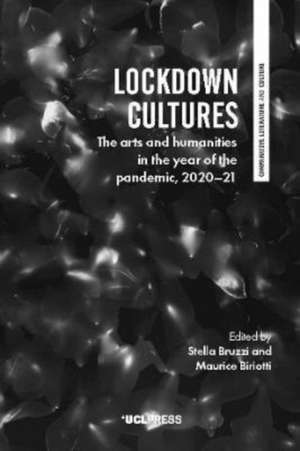
Lockdown Cultures
en Limba Engleză Paperback – 10 noi 2022
Evoluția recentă a domeniului științelor umaniste reflectă o tranziție necesară de la analiza teoretică izolată către un rol activ de interpretare a crizelor globale imediate. În volumul Lockdown Cultures, editat de Maurice Biriotti și Stella Bruzzi, descoperim o demonstrație de forță a modului în care artele și literatura pot procesa un eveniment disruptiv precum pandemia de Covid-19. Putem afirma că lucrarea funcționează nu doar ca o cronică a anilor 2020–2021, ci și ca un manifest pentru relevanța disciplinelor umaniste într-o epocă dominată de discursul pur tehnic sau medical. Considerăm că structura volumului este unul dintre punctele sale forte, fiind organizat în secțiuni ce permit o progresie logică de la tensiunile politice imediate către analogii istorice profunde. Prima parte, dedicată politicii, explorează teme precum traducerea informațiilor medicale în idiș sau „plaga productivității” la Shakespeare, în timp ce a doua parte, centrată pe istorie, ancorează experiența prezentă în episoade precum ciuma în Mesopotamia sau sacul Romei de către gali. Această pendulare între prezent și trecut subliniază ideea că umanitatea a posedat întotdeauna instrumentele culturale pentru a supraviețui izolării. Ca alternativă la Encountering the Plague pentru cursurile de studii culturale, Lockdown Cultures vine cu avantajul unei perspective mai largi asupra identității digitale și decoloniale, integrând peste 30 de eseuri care depășesc simpla analiză a bolii. Spre deosebire de Being Human during COVID, care se concentrează pe reziliența prin artă în viața cotidiană, acest volum de la UCL Press menține un rigoare academică sporită, chestionând fundamentele politice și istorice ale răspunsului nostru colectiv la criză. Tonul este unul sobru, analitic, evitând sentimentalismele în favoarea unei înțelegeri profunde a modului în care ni s-au schimbat obiceiurile de consum cultural și educațional.
Preț: 197.86 lei
Carte indisponibilă temporar
Specificații
ISBN-10: 1800083432
Pagini: 344
Dimensiuni: 156 x 234 x 29 mm
Greutate: 0.64 kg
Editura: UCL Press
De ce să citești această carte
Această lucrare este esențială pentru studenții și cercetătorii din domeniul științelor umaniste, oferind un cadru analitic pentru înțelegerea impactului social al izolării. Cititorul câștigă o perspectivă interdisciplinară asupra modului în care literatura, istoria și arta ne ajută să navigăm prin crize. Este un argument solid pentru utilitatea practică a filozofiei și istoriei în fundamentarea deciziilor politice și sociale contemporane, demonstrând că vocea umanistului este indispensabilă în dialogul public post-pandemie.
Despre autor
Maurice Biriotti este un autor și editor recunoscut pentru activitatea sa la intersecția dintre mediul academic și cel de afaceri, explorând modul în care perspectivele umaniste pot influența deciziile în organizații complexe. Stella Bruzzi este o personalitate academică marcantă, profesor de film și televiziune, cunoscută pentru cercetările sale asupra documentarului și identității culturale. Împreună, în cadrul seriei Comparative Literature and Culture, aceștia au coordonat un colectiv divers de experți pentru a oferi o viziune coerentă asupra transformărilor culturale provocate de lockdown, consolidând prestigiul UCL Press în zona studiilor culturale contemporane.
Descriere scurtă
Lockdown Cultures is both a cultural response to our extraordinary times and a manifesto for the arts and humanities and their role in our post-pandemic society. This book offers a unique response to the question of how the humanities have responded to the dominant crisis of our times: the Covid-19 pandemic. While the roles of engineers, epidemiologists, and, of course, medics are assumed, this volume illustrates some of how the humanities understood and analyzed 2020–21, the year of lockdown and plague. Though the impulse behind the book was topical, underpinning the richly varied and individual essays is a lasting concern with the value of the humanities in the twenty-first century. Each contributor approaches this differently but there are two dominant strands: how art and culture can help us understand the Covid crisis; and how the value of the humanities can be demonstrated by engaging with cultural products from the past. The result is a book that serves as a testament to the humanities’ reinvigorated and reforged sense of identity. It bears witness to a globally impactful event while showcasing interdisciplinary thinking and examining how the pandemic has changed how we read, watch, write and educate. More than thirty individual contributions collectively reassert the importance of the arts and humanities for contemporary society.
Notă biografică
Cuprins
List of contributors
Foreword
Acknowledgements
Introduction
Maurice Biriotti
Part I: Politics
1 ‘Give me liberty or death’
Lee Grieveson
2 Translating Covid-19 information into Yiddish for the Montreal-area Hasidic community
Lily Kahn, Zoë Belk, Kriszta Eszter Szendroi, and Sonya Yampolskaya
3 Shakespeare and the plague of productivity
Harvey Wiltshire
4 Decolonial option and the end of the world
Izabella Wodzka
5 Community building and creative practice within UK DIY cultures during Covid-19
Kirsty Fife
6 Now are we cyborgs? Affinities and technology in the Covid-19 lockdowns
Emily Baker and Annie Ring
Part II: History
7 Pathogens in ancient Mesopotamia
Markham J. Geller
8 Producing and accepting new knowledge in Jens Bjørneboe’s Semmelweis (1968)
Elettra Carbone
9 Ethnic Germans in Britain 1914–18
Matthias J. Gronau
10 Withdrawn and still engaged: Cicero
Gesine Manuwald
11 The Gallic Sack of Rome
Elizabeth McKnight
12 On Spinalonga
Panayiota Christodoulidou
Part III: Performance, identity and the screen
13 ‘The thing itself’
Alexander Samson
14 Towards a new history: The corona-seminar and the drag king virus
Helena Fallstrom
15 ‘In spite of the tennis’: Beckett’s sporting apocalypse’
Sam Caleb
16 Screening dislocated despair: Projecting the neoliberal left-behinds in 100 Flowers Hidden Deep
Nashuyuan Serenity Wang
17 A digital film for digital times: Some lockdown thoughts on Gravity
Stephen M. Hart
18 The Great Plague: London’s Dreaded Visitation, 1665
Justin Hardy
Part IV: Literature and writing
19 Lessons for lockdown from Thomas Mann’s The Magic Mountain
Jennifer Rushworth
20 The locked room: On reading crime fiction during the Covid-19 pandemic
Jakob Stougaard-Nielsen
21 The weight of the shrinking world
Florian Mussgnug
22 A voice-mail lyric for a discipline in crisis: On Ben Lerner’s ‘The Media’
Matthew James Holman
23 20,000 leagues under confinement
Patrick Bray
24 Reflections on Guixiu literary cultures in East Asia
Tzu-Yu Lin
Part V: Personal reflections
25 At home
Annika Lindskog
26 Lockdown cultures: A room of one’s own
Naomi Siderfin
27 Historical dreaming
Adelais Mills
28 In pursuit of blandness: On re-reading Jullien’s In Praise of Blandness during lockdown
Emily Furnell
29 Blinded Lights: Going viral during the Covid-19 pandemic
Sarah Moore
Part VI: Visual responses
30 Morphologies of agents of the pandemic
David Burrows and SMRU (The Social Morphologies Research Unit) (Martin Holbraad, John Cussans, Kelly Fagan Robinson, Melanie Jackson, Dean Kenning, Inigo Minns, Lucy Sames, Hermione Spriggs, Mary Yacoob)
31 Wildfire
John Thomson and Alison Craighead
32 Gospel Oak
Sharon Morris
33 I have a studio (visit) therefore I exist
Carey Young, Alice Channer, Anne Hardy and Karin Ruggaber
34 Inventory
Jayne Parker
35 After a long time or a short time
Elisabeth S. Clark
36 When the Roof Blew Off
Joe Cain
Index