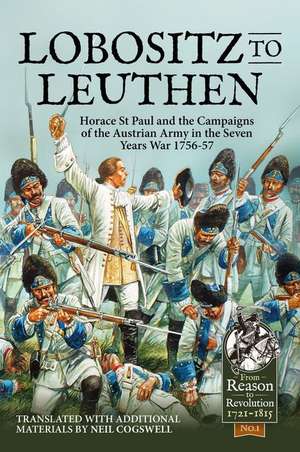
Lobositz to Leuthen
Editat de Neil Cogswellen Limba Engleză Paperback – 5 ian 2022
Recomandăm Lobositz to Leuthen istoricilor militari, cercetătorilor secolului al XVIII-lea și pasionaților de hărți tactice care caută o perspectivă autentică asupra armatei austriece. Observăm că această lucrare nu este o istorie retrospectivă, ci materialul brut din care se clădește istoria: jurnalul de zi cu zi al lui Horace St Paul, un tânăr englez forțat de un duel nefericit să fugă pe continent și să devină martor ocular al Războiului de Șapte Ani. Publicată de HELION & COMPANY, ediția se distinge prin rigoarea documentară. Jurnalul urmărește operațiunile austriece din Boemia și Silezia, oferind detalii despre asediul Pragăi și înfrângerea dramatică de la Leuthen. Valoarea editorială este amplificată de cele 232 de planșe cu hărți și planuri, care permit cititorului să urmărească mișcările de trupe cu o precizie cvasi-chirurgicală. Stilul lui St Paul este direct și onest; el nu ezită să noteze zilele în care „nu s-a întâmplat nimic”, dar devine extrem de tehnic în momentele de asediu, înregistrând detalii despre logistica și structura regimentelor care ar scăpa unui istoric generalist. Lobositz to Leuthen acoperă aceeași arie tematică precum The Seven Years War in Europe de Franz A.J. Szabo, dar cu o abordare mult mai practică și granulară, axată pe experiența de teren, spre deosebire de analiza strategică a lui Szabo. În contextul operei editorului Neil Cogswell, acest volum reprezintă fundamentul necesar pentru a înțelege Olmutz to Torgau, lucrare care continuă cronica armatei austriece până în 1760. Dacă în Zweybrucken in Command accentul cade pe armata imperială a micilor state germane, volumul de față rămâne documentul esențial pentru înțelegerea mecanismelor interne ale forțelor Mariei Tereza în prima parte a conflictului.
Preț: 425.97 lei
Preț vechi: 463.01 lei
-8%
Carte disponibilă
Livrare economică 26 octombrie-09 noiembrie
Specificații
ISBN-10: 1914059646
Pagini: 714
Dimensiuni: 155 x 234 x 28 mm
Greutate: 1.07 kg
Editura: HELION & COMPANY
De ce să citești această carte
Pentru practicienii istoriei militare, acest volum oferă acces la o sursă primară rară, tradusă și adnotată cu precizie. Cititorul câștigă o înțelegere intimă a campaniilor austriece dintre 1756 și 1757, susținută de un aparat cartografic impresionant de 232 de hărți. Este un instrument de lucru indispensabil pentru oricine dorește să depășească miturile despre Frederick cel Mare și să analizeze realitatea tactică a epocii.
Descriere scurtă
St Paul was a handsome young man who was possessed of considerable social graces and received a liberal allowance from his father. From France, he moved to Brussels, where he was accepted at the Court of Prince Charles of Lorraine, Governor-General of the Austrian Netherlands and brother-in-law of Maria Theresa, the Empress Queen. In 1756 Frederic II of Prussia invaded Saxony thereby precipitating a general war in Europe. Prince Charles of Lorraine confidently expected to be appointed to the chief command of the Austrian army, once it was fully mobilized. The Prince thought sufficiently well of St Paul to offer him a post at his side as aide-de-camp and sent him to join Marshal Browne, then commanding in Bohemia, as a volunteer to learn something of soldiering.
St Paul joined Marshal Browne shortly before the Austrain army advanced to attempt to relieve the Saxons, then besieged at Pirna. Having no regimental duties St Paul kept a journal of the day to day operations of the Austrians, thereby learning his new trade. He was present at the first major action of the war at Lobositz. The following year, now in the suite of Prince Charles of Lorraine, St Paul was present at the great battle outside Prague and was subsequently besieged in that city. He was also in a position to gather eyewitness accounts of other actions - notably that at Kolin - as he accompanied the victorious Austrian forces on their advance from Bohemia into Silesia while the King of Prussia was away seeking to prevent the armies of France and the Empire from re-conquering Saxony.
Once in Silesia the Austrian army besieged and stormed the great fortress of Schweidnitz and then crushed the remains of the Prussian army outside Breslau and captured that Capital city. Nike, the capricious Goddess of Victory, had crowned the triumphant Austrians. Nemesis, the Goddess of Retribution, had other ideas. One month after his stunning victory over the French and Empire forces at Rossbach, King Frederic of Prussia hurled his outnumbered and weary troops against the Austrians at Leuthen just outside Breslau.
The Journal of St Paul is a day by day account. He is not shy to write "Nothing happened", also when the action is hottest he can be understandably brief. As a man learning his trade, he often records details of almost arcane significance. As his original editor George Grey Butler noted: "This is not history, but it is the stuff from which history is written." Accompanying the text are a detailed Gazeteer and Lists of Persons and Regiments indicated in the text as well as 232 plates of maps and plans on which the reader can follow the operations described. This is a landmark work in the history of the Seven Years War. A continuation of this journal, describing the Campaigns from 1758 to 1760, is in preparation.