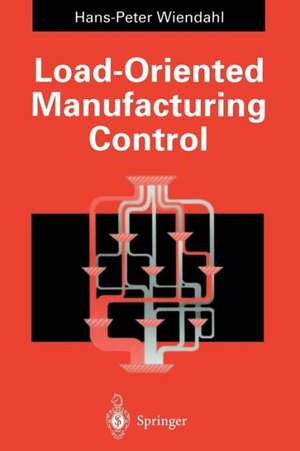
Load-Oriented Manufacturing Control
Autor Hans-Peter Wiendahlen Limba Engleză Paperback – 25 oct 2012
Preț: 619.91 lei
Preț vechi: 729.31 lei
-15%
Puncte Express: 930
Carte tipărită la comandă
Livrare economică 28 iulie-11 august
Livrare prin curier în România Termenul estimat este afișat lângă disponibilitate.
Transport gratuit pentru acest produs Plată online sau ramburs, în funcție de opțiunile comenzii.
Retur gratuit în 14 zile Comandă securizată și suport în română.
Specificații
ISBN-13: 9783642633430
ISBN-10: 3642633439
Pagini: 388
Ilustrații: XV, 368 p.
Dimensiuni: 155 x 235 x 20 mm
Greutate: 0.54 kg
Ediția:Softcover reprint of the original 1st ed. 1995
Editura: Springer Berlin, Heidelberg
Colecția Springer
Locul publicării:Berlin, Heidelberg, Germany
ISBN-10: 3642633439
Pagini: 388
Ilustrații: XV, 368 p.
Dimensiuni: 155 x 235 x 20 mm
Greutate: 0.54 kg
Ediția:Softcover reprint of the original 1st ed. 1995
Editura: Springer Berlin, Heidelberg
Colecția Springer
Locul publicării:Berlin, Heidelberg, Germany
V-ar putea interesa
-
 CNC RoboticsGeoff WilliamsPreț: 285.65 lei
 -
 Computational Principles of Mobile RoboticsGregory Dudek-20%Preț: 350.17 lei437.35 lei
 -
 Edison's EveGaby WoodPreț: 114.31 lei
 -
 Biologically Inspired RoboticsYunhui Liu-18%Preț: 1108.19 lei1351.46 lei
 -
 The Unofficial Lego Mindstorms Nxt 2.0 Inventor's GuideDavid J. PerduePreț: 148.84 lei
 -
 The LEGO Technic Idea Book: Simple MachinesYoshihito Isogawa-20%Preț: 131.55 lei163.99 lei
 -
 The LEGO Technic Idea Book: Wheeled WondersYoshihito Isogawa-20%Preț: 109.22 lei135.80 lei
 -
 Logistik-Wörterbuch. Dictionary of LogisticsVanessa Scott-Sabic-18%Preț: 759.42 lei926.12 lei
Public țintă
Professional/practitionerCuprins
1 Introduction.- 1.1 Preface.- 1.2 Changes in the Manufacturing Environment.- 1.3 Shifting Objectives of Manufacturing Control.- 1.4 Scheduling in Practice.- 1.5 The Weak Points of Conventional Manufacturing Control.- 1.6 References.- 2 Conventional Production Scheduling and Control.- 2.1 Abstract.- 2.2 Survey.- 2.3 Lead Time Scheduling and Capacity Scheduling.- 2.4 Evaluation of Conventional Lead Time Scheduling.- 2.5 Requirements for New Methods of Production Scheduling and Control.- 2.6 References.- 3 Lead Time — A Key Term in Manufacturing Control.- 3.1 Abstract.- 3.2 Introduction.- 3.3 Lead Time Components.- 3.4 Simple and Weighted Mean Lead Time at a Work Center.- 3.5 Order Lead Times.- 3.6 Statistical Evaluation of Work Center Lead Times.- 3.7 Work Center Lead Time in the Shop Calendar.- 3.8 Uncertainty of Measurement and Accuracy of Computed Lead Time Values.- 3.9 Examples of Authentic Lead Time Measurements.- 3.10 References.- 4 The Throughput Diagram — A General, Realistic Model of the Manufacturing Process.- 4.1 Abstract.- 4.2 Historical Evolution.- 4.3 Basic Form of the Throughput Diagram.- 4.4 The Work Center Throughput Diagram and its Basic Data.- 4.5 Order Throughput Diagram.- 4.6 References.- 5 Analysis, Monitoring, and Diagnosis of the Manufacturing Flow.- 5.1 Abstract.- 5.2 Manufacturing Flow Monitoring.- 5.3 Manufacturing Flow Analysis.- 5.4 A Continuous Monitoring System for Manufacturing Flow.- 5.5 Diagnosis of the Manufacturing Flow in the Throughput Diagram.- 5.6 Use of Graphics for the Representation of Throughput Diagrams and Key Data.- 5.7 Implications for Manufacturing Control.- 5.8 References.- 6 Load-Oriented Order Release.- 6.1 Abstract.- 6.2 Fundamental Relationships.- 6.3 Procedure.- 6.4 Conversion of the Orders to be Loaded.- 6.5Sample Demonstration of the Release Process.- 6.6 How to Choose the Load Limit and Loading Percentage Values.- 6.7 Interlinking Order Control with Manufacturing Control.- 6.8 Effects of the Load Limit and Time Limit Parameters in Simulation and in Practice.- 6.9 Controller Analogy of Load-Oriented Order Release.- 6.10 Priority Rules and Order Sequencing in Load-Oriented Order Release.- 6.11 References.- 7 Schedule-Oriented Capacity Planning and Control.- 7.1 Abstract.- 7.2 The Problem and the Method.- 7.3 Defining the Load Centers.- 7.4 Schedule-Oriented Capacity Planning Procedure.- 7.5 References.- 8 Implementation of Load-Oriented Manufacturing Control.- 8.1 Abstract.- 8.2 Prerequisites.- 8.3 Program Modules of Load-Oriented Manufacturing Control.- 8.4 System-to-User Interfaces and Hardware Configuration.- 8.5 Implementation Strategies.- 8.6 Load-Oriented Manufacturing Control in Automated Production Sites.- 8.7 Effects of Load-Oriented Manufacturing Control.- 8.8 References.- 9 Comparison of Load-Oriented Manufacturing Control with Other Methods.- 9.1 Abstract.- 9.2 Overview.- 9.3 The Kanban Principle.- 9.4 The Job-Progress Number System.- 9.5 Finite Control with a Graphic Control Unit (Electronic Leitstand).- 9.6 Queueing Models.- 9.7 The OPT System.- 9.8 References.- 10 Summary.- Appendix A.- Appendix B.