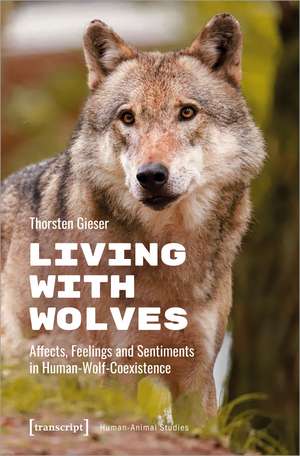
Living with Wolves: Affects, Feelings and Sentiments in Human-Wolf-Coexistence
Autor Thorsten Gieseren Limba Engleză Paperback – 6 aug 2024
Preț: 242.62 lei
Preț vechi: 314.05 lei
-23%
Puncte Express: 364
Carte disponibilă
Livrare economică 01-15 august
Livrare prin curier în România Termenul estimat este afișat lângă disponibilitate.
Transport gratuit de la 400.00 lei Plată online sau ramburs, în funcție de opțiunile comenzii.
Retur gratuit în 14 zile Comandă securizată și suport în română.
Specificații
ISBN-13: 9783837674705
ISBN-10: 3837674703
Pagini: 234
Ilustrații: 26
Dimensiuni: 148 x 225 x 23 mm
Greutate: 0.37 kg
Editura: transcript
Colecția Transcript
Locul publicării:Bielefeld, Germany
ISBN-10: 3837674703
Pagini: 234
Ilustrații: 26
Dimensiuni: 148 x 225 x 23 mm
Greutate: 0.37 kg
Editura: transcript
Colecția Transcript
Locul publicării:Bielefeld, Germany
V-ar putea interesa
-
 More Than Just a DogSimon WoolerPreț: 121.09 lei
 -
 Deep ListeningEmily KasrielPreț: 106.93 lei
 -
 How Animals Heal UsJay GriffithsPreț: 165.77 lei
 -
 Love in ExileShon FayePreț: 98.60 lei
 -
 Of Wolves and MenBarry Lopez-55%Preț: 77.32 lei170.61 lei
 -
 Take My Grief AwayKaterina GordeevaPreț: 121.02 lei
 -
 The Human AnimalMarkus GabrielPreț: 233.44 lei
 -
 Lineages of ModernityEmmanuel ToddPreț: 160.64 lei
 -
 Empathy and ResistanceKristina LunzPreț: 109.62 lei
 -
 -25%Preț: 91.72 lei122.11 leiRecomandat
 -
 Return of the WolfPaula WildPreț: 166.12 lei
 -
 Thinking Like a WolfRick McintyrePreț: 144.97 lei
 -
 The Philosopher and the WolfMark RowlandsPreț: 77.43 lei
 -
 No Paradise with WolvesKatie StaceyPreț: 109.48 lei
 -
 Somebody Is Walking on Your GraveMariana EnríquezPreț: 140.76 lei
 -
 Cry of the WildCharles Foster-21%Preț: 61.25 lei77.41 lei
 -
 The WolfKaren Lloyd-14%Preț: 1016.09 lei1181.51 lei
 -
 Pets and Their PeopleCharles FosterPreț: 204.58 lei
 -
 Hunt for the Shadow WolfDerek GowPreț: 91.69 lei
 -
 MammothEva BaltasarPreț: 90.21 lei
Recenzii
»Drawing from the natural sciences, social sciences and the humanities ‒ including behavioural ecology, the human dimensions of wildlife, environmental anthropology and animal geography ‒ this book is a great example of interdisciplinarity in practice. This book is an engaging, thought-provoking and stimulating read that is relevant not only for academics and practitioners but also for other interest groups as well as general readers interested in managing a shared (co)existence with non-human others.«
»One of the main insights we get from this nicely written and well-argued book is that not all wolves are the same. As in relations between humans, knowing the idiosyncrasies of a specific wolf individual can be crucial for balancing encounters in an increasingly tight ecology ...The author seems right in observing that, whether we like it or not, current socioecological dynamics lead us to be ‘more and more entangled’ with wolves, wild boars, raccoons, ducks, nutrias, and many other wild species.«
»›Living with wolves‹ is an excellent example of multispecies ethnography. It is a timely intervention from a continent where large carnivores are undergoing a resurgence and increasingly coming into conflict with humans.«
»Die Lektüre eröffnet die Chance, soziale Ordnung auch von ihren tierischen Grenzen her zu denken – und damit gewohnte Kategorien wie Mensch, Natur, Kultur aber auch Verantwortung zu hinterfragen: Das wiederum ermöglicht einen präziseren soziologischen Blick auf Zusammenleben, Machtverhältnisse und Handlungsspielräume.«
»One of the main insights we get from this nicely written and well-argued book is that not all wolves are the same. As in relations between humans, knowing the idiosyncrasies of a specific wolf individual can be crucial for balancing encounters in an increasingly tight ecology ...The author seems right in observing that, whether we like it or not, current socioecological dynamics lead us to be ‘more and more entangled’ with wolves, wild boars, raccoons, ducks, nutrias, and many other wild species.«
»›Living with wolves‹ is an excellent example of multispecies ethnography. It is a timely intervention from a continent where large carnivores are undergoing a resurgence and increasingly coming into conflict with humans.«
»Die Lektüre eröffnet die Chance, soziale Ordnung auch von ihren tierischen Grenzen her zu denken – und damit gewohnte Kategorien wie Mensch, Natur, Kultur aber auch Verantwortung zu hinterfragen: Das wiederum ermöglicht einen präziseren soziologischen Blick auf Zusammenleben, Machtverhältnisse und Handlungsspielräume.«