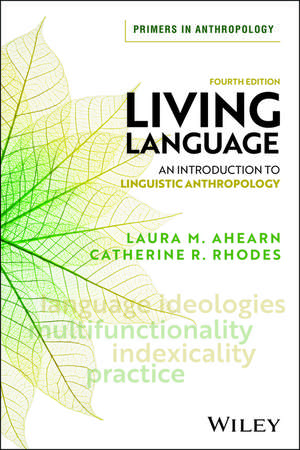
Living Language
Autor Laura M. Ahearn, Catherine R. Rhodesen Limba Engleză Paperback – 11 noi 2026
Now in its Fourth Edition, Living Language: An Introduction to Linguistic Anthropology continues to ground students in how language both shapes and is shaped by social contexts, cultural meanings, and power dynamics. Fully updated throughout, this fourth edition covers both theory and real-world interaction, frontloading with a robust conceptual framework and equipping readers to interpret the chapters that follow.
New to this edition are discussions of AI in relation to literacy, updated coverage of transgender language research and pronouns, and a perspectival shift from language endangerment to language shift grounded in Native and Indigenous linguistic anthropologists' perspectives. The text now explicitly addresses scale as a concept and highlights differences between Internet and cellular-based communication.
This insightful and indispensable book offers:
- Sign language scholarship integrated throughout the entire text rather than confined to a single chapter, reflecting current disciplinary approaches
- Cartoons, data tables, and relatable examples of actual language use illustrating linguistic anthropology's relevance in a globalized world
- A unified theoretical framework rooted in social theory covering language ideologies, multifunctionality, practice, and indexicality across chapters
- An accessible yet rigorous presentation that treats language as a non-neutral form of social action without oversimplifying core concepts
- A new appendix providing examples of classroom activities that can help instructors teach and students explore the key concepts of the book.
Preț: 375.77 lei
Precomandă
Puncte Express: 564
Carte nepublicată încă
Livrare prin curier în România Precomanda se expediază când titlul devine disponibil.
Transport gratuit de la 400.00 lei Plată online sau ramburs, în funcție de opțiunile comenzii.
Retur gratuit în 14 zile Comandă securizată și suport în română.
Doresc să fiu notificat când acest titlu va fi disponibil:
Se trimite...
Specificații
Notă biografică
Laura M. Ahearn, PhD, is a curriculum developer for the International Baccalaureate Organization and former tenured professor at Rutgers University. She is the author of Invitations to Love: Literacy, Love Letters, and Social Change in Nepal and the first three editions of Living Language. A 2014 Science and Technology Policy Fellow, she led research projects at USAID and later served as Senior Technical Director at Social Impact.
Catherine R. Rhodes, PhD, is an Associate Professor of Anthropology at the University of New Mexico, with affiliated appointments in Latin American Studies, Educational Linguistics, and Organization, Information, and Learning Sciences. She holds a dual PhD in Anthropology and Education from the University of Pennsylvania and was a 2024-2025 Fulbright U.S. Scholar fellow to Mexico. She is author of Undoing Modernity and co-author of Migration Narratives.
Catherine R. Rhodes, PhD, is an Associate Professor of Anthropology at the University of New Mexico, with affiliated appointments in Latin American Studies, Educational Linguistics, and Organization, Information, and Learning Sciences. She holds a dual PhD in Anthropology and Education from the University of Pennsylvania and was a 2024-2025 Fulbright U.S. Scholar fellow to Mexico. She is author of Undoing Modernity and co-author of Migration Narratives.
Cuprins
List of Figures x
List of Tables xiii
Preface (Note to the Reader) xiv
Acknowledgments xxi
Part I Language: Some Basic Questions 1
1 The Socially Charged Life of Language 3
So, What Do You Need to Know in Order to "Know" a Language? 9
Examples of Linguistic Diversity 14
Examples of Diversity in Research Topics in Linguistic Anthropology 18
Keith Basso 19
Jenny Davis 19
Marjorie Harness Goodwin 20
H. Samy Alim 21
Bonnie Urciuoli 21
Jonathan Rosa 22
Alessandro Duranti 22
E. Mara Green 23
Kathryn A. Woolard 23
Anna Babel 24
James M. Wilce 24
Steven Black 25
Key Terms in Linguistic Anthropology 25
Multifunctionality 26
Bakhtin's Double-Voiced Discourse 32
Goffman's Participation Framework and Production Format 33
Language Ideologies 35
Practice 37
Indexicality 40
Conclusion: The Inseparability of Language, Culture, and Social Relations 45
2 Discourse, Power, and Agency 46
What Is Discourse? 47
What Is Power? 54
Power Through Hegemony 54
Foucault's Power Relations and Discourse 56
Practice Theory and Power 58
What Is Agency? 72
The Grammatical Encoding of Agency 77
Talk About Agency: Meta-agentive Discourse 80
Conclusion 86
3 The Research Process in Linguistic Anthropology 87
What Kinds of Research Questions Do Linguistic Anthropologists Formulate? 88
How Do Linguistic Anthropologists Plan for Their Research? 91
What Kinds of Data Do Linguistic Anthropologists
Collect, and with What Methods? 92
Participant Observation 94
Interviews 95
Surveys and Questionnaires 97
Naturally Occurring Conversations 98
Experimental Methods 100
Matched Guise Tests 101
Written Texts 103
Mixed Methods and Interdisciplinary Research 104
How Do Linguistic Anthropologists Analyze Their Data? 105
Analyzing Conversations and Discourse and the Importance of "Scale" 108
What Products Do Linguistic Anthropologists Generate from Their Research? 113
What Sorts of Ethical Issues Do Linguistic Anthropologists Face? 115
Conclusion 120
4 Language Acquisition and Socialization 121
Language and Humans 122
Language Acquisition and Socialization Processes 124
Thinking Critically About Language Acquisition and Socialization 127
Gaps in the "Language Gap" Approach 132
Language Socialization in Bilingual, Multilingual, and Translanguaging Contexts 135
Language Socialization Throughout the Lifespan 138
Conclusion 144
5 Language, Thought, and Culture 146
A Hundred Years of Linguistic Relativity 147
Linguistic Relativity and the So-Called Sapir-Whorf Hypothesis 150
Investigating the Effects of Language on Thought 153
Language-in-General 154
Linguistic Structures 160
Color 164
Space 165
Time 168
Language Use 170
Conclusion 175
Part II Communicating Across Time, Space, and Scale 179
6 Global Communication 181
Defining "Speech Community" 182
Size and Location of the Community 183
What Is Shared by the Members of a "Speech or Sign Community"? 183
The Type of Interactions That "Speech or Sign Community" Members Have 184
Alternatives to the Concept of "Speech Community" 187
Speech Areas 188
Speech Networks 189
Communities of Practice 191
Multilingual and Transnational Linguistic Practices 195
Diglossia, Code-Mixing, Code-Switching, Translanguaging, and Heteroglossia 206
Diglossia 208
Code-Switching 209
Code-Mixing 211
Translanguaging 214
Heteroglossia 215
Conclusion 217
7 Literacy Practices 218
From Literacy to Literacies 221
Ethnographic Examples of Literacy Practices 223
Preschool Literacy Practices in the Southeastern United States 223
"Unsanctioned" Literacy Practices 227
Pema Kumari's Letter 229
Love-Letter Writing in Nepal 231
From Literacy to Narrative 233
Conclusion 239
8 Digitally Mediated Communication 241
A Brief History of Communicative Technology Anxieties 241
Who's Zoomin' Who? 248
Online Avatars 251
Instant Messaging (IMing) 254
Text Messaging and Beyond 256
Artificial Intelligence (AI) and Literacy 260
So Close and Yet So Far 268
Online Research and (New) Media 270
Conclusion 272
9 Performance, Performativity, and the Constitution of Communities 274
Performance Defined in Opposition to Competence 276
Performativity 278
Performance as a Display of Verbal Artistry 284
Ethnographies of Performance and Performativity 288
Conclusion 298
Part III Language, Power, and Social Differentiation 299
10 Language and Gender 301
Group A 302
Group B 302
What Is Gender, and How Does It Relate to Language? 303
Do Men and Women Speak Alike or Differently? 310
Cultural Variation in How We Do Gender 322
Reflecting on Myths and Realities 328
Conclusion 332
11 Language, Race, and Ethnicity 333
Defining Race and Ethnicity 334
The Rule-Governed Nature of African American English 341
Invariant or Habitual "Be" 342
Copula Deletion 344
Double Negatives 345
The Reduction of Final Consonants 346
Pronouncing the Word as "Ask" or "Aks" 347
Racist Language and Racism in Language 349
Language and Racial/Ethnic Identities 354
Conclusion 357
12 The Politics of Language Revitalization 358
Dangerous Metaphors 362
Metaphors to Live By 367
Emergence as Practice 369
Whose Practice? 378
Why Does Language Shift Happen? 380
Can Language Shift Be Reversed? 382
Conclusion 385
13 Conclusion: Language Is Political 387
Appendix 389
Linguistic Autobiographical Essay 389
Reflecting on Ethics: Citational Practices 396
Reflecting on Ethics: Applying Codes of Ethics 398
Practicing and Reflecting on Methods: Perceptual Dialectology 399
Practicing and Reflecting on Methods: Interview and Transcription 401
Practicing and Reflecting on Methods: Nonverbal Observation 404
Discussion: Linguistic Relativity 405
Discussion: Pronouns 406
Discussion: Communication Behaviors and Gender 407
Discussion: English Only 411
Applying Linguistic Anthropology: Communicating Linguistic Anthropology to Broader Audiences 415
Applying Linguistic Anthropology: Student Examples 416
Notes 418
References 449
Index 507