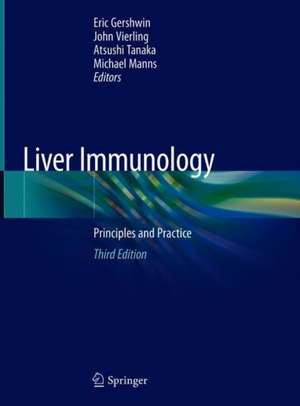
Liver Immunology
Editat de M. Eric Gershwin, John M. Vierling, Atsushi Tanaka, Michael P. Mannsen Limba Engleză Hardback – 4 noi 2020
Pregătirea pentru examenul de rezidențiat, board-ul de specialitate sau certificările internaționale în gastroenterologie și hepatologie necesită o înțelegere profundă a mecanismelor imunitare care guvernează patologia hepatică. În acest context, Liver Immunology, ajuns la a treia ediție, se impune ca o resursă clinică de o rigoare excepțională. Observăm o tranziție logică în structura tratatului: de la analiza teoretică a ficatului ca „sediu al toleranței” și organ limfoid, către aplicații clinice complexe. Remarcăm integrarea unor capitole noi ce vizează genetica și epigenetica pierderii toleranței imunitare, oferind o perspectivă modernă asupra etiologiei bolilor hepatice. Această ediție depășește abordarea clasică a hepatitelor virale, explorând detaliat axa microbiotă-intestin-ficat și rolul acizilor biliari în imunomodulare. Față de Immunology of Liver Disease de H.C. Thomas, care se concentrează predilect pe răspunsul imun în infecțiile virale, volumul de față, editat de M. Eric Gershwin și Michael P. Manns, extinde aria de expertiză către bolile metabolice precum steatoza hepatică non-alcoolică (NAFLD) și manifestările la populații speciale. Merită menționat că lucrarea completează Hepatology de Sanjaya K. Satapathy prin adăugarea unei profunzimi mecanistice; acolo unde manualele generale de hepatologie descriu managementul clinic, Liver Immunology explică „de ce”-ul imunopatologic din spatele fiecărei decizii terapeutice. Stilul este unul clinic și concis, facilitând înțelegerea modului în care produsele derivate din ficat declanșează sau rezolvă inflamația sistemică. Experiența de lectură este susținută de o progresie clară, de la diagnosticul imunologic și abordarea patologului asupra histologiei, până la particularitățile terapeutice în cazul pacienților cu transplant, oferind astfel un instrument indispensabil pentru medicina bazată pe dovezi.
Preț: 1394.43 lei
Preț vechi: 1467.82 lei
-5%
Carte disponibilă
Livrare economică 16-30 noiembrie
Specificații
ISBN-10: 303051708X
Pagini: 652
Ilustrații: XV, 633 p. 145 illus., 135 illus. in color.
Dimensiuni: 215 x 285 x 38 mm
Greutate: 1.93 kg
Ediția:Third Edition 2020
Editura: Springer
Locul publicării:Cham, Switzerland
De ce să citești această carte
Această lucrare este esențială pentru medicii gastroenterologi și imunologi care doresc să stăpânească complexitatea ficatului ca organ imunitar. Cititorul câștigă o viziune integrată asupra interacțiunilor dintre sistemul imunitar înnăscut și bolile hepatice cronice. Este un titlu de referință pentru cei care tratează cazuri complexe de autoimunitate sau pacienți transplantați, oferind protocoale bazate pe cele mai recente descoperiri genetice și microbiologice.
Despre autor
M. Eric Gershwin este un specialist de renume mondial în imunologie, cu o carieră dedicată descifrării mecanismelor bolilor autoimune. Expertiza sa este fundamentată de lucrări de referință precum Autoimmune Disease Diagnosis și Diagnostic Criteria in Autoimmune Diseases, unde a stabilit standardele pentru identificarea a peste 100 de afecțiuni cronice. În Liver Immunology, Gershwin colaborează cu experți precum Michael P. Manns pentru a aplica aceste principii riguroase de diagnostic în hepatologie. Abordarea sa pune accent pe corelația dintre cercetarea fundamentală de laborator și practica clinică la patul bolnavului.
Descriere scurtă
The book begins with an analysis of the core concepts of immunology, including the definition of autoimmunity and its unique application to the liver, a tolerogenic organ. Subsequent chapters then explore the biological elements of liver diseases caused by epigenetics, genetics, and innate and adaptive immunity. Specific clinical presentations and aspects of liver diseases are also examined, such as Hepatitis C, non-alcoholic fatty liver disease and parasitic infections. Closing chapters then discuss liver diseases among specific populations, including pediatrics, those with comorbidities and preexisting conditions, pregnant women, and finally patients with transplanted organs.
A timely and invaluable update to the clinical literature, Liver Immunology: Principles and Practice, Third Edition, is once again a comprehensive work that will not only enhance the understanding of liver diseases but also provide the kind of novel insights that greatly accelerates the evidence-based care of children and adults afflicted with these diseases. This volume is again a must-read for clinicians at all levels, for investigators and for students.
Cuprins
Notă biografică
Distinguished Professor of Medicine
The Jack and Donald Chia Endowed Professor
University of California School of Medicine Davis, CA
USA
John M. Vierling, MD
Professor of Medicine and Surgery
Chief of Hepatology
Director of Baylor Liver Health
Baylor College of Medicine
Houston, TX
USA
Atsushi Tanaka, MD, PhD
Professor
Department of Medicine
Teikyo University School of Medicine
Tokyo, Japan
Michael P. Manns, MD
Professor and Department of Medicine Chair
Department of Gastroenterology, Hepatology, and Endocrinology
Hannover Medical School Hannover, Germany