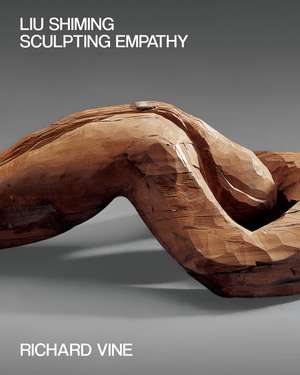
Liu Shiming: Sculpting Empathy
Autor Richard Vineen Limba Engleză Paperback – 31 mar 2026 – vârsta ani
Though well respected in China, the sculptor, who died in 2010 at the age of eighty-four, is only now beginning to win the wider recognition he deserves. Meanwhile, contemporary competitors are numberless, most of them Instagram-friendly, while art history tends to focus on towering names and indisputably major movements and events: Braque and Picasso inventing Cubism, Duchamp’s readymades redefining art itself, Warhol’s mind-bending Brillo Boxes, and so on. So why examine an artist in the middle ground? Perhaps, first, because that is where the vast majority of us live, trying to make sense of our lives and grateful for the occasional insight, release, or enrichment that visual art can bring us. Second, because the story of Liu Shiming reveals a great deal about the forces that have shaped postwar art worldwide. He was a man who sought to lead a simple life, dedicated entirely to art, in the midst of China’s epochal, dangerously complex twentieth-century social and political changes.
Preț: 275.52 lei
Puncte Express: 413
Carte disponibilă
Livrare economică 07-21 noiembrie
Livrare prin curier în România Termenul estimat este afișat lângă disponibilitate.
Transport gratuit de la 400.00 lei Plată online sau ramburs, în funcție de opțiunile comenzii.
Retur gratuit în 14 zile Comandă securizată și suport în română.
Specificații
ISBN-13: 9781978847415
ISBN-10: 1978847416
Pagini: 196
Ilustrații: 73 color images
Dimensiuni: 203 x 254 x 23 mm
Greutate: 0.82 kg
Editura: Rutgers University Press
Colecția Rutgers University Press
ISBN-10: 1978847416
Pagini: 196
Ilustrații: 73 color images
Dimensiuni: 203 x 254 x 23 mm
Greutate: 0.82 kg
Editura: Rutgers University Press
Colecția Rutgers University Press
V-ar putea interesa
-
 Art in ChinaCraig Clunas-23%Preț: 150.21 lei194.35 lei
 -
 The Art Isles: A 15,000-Year Story of Art in Britain and IrelandCharlotte MullinsPreț: 197.55 lei
 -
 Art Is: A Journey into the LightMakoto FujimuraPreț: 186.87 lei
 -
 The Art of Contemporary ChinaJiang Jiehong-18%Preț: 90.55 lei109.81 lei
 -
 Contemporary Chinese ArtWu Hung-8%Preț: 446.28 lei485.08 lei
 -
 The Arts of China, Sixth EditionMichael SullivanPreț: 339.54 lei
 -
 Anxiety Aesthetics – Maoist Legacies in China, 1978–1985Jennifer Doroth LeePreț: 244.92 lei
 -
 The Dehumanization of Art and Other Essays on Art, Culture, and LiteratureJosé Ortega Y. GassetPreț: 90.47 lei
 -
 -24%Preț: 94.94 lei125.31 lei
 -
 The Liu Kuo-Sung ReaderEugene Y WangPreț: 363.53 lei
 -
 A Solitary Traveler in the Long NightZhang QinPreț: 118.12 lei
 -
 Chinese Art TodayJoshua GongPreț: 400.55 lei
 -
 Gilbert & George and the CommunistsJames Birch-18%Preț: 116.74 lei142.85 lei
 -
 Video Art in China 1985-2020Qian Yang-18%Preț: 785.07 lei957.40 lei
 -
 -18%Preț: 733.68 lei894.73 lei
 -
 The Conformed Body: Contemporary Art in ChinaJiehong Jiang-18%Preț: 791.20 lei964.87 lei
 -
 -18%Preț: 787.56 lei960.43 lei
 -
 The Emergence of Chinese Avant-Garde ArtMin'an Wang-18%Preț: 725.11 lei884.28 lei
 -
 -19%Preț: 420.11 lei518.66 leiNou
Notă biografică
Liu Shiming was born in Tianjin, China in 1926 and is a sculptor trained at the Central Academy of Fine Arts in both Chinese tradition and French modernism. After early recognition for monumental works, he made a radical shift, leaving urban life to observe daily rhythms in rural Henan and Hebei. Returning to Beijing in 1975, he worked in cultural relics restoration at the National Museum of Chinese History. Rejoining CAFA in 1980, access to an electric kiln enabled his distinctively human, free-spirited clay sculptures.
Richard Vine is a New York-based art critic and the former managing editor of Art in America.
Richard Vine is a New York-based art critic and the former managing editor of Art in America.
Cuprins
Contents
Preface
Origins
Tianjin, Tangshan, Beijing: 1926–46
Student Years
Beijing: 1946–51
Early Success
Beijing, Shanxi, and Elsewhere: 1952–60
Provinces
Henan, Hebei, and Elsewhere: 1961–74
Return to Beijing
National Museum of Chinese History: 1975–80
Central Academy of Fine Arts: 1980–1995
Home
1995–2010
Cultural Contribution
Appendix
Life Chronology, Exhibition History, Awards, and Bibliography
Preface
Origins
Tianjin, Tangshan, Beijing: 1926–46
Student Years
Beijing: 1946–51
Early Success
Beijing, Shanxi, and Elsewhere: 1952–60
Provinces
Henan, Hebei, and Elsewhere: 1961–74
Return to Beijing
National Museum of Chinese History: 1975–80
Central Academy of Fine Arts: 1980–1995
Home
1995–2010
Cultural Contribution
Appendix
Life Chronology, Exhibition History, Awards, and Bibliography
Descriere
Though well respected in China, the sculptor Liu Shiming, who died in 2010 at the age of 84, is only now beginning to win the wider recognition he deserves. Meanwhile, contemporary competitors are numberless, most of them Instagram-friendly, while art history tends to focus on towering names and indisputably major movements and events: Braque and Picasso inventing Cubism, Duchamp’s readymades redefining art itself, Warhol’s mind-bending Brillo Boxes, etc. So why examine an artist in the middle ground? Richard Vine contends that the story of Liu Shiming reveals a great deal about the forces that have shaped postwar art worldwide. He was a man who sought to lead a simple life, dedicated entirely to art, in the midst of China’s epochal, dangerously complex 20th-century social and political changes.