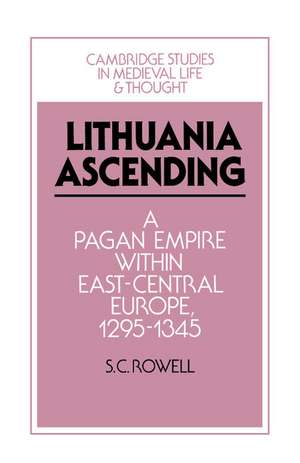
Lithuania Ascending
Autor S. C. Rowellen Limba Engleză Paperback – 23 dec 2013
Găsim în Lithuania Ascending o analiză riguroasă a modului în care un stat păgân a reușit nu doar să supraviețuiască cruciadelor europene, ci să devină o putere dominantă în estul continentului. Structura lucrării este concepută metodologic pentru a ghida cititorul de la analiza critică a surselor (capitolul 2) către dinamica politică și economică a regiunii între 1290 și 1345. Autorul S. C. Rowell organizează materialul tematic, acordând o atenție deosebită raportului dintre cultele păgâne și realpolitik-ul medieval, demonstrând cum religia a fost utilizată ca instrument diplomatic în relația cu papalitatea și puterile vecine. Progresia narativă urmărește transformarea Marelui Ducat sub dinastia Gediminidă, explorând paradoxul unui stat care, deși necreștinat oficial până târziu, a concurat cu Moscova pentru controlul structurilor ecleziastice din fostele teritorii rusești. Lithuania Ascending acoperă aceeași arie istorică precum The North-Eastern Frontiers of Medieval Europe de Alan V. Murray, dar cu o abordare mult mai centrată pe mecanismele interne de putere ale statului lituanian și pe reziliența culturii sale autohtone în fața expansiunii latine. În timp ce alte lucrări tratează regiunea prin prisma cuceririi, S. C. Rowell pune accent pe agenția politică a liderilor lituanieni. Prin utilizarea hărților și a datelor arheologice, textul oferă o perspectivă detaliată asupra unei perioade marcate de foamete, cruciade și colapsul autorității centrale în Imperiul German, elemente care fac ca Evul Mediu est-european să pară surprinzător de relevant pentru contextul geopolitic actual. Este o lucrare de referință publicată de Cambridge University Press, esențială pentru înțelegerea rădăcinilor multiculturale ale Europei Centrale.
Preț: 216.13 lei
Carte disponibilă
Livrare economică 14-28 noiembrie
Specificații
ISBN-10: 1107658764
Pagini: 416
Ilustrații: 5 maps 4 tables
Dimensiuni: 140 x 216 x 25 mm
Greutate: 0.58 kg
Editura: Cambridge University Press
Locul publicării:New York, United States
V-ar putea interesa
-
 Preț: 118.26 lei
 -
 -9%Preț: 94.17 lei102.92 lei
 -
 Legacies of DachauHarold MarcusePreț: 376.26 lei
 -
 The Rise of the CastleM. W. ThompsonPreț: 300.62 lei
 -
 Stalinist TerrorJ. Arch GettyPreț: 426.96 lei
 -
 The Jew AccusedAlbert S. LindemannPreț: 249.71 lei
 -
 Peasant and FrenchJames R. LehningPreț: 299.23 lei
 -
 Birth of the LeviathanThomas ErtmanPreț: 266.90 lei
 -
 Politics in the Rural SocietyP. M. JonesPreț: 347.03 lei
 -
 PogromsJohn Doyle KlierPreț: 296.34 lei
 -
 Esau's TearsAlbert S. LindemannPreț: 284.80 lei
 -
 Raymond PoincarJ. F. V. KeigerPreț: 403.74 lei
 -
 Revolution and Political Conflict in the French Navy 1789 1794William S. CormackPreț: 418.00 lei
 -
 Risks at SeaFrank C. SpoonerPreț: 304.54 lei
 -
 -17%Preț: 90.56 lei109.57 lei
 -
 -13%Preț: 87.21 lei99.97 lei
 -
 The Assassination of HeydrichJan G WienerPreț: 138.48 lei
 -
 Preț: 73.24 lei
 -
 Welcome to the Desert of Post-SocialismSrecko HorvatPreț: 152.58 lei
 -
 Preț: 431.91 lei
De ce să citești această carte
Această carte este indispensabilă pentru studenții și cercetătorii istoriei medievale care doresc să înțeleagă cum Lituania a devenit cel mai mare stat al Europei în secolul al XIV-lea. Cititorul câștigă o perspectivă unică asupra modului în care diplomația și forța militară pot menține un stat păgân în centrul unei Europe creștine. Este o lectură fundamentală pentru a înțelege complexitatea politică dincolo de narațiunile simpliste ale cruciadelor.
Descriere scurtă
Cuprins
Recenzii
"English (and in some respects the first time in any language), the rise of pagan Lithuania during the rule of Grand Duke Gediminas, with attention given also to the reigns of his predecessor Vytenis and successor Jaunutis." Choice
"It deserves careful attention from every serious student of medieval Russia and East Central Europe." Jean W. Sedlar, American Historical Review
"He [Rowell] has utilized the archives of ten different countries and an astounding array of published primary sources, Quellenforschungen, and specialized studies. He carefully introduces and re-introduces his cast of geographic, ethnic, institutional, and human characters, so that the reader does not get lost...Rowell has written a splendid book and has done so with erudition and zest....There is nothing at all like this book in any western language." International History Review
"This superb book is a major contribution to the history of east-central Europe in the Middle Ages, and to medieval history in general. It is an exceptionally welcome and original addition to a series of recent works about east-central Europe in the medieval period that are conceived in...English and that situate this region, and the countries and peoples that make it up, within a new and informed comparative perspective. In exceptionally clear and polished prose, it weaves together political, dynastic, economic, diplomatic, and ecclesiastical history to trace and explain the rise of the Jogaila dynasty to Christianity and the series of unions with Poland that followed in the late fourteenth and fifteenth centuries. The book...is, above all else, astonishingly learned." Piotr Górecki, Speculum