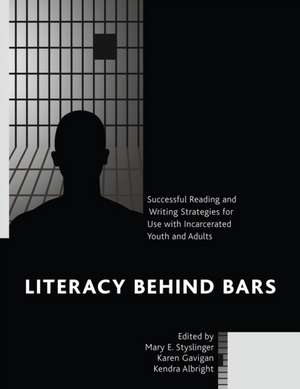
Literacy behind Bars: Successful Reading and Writing Strategies for Use with Incarcerated Youth and Adults
Editat de Mary E. Styslinger, Karen Gavigan, Kendra Albrighten Limba Engleză Paperback – 18 ian 2017
creating graphic novels,book clubs,writing about gang life,reading buddies,urban literaturedeveloping a writing workshopestablishing a school library
Preț: 361.67 lei
Preț vechi: 461.36 lei
-22%
Puncte Express: 543
Carte tipărită la comandă
Livrare economică 30 noiembrie-14 decembrie
Livrare prin curier în România Termenul estimat este afișat lângă disponibilitate.
Transport gratuit de la 400.00 lei Plată online sau ramburs, în funcție de opțiunile comenzii.
Retur gratuit în 14 zile Comandă securizată și suport în română.
Specificații
ISBN-13: 9781442269255
ISBN-10: 1442269251
Pagini: 108
Dimensiuni: 216 x 279 x 8 mm
Greutate: 0.3 kg
Editura: Bloomsbury Publishing
Colecția Rowman & Littlefield
Locul publicării:New York, United States
ISBN-10: 1442269251
Pagini: 108
Dimensiuni: 216 x 279 x 8 mm
Greutate: 0.3 kg
Editura: Bloomsbury Publishing
Colecția Rowman & Littlefield
Locul publicării:New York, United States
V-ar putea interesa
-
 Preț: 166.46 lei
 -
 Preț: 159.50 lei
 -
 The Letters of Sylvia BeachSylvia BeachPreț: 152.98 lei
 -
 From Pitch to PublicationCarole Blake-17%Preț: 89.59 lei108.54 lei
 -
 Books: A Living HistoryMartyn LyonsPreț: 114.69 lei
 -
 Preț: 120.59 lei
 -
 Out of PrintGeorge BrockPreț: 323.47 lei
 -
 Online Book MarketingLorraine PhillipsPreț: 109.31 lei
 -
 Preț: 175.95 lei
 -
 Publish Your Photography BookMary SwansonPreț: 117.63 lei
 -
 Pursuit: The Memoirs of John CalderJohn CalderPreț: 112.73 lei
Cuprins
Foreword
Acknowledgements
List of Figures
List of Tables
Preface
Part I. Supporting Writers
1.Word by Word: Teaching Poetic Economy Behind Bars
Deborah Appleman
2.Teaching to the Heart: Fostering Empathy through Writing Workshop
Timothy R. Bunch
3.Composing Public Service Announcements: Using Digital Mentor Texts to
Support Student Writers in a Juvenile Detention Facility
Kristine E. Pytash
4. Writing About the Secrets of Gang Life
Kendra S. Albright
Part II. Encouraging Readers
5. Call-and-Responsive Reading: Street Literature as Agency for Incarcerated Readers
Vanessa Irvin
6. Books Behind the Fence
Susan McNair
7. Creating a Community of Writers Using Graphic Novels
Karen W. Gavigan
8. The Places We Can Go: Book Clubs for Social Justice
Jennifer L. Doyle, Elizabeth M. Bemiss, Mary E. Styslinger
Part III. Inspiring Partnerships
9. Theme for English B: Teaching and Learning with Incarcerated Youth
Peter Williamson, Megan Mercurio, Constance Walker
10. Reading Buddies: A School-University Partnership
Mary E. Styslinger, Timothy R. Bunch
11. Building Bridges Across the Disciplines: Professional Development Behind the
Fence
Victoria A. Oglan, Janie R. Goodman
About the Editors and Contributors
Index
Acknowledgements
List of Figures
List of Tables
Preface
Part I. Supporting Writers
1.Word by Word: Teaching Poetic Economy Behind Bars
Deborah Appleman
2.Teaching to the Heart: Fostering Empathy through Writing Workshop
Timothy R. Bunch
3.Composing Public Service Announcements: Using Digital Mentor Texts to
Support Student Writers in a Juvenile Detention Facility
Kristine E. Pytash
4. Writing About the Secrets of Gang Life
Kendra S. Albright
Part II. Encouraging Readers
5. Call-and-Responsive Reading: Street Literature as Agency for Incarcerated Readers
Vanessa Irvin
6. Books Behind the Fence
Susan McNair
7. Creating a Community of Writers Using Graphic Novels
Karen W. Gavigan
8. The Places We Can Go: Book Clubs for Social Justice
Jennifer L. Doyle, Elizabeth M. Bemiss, Mary E. Styslinger
Part III. Inspiring Partnerships
9. Theme for English B: Teaching and Learning with Incarcerated Youth
Peter Williamson, Megan Mercurio, Constance Walker
10. Reading Buddies: A School-University Partnership
Mary E. Styslinger, Timothy R. Bunch
11. Building Bridges Across the Disciplines: Professional Development Behind the
Fence
Victoria A. Oglan, Janie R. Goodman
About the Editors and Contributors
Index
Recenzii
Written by professionals with experience working with incarcerated people, this resource is for educators and librarians who engage youth and adults 'behind the fence' in the English language arts.. The foreword and preface present a well-documented overview that connects poor literacy skills to incarceration. The editors introduce their text with a strong rationale that explains the literary deficits and unique needs of the incarcerated.. Well-written, insightful, timely, applicable across place and audience, this book is a fantastic resource for librarians and teachers working with incarcerated populations. These lessons are easily adaptable to an urban, general education setting and may improve the literacy skills of those at risk.
Well-written and academic in nature, this will most likely be needed in libraries supporting the educational needs of incarcerated teens and adults either to reaffirm what they are already achieving or to convince those in power to try something new.
Literacy Behind Bars is an integral text for professionals on both sides of the barbed wire fence. As an veteran secondary English of 25 years with experience in juvenile justice education and research, I stand in both excitement and awe to review this resource for multiple reasons. First, it is a valuable resource for educators demystifying literacy instruction for arguably the most vulnerable population in education. Second, the authors and contributors are well versed in education within confined settings and/or literacy curriculum development and instruction. And last, themes of reverence, hospitality, empathy, and acknowledgment of youth as unique individuals with both human and cultural capital to share with the world permeate each chapter. . . . this text presents specific, research and theory based lessons that will, through the development of reading, writing, creative and communication skills, empower students, giving voice to the voiceless and helping youth understand their own potential contributions to the greater conversations of the world.
Mixing personal experiences and stories from incarcerated inmates while built on a strong foundation of research, this volume provides valuable information and insights to teachers and librarians working in correctional facilities. Many of the essays describe literacy programs which bridge the core contradiction - a correctional facility is about rules and restrictions, while literacy is about freedom and choices - and could thus serve as relevant models for others working with people living behind bars in the age of mass incarceration.
Literacy behind Bars is grounded in solid research, offers exciting new strategies, and is enlivened by firsthand accounts of teaching experience.
Well-written and academic in nature, this will most likely be needed in libraries supporting the educational needs of incarcerated teens and adults either to reaffirm what they are already achieving or to convince those in power to try something new.
Literacy Behind Bars is an integral text for professionals on both sides of the barbed wire fence. As an veteran secondary English of 25 years with experience in juvenile justice education and research, I stand in both excitement and awe to review this resource for multiple reasons. First, it is a valuable resource for educators demystifying literacy instruction for arguably the most vulnerable population in education. Second, the authors and contributors are well versed in education within confined settings and/or literacy curriculum development and instruction. And last, themes of reverence, hospitality, empathy, and acknowledgment of youth as unique individuals with both human and cultural capital to share with the world permeate each chapter. . . . this text presents specific, research and theory based lessons that will, through the development of reading, writing, creative and communication skills, empower students, giving voice to the voiceless and helping youth understand their own potential contributions to the greater conversations of the world.
Mixing personal experiences and stories from incarcerated inmates while built on a strong foundation of research, this volume provides valuable information and insights to teachers and librarians working in correctional facilities. Many of the essays describe literacy programs which bridge the core contradiction - a correctional facility is about rules and restrictions, while literacy is about freedom and choices - and could thus serve as relevant models for others working with people living behind bars in the age of mass incarceration.
Literacy behind Bars is grounded in solid research, offers exciting new strategies, and is enlivened by firsthand accounts of teaching experience.