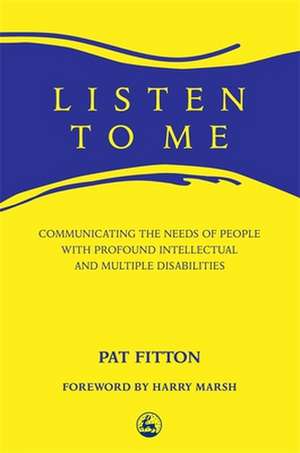
Listen To Me: Communicating the Needs of People with Profound Intellectual and Multiple Disabilities
Autor Pat Fittonen Limba Engleză Paperback – iun 1993
- How to cope with the complex problems of someone with this level of disability, interpret their needs successfully, and maintain effective contact with all the professionals and organisations who deal with them.
- How to enrich that person's experience and ensure that others value him or her as a distinct individual with a right to a meaningful life.
Highly practical, and using examples from the author's experience with her own daughter, each chapter deals with communicating such rights and needs in particular situations, and includes references for further information and reading. The author explains how to prepare a Care Book which includes the essential personal information, not simply about medication and physical procedures but about the individual's interests, preferences and background. She explains how it can be used to communicate effectively with busy professionals.
Preț: 200.68 lei
Preț vechi: 269.83 lei
-26%
Puncte Express: 301
Carte disponibilă
Livrare economică 17 noiembrie-01 decembrie
Livrare prin curier în România Termenul estimat este afișat lângă disponibilitate.
Transport gratuit de la 400.00 lei Plată online sau ramburs, în funcție de opțiunile comenzii.
Retur gratuit în 14 zile Comandă securizată și suport în română.
Specificații
ISBN-13: 9781853022449
ISBN-10: 1853022446
Pagini: 244
Ilustrații: black & white illustrations
Dimensiuni: 158 x 235 x 13 mm
Greutate: 0.38 kg
Editura: JESSICA KINGSLEY PUBLISHERS
Colecția Jessica Kingsley Publishers
Locul publicării:London, United Kingdom
ISBN-10: 1853022446
Pagini: 244
Ilustrații: black & white illustrations
Dimensiuni: 158 x 235 x 13 mm
Greutate: 0.38 kg
Editura: JESSICA KINGSLEY PUBLISHERS
Colecția Jessica Kingsley Publishers
Locul publicării:London, United Kingdom
V-ar putea interesa
-
 Disability and DisadvantageKimberley Brownlee-11%Preț: 385.39 lei431.69 lei
 -
 Deaf around the World: The Impact of LanguageGaurav Mathur-20%Preț: 470.31 lei586.87 lei
 -
 Learning Disability Policy and Practice: Changing Lives?Valerie Williams-24%Preț: 260.26 lei342.97 lei
 -
 Design Meets DisabilityGraham PullinPreț: 476.03 lei
 -
 Functional Impairment: Management, Types & ChallengesEmaad M O Abdel-Rahman-23%Preț: 1303.41 lei1701.90 lei
 -
 Education of Students with Disabilities: Federal Issues & PoliciesHarrison Garlach-27%Preț: 889.01 lei1210.67 lei
 -
 -20%Preț: 116.71 lei145.75 lei
 -
 -26%Preț: 199.03 lei268.29 lei
 -
 Joey Goes to the DentistCandace Vittorini-19%Preț: 97.44 lei119.76 lei
 -
 Disabled People and Housing: Choices, Opportunities and BarriersLaura HemingwayPreț: 282.66 lei
 -
 -25%Preț: 205.83 lei273.53 lei
 -
 -20%Preț: 354.96 lei443.29 lei
 -
 -21%Preț: 93.88 lei118.41 lei
 -
 Asperger's Syndrome: A Guide for Parents and ProfessionalsDr Anthony Attwood-20%Preț: 118.28 lei147.66 lei
 -
 Preț: 82.03 lei
Recenzii
This book would be of great value to all who have contact with a person with profound and multiple learning disabilities. Apart from the insight into the needs from the person's and carers' point of view, it provides a wealth of information including useful addresses and further references that may be of value.
To those parents who see no end to their toil, anxieties and battles it will provide much comfort and information. The author begs from all of us who are involved with severe disability to `see the person first, rather than the disability' and to ask of parents: "what does your child enjoy doing" rather than concentrating on his or her medical problems. It gave me much food for thought.
Many mothers have wondered if there was a book that could serve as a blueprint in their battle to do their best for their son/daughter - something which would outline what services are available and what support groups are out there for them and their child. Pat Fitton's book... takes on this task very well, using the story of her own battle to support her daughter Kathy, who had severe and multiple disabilities. Ms Fitton does this with a refreshing lack of mawkishness - a trap not always avoided by other authors. This book seeks to advise parents on strategies for clear communications; as such it should be of benefit to all parties. Ms Fitton does not stray from her goal - to encourage us to 'listen' to the severely, multiply disabled non-verbal person.
The book is, I believe, modern in concept and in its argument. Pat Fitton gives us a thoughtful and clear account of what is demanded of the parent and carer, and also of what they might reasonably expect our education, welfare benefits, health, leisure and social services to provide when someone has a disability... very moving and very informative at the same time: it is difficult to recall many books which have such a powerful effect... An important source of support mentioned by many parents is the information, advice and empathy received from other parents and carers. Listen to Me is a major contribution to that tradition of mutual support and understanding.
To those parents who see no end to their toil, anxieties and battles it will provide much comfort and information. The author begs from all of us who are involved with severe disability to `see the person first, rather than the disability' and to ask of parents: "what does your child enjoy doing" rather than concentrating on his or her medical problems. It gave me much food for thought.
Many mothers have wondered if there was a book that could serve as a blueprint in their battle to do their best for their son/daughter - something which would outline what services are available and what support groups are out there for them and their child. Pat Fitton's book... takes on this task very well, using the story of her own battle to support her daughter Kathy, who had severe and multiple disabilities. Ms Fitton does this with a refreshing lack of mawkishness - a trap not always avoided by other authors. This book seeks to advise parents on strategies for clear communications; as such it should be of benefit to all parties. Ms Fitton does not stray from her goal - to encourage us to 'listen' to the severely, multiply disabled non-verbal person.
The book is, I believe, modern in concept and in its argument. Pat Fitton gives us a thoughtful and clear account of what is demanded of the parent and carer, and also of what they might reasonably expect our education, welfare benefits, health, leisure and social services to provide when someone has a disability... very moving and very informative at the same time: it is difficult to recall many books which have such a powerful effect... An important source of support mentioned by many parents is the information, advice and empathy received from other parents and carers. Listen to Me is a major contribution to that tradition of mutual support and understanding.
Cuprins
Acknowledgements. This Book is not… This Book is for… Foreword by Harry Marsh. Introduction: Kathy. Part One: Learn About Me. 1. Diagnosis and First Contact with Hospitals. Part Two: We Need to Communicate. 2. We Need to Communicate. 3. Writing to People. 4. Telephoning. 5. Talking to People. Part Three: Tell Them About Me. 6. The Care Book. 7. Diaries. 8. Information Sheets. 9. Medication. Part Four: 10. In Nursery, School or Centre. 11. Respite and Residential Services. 12. Independent Living Arrangements. 13. Wheelchairs. 14. Mobility, Equipment and Adaptations. 15. Benefits. Part Five: Doctors and Hospitals. 16. Your G.P. 17. In Casualty. 18. In Hospital. 19. Things Can Only Get Better… Part Six: 20. Leisure Activities. 21. Families and Friends. 22. The Future - Wills, Trusts and Guardians. Part Seven: Conclusion. 23. Who Cares for the Carers?