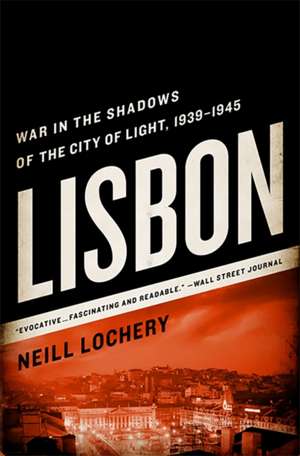
Lisbon: War in the Shadows of the City of Light, 1939-1945
Autor Neill Locheryen Limba Engleză Paperback – 30 oct 2012
Preț: 91.82 lei
Preț vechi: 123.23 lei
-25%
Puncte Express: 138
Carte disponibilă
Livrare economică 07-21 noiembrie
Livrare express 24-30 octombrie pentru 60.65 lei
Livrare prin curier în România Termenul estimat este afișat lângă disponibilitate.
Transport gratuit de la 400.00 lei Plată online sau ramburs, în funcție de opțiunile comenzii.
Retur gratuit în 14 zile Comandă securizată și suport în română.
Specificații
ISBN-13: 9781610391887
ISBN-10: 1610391888
Pagini: 346
Ilustrații: 24-pp. B/W photo insert on gloss
Dimensiuni: 154 x 232 x 26 mm
Greutate: 0.41 kg
Editura: Little Brown
Colecția PublicAffairs
Locul publicării:London, United Kingdom
ISBN-10: 1610391888
Pagini: 346
Ilustrații: 24-pp. B/W photo insert on gloss
Dimensiuni: 154 x 232 x 26 mm
Greutate: 0.41 kg
Editura: Little Brown
Colecția PublicAffairs
Locul publicării:London, United Kingdom
V-ar putea interesa
-
 Brazil: The Fortunes of WarNeill LocheryPreț: 260.54 lei
 -
 Preț: 219.04 lei
 -
 When Money DiesAdam FergussonPreț: 116.16 lei
 -
 Perilous QuestionAntonia FraserPreț: 130.64 lei
 -
 -40%Preț: 99.13 lei166.27 leiRecomandat
 -
 Stalingrad: The City that Defeated the Third ReichJochen Hellbeck-40%Preț: 110.77 lei185.51 lei
 -
 Preț: 300.37 lei
 -
 Histoire de la maison royale de Saint-Cyr (1686-1793), (Éd.1853)Théophile LavalléePreț: 200.63 lei
 -
 Preț: 230.86 lei
 -
 Preț: 246.80 lei
 -
 Histoire de la question coloniale en France , (Éd.1891)Léon DeschampsPreț: 208.27 lei
 -
 Histoire de la Réforme, de la Ligue et du règne de Henri IV (Éd.1834-1835)Baptiste CapefiguePreț: 223.20 lei
 -
 Preț: 215.63 lei
 -
 Preț: 231.92 lei
 -
 Preț: 277.64 lei
 -
 Preț: 269.45 lei
 -
 Preț: 270.60 lei
 -
 Preț: 231.92 lei
 -
 Preț: 208.27 lei
 -
 Histoire de la Révolution française. Tome deuxième (Éd.1839)Adolphe ThiersPreț: 224.22 lei
 -
 Histoire de la Terreur 1792-1794. T. huitième (Éd.1862-1881)Mortimer TernauxPreț: 269.57 lei
 -
 Histoire de la Terreur 1792-1794. T. septième (Éd.1862-1881)Mortimer TernauxPreț: 254.23 lei
 -
 Histoire de la Terreur à Bordeaux. 2 (Éd.1877)Aurélien ViviePreț: 231.20 lei
 -
 Histoire de la vie et des ouvrages des plus célèbres architecte. Tome 1 (Éd.1830)Antoine Chrysosto Quatremère de QuincyPreț: 192.17 lei
 -
 Histoire de la ville de CharlieuJ -B DesevelingesPreț: 193.18 lei
 -
 Histoire de la ville de Guise et de ses environsLouis-Victor PécheurPreț: 216.35 lei
 -
 Preț: 124.12 lei
Descriere
Lisbon had a pivotal role in the history of World War II, though not a gun was fired there. The only European city in which both the Allies and the Axis power operated openly, it was temporary home to much of Europe's exiled royalty, over one million refugees seeking passage to the U.S., and a host of spies, secret police, captains of industry, bankers, prominent Jews, writers and artists, escaped POWs, and black marketeers. An operations officer writing in 1944 described the daily scene at Lisbon's airport as being like the movie Casablanca," times twenty. In this riveting narrative, renowned historian Neill Lochery draws on his relationships with high-level Portuguese contacts, access to records recently uncovered from Portuguese secret police and banking archives, and other unpublished documents to offer a revelatory portrait of the War's back stage. And he tells the story of how Portugal, a relatively poor European country trying frantically to remain neutral amidst extraordinary pressures, survived the war not only physically intact but significantly wealthier. The country's emergence as a prosperous European Union nation would be financed in part, it turns out, by a cache of Nazi gold.