Cantitate/Preț
Produs

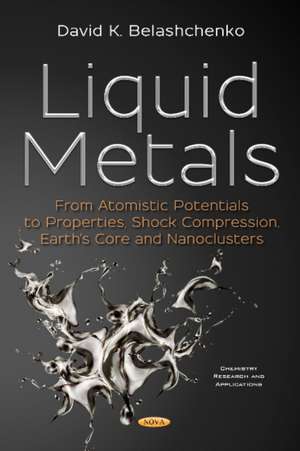
Liquid Metals: From Atomistic Potentials to Properties, Shock Compression, Earth's Core and Nanoclusters

Autor David K Belashchenko
en Limba Engleză Hardback – 18 iun 2018

Bazându-ne pe datele furnizate de Nova Science Publishers Inc, observăm că Liquid Metals reprezintă o sinteză tehnică riguroasă dedicată modelării computerizate a metalelor în stare lichidă și amorfă. Autorul David K Belashchenko structurează lucrarea în două secțiuni majore: o introducere metodologică în dinamica moleculară și metoda Monte Carlo, urmată de o aplicare vastă a modelului atomului încorporat (EAM) pentru 17 metale specifice. Ne-a atras atenția precizia cu care sunt tratate stările extreme, autorul extinzând calculele până la presiuni de ordinul sutelor de GPa, relevante pentru fizica planetară.

Spre deosebire de Theory of Adiabatic Potential and Atomic Properties of Simple Metals, care se concentrează pe conceptele de pseudopotential pentru metale simple, lucrarea de față avansează către sisteme complexe și condiții de compresie prin șoc (procese Hugoniot). De asemenea, Liquid Metals completează perspectiva oferită de Atomic clusters and nanoparticles. Agregats atomiques et nanoparticules, adăugând o discuție critică asupra ambiguității utilizării conceptelor clasice de rază și tensiune superficială în cazul nanoclusterelor, propunând în schimb o abordare mai coerentă din punct de vedere termodinamic.

Structura progresivă a cărții facilitează tranziția de la fundamentele topologice ale lichidelor către aplicații geofizice concrete, precum estimarea temperaturii în nucleul intern și extern al Pământului. Tabelele detaliate cu potențiale de interacțiune din anexă și datele calculate pentru difuzie și structură fac din acest volum un instrument de lucru esențial pentru cercetătorii care operează cu simulări la scară atomică în chimia teoretică și știința materialelor.

Citește tot Restrânge

Preț: 195455 lei

Preț vechi: 262334 lei
-25%

Puncte Express: 2932

Carte disponibilă

Livrare economică 06-20 mai


Specificații

ISBN-13: 9781536131406
ISBN-10: 1536131407
Pagini: 364
Dimensiuni: 180 x 260 mm
Greutate: 1.13 kg
Editura: Nova Science Publishers Inc
Colecția Nova Science Publishers, Inc (US)
Locul publicării:United States

De ce să citești această carte

Recomandăm această lucrare specialiștilor în fizica stării condensate și inginerilor de materiale care utilizează simulări numerice. Cititorul câștigă acces la parametri de potențial recalibrați pentru 17 metale și la o metodologie robustă pentru studiul solidificării în condiții de supracitire. Este o resursă fundamentală pentru înțelegerea comportamentului materiei în condiții extreme, de la nanoclustere la nuclee planetare.


Descriere

Basic problems concerning the computer simulation of liquid metals in usual and extreme conditions with the use of interparticle potentials, mainly multi-particle potentials of the embedded atom model are considered in the book. The general questions of a structure of simple liquids, and the methods of simulation of non-crystalline systems (liquid and amorphous) a method of molecular dynamics, Monte Carlo, quantum-mechanical modeling, etc. are considered in the first five chapters. The types of interparticle potentials applied, the analysis of atomistic models, topological characteristics of liquids, and the results of modeling one-component and binary systems with the use of the simplest interparticle potentials are considered. In the second part of the book, a specification of interparticle interaction is given for 17 metals of the various groups of the periodic system with the use of the embedded atom model. Parameters of potentials under ambient pressure are found using the experimental data about properties of metal on the binodal, and for strongly compressed states via the metal properties found in Hugoniot adiabatic processes. The role of electronic terms in energy is considered in detail. Tables of the potentials are given in the Appendix. Then, thermodynamic, structural and diffusion properties of these metals in wide intervals of the pressure and temperatures are calculated (usually to hundreds of GPa and tens of thousands of Kelvin). The results of the calculations are tabulated. In the final chapters of the book, specific problems with respect to liquid metals are considered. Here, the problems of the structure and conditions in the center of the Earth, Moon and Jupiter satellites, calculations of shock adiabats, and the isotopic effect of diffusion are covered. The assessments of structure and temperature in the inner and outer cores of the Earth are given. Calculations of a series of shock adiabats for the initially porous or liquid metal samples are carried out, and questions of accuracy concerning the available experimental data are analyzed. Also, some non-classical mechanisms of liquid solidification, in particular, the cluster mechanism of solidification during strong overcooling, are discussed. The general problems of the thermodynamic description of nanoclusters are considered. The ambiguity of the use of the radius, volume, surface area and surface tension concepts for nanoclusters is shown, and a more reasonable approach is suggested. The series of nanoclusters of various sizes are constructed for several metals, and the dependence of their properties on the cluster size, including a melting temperature, are investigated. The possibility to compare the applicability of the Second Law of Thermodynamics in its usual form to the melting/solidification of nanoclusters is discussed.

Cuprins

For more information, please visit our website at:Hardcover: https://www.novapublishers.com/catalog/product_info.php?products_id=63932E-book: https://www.novapublishers.com/catalog/product_info.php?products_id=63933