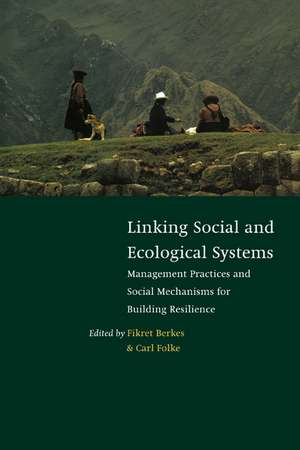
Linking Social and Ecological Systems
Editat de Fikret Berkes, Carl Folke, Berkes Fikreten Limba Engleză Paperback – 26 oct 2002
Observăm în Linking Social and Ecological Systems o schimbare fundamentală de paradigmă, sub coordonarea editorială a profesorilor Fikret Berkes și Carl Folke. Acești cercetători de prestigiu, afiliați unor instituții precum University of Manitoba și Institutul Beijer din Stockholm, propun o abordare interdisciplinară care refuză separarea tradițională între științele naturii și cele sociale. Lucrarea fundamentează teoretic necesitatea de a privi mediul și societatea ca un tot unitar, oferind soluții concrete pentru managementul schimbărilor de mediu. Structura volumului se bazează pe studii de caz internaționale, analizând modul în care cunoștințele ecologice sunt acumulate și transmise prin mecanisme sociale. Putem afirma că rigoarea celor 49 de ilustrații și 15 tabele susține argumentația privind reziliența sistemelor. Față de lucrările anterioare ale lui Fikret Berkes, precum Sacred Ecology, unde accentul era pus pe cunoașterea indigenă, acest volum extinde cadrul către dinamica instituțională și principiile de guvernare globală, teme explorate ulterior și în Governing the Coastal Commons. Cititorii familiarizați cu Principles of Ecosystem Stewardship de F Stuart Chapin III vor aprecia în acest volum modul în care sunt detaliate mecanismele sociale specifice care permit comunităților să se adapteze. În timp ce F Stuart Chapin III se concentrează pe provocările globale precum schimbările climatice, Linking Social and Ecological Systems oferă un set de principii aplicabile la nivel local și regional pentru construirea rezilienței. Tonul este unul academic, precis, transformând datele complexe din teren într-un ghid de bune practici pentru sustenabilitate.
Preț: 537.72 lei
Preț vechi: 604.17 lei
-11%
Carte tipărită la comandă
Livrare economică 07-21 decembrie
Specificații
ISBN-10: 0521785626
Pagini: 476
Ilustrații: 49 b/w illus. 15 tables
Dimensiuni: 152 x 229 x 28 mm
Greutate: 0.77 kg
Editura: Cambridge University Press
Locul publicării:Cambridge, United Kingdom
V-ar putea interesa
-
 -31%Preț: 539.46 lei780.53 lei
 -
 Dispersal Ecology and EvolutionJean Clobert-25%Preț: 602.84 lei801.13 lei
 -
 Principles of Ecosystem StewardshipF Stuart Chapin Iii-15%Preț: 566.08 lei665.98 lei
 -
 Shaping EcologyPeter G. AyresPreț: 206.38 lei
 -
 Trait-Mediated Indirect InteractionsTakayuki Ohgushi-11%Preț: 459.27 lei516.04 lei
 -
 Environmental BiologyMike Calver-23%Preț: 812.68 lei1055.42 lei
 -
 Large-Scale Landscape ExperimentsDavid. B LindenmayerPreț: 418.29 lei
 -
 Too Smart for our Own GoodCraig Dilworth-8%Preț: 434.91 lei472.73 lei
 -
 Fire in Mediterranean EcosystemsJon E. Keeley-14%Preț: 1136.76 lei1321.82 lei
 -
 Aquatic EcosystemsNicholas V. C. Polunin-14%Preț: 1084.83 lei1261.43 lei
 -
 1493Charles C. MannPreț: 110.33 lei
De ce să citești această carte
Această carte este esențială pentru cercetătorii și profesioniștii din domeniul ecologiei și științelor sociale care caută o înțelegere profundă a sustenabilității. Cititorul câștigă o perspectivă clară asupra modului în care instituțiile umane influențează sănătatea ecosistemelor. Este un instrument de referință pentru fundamentarea strategiilor de management bazate pe reziliență, oferind atât teorie solidă, cât și dovezi empirice din diverse regiuni ale lumii.
Despre autor
Fikret Berkes este profesor emerit la University of Manitoba, în cadrul Natural Resources Institute. Este recunoscut la nivel mondial pentru cercetările sale privind sistemele socio-ecologice, managementul resurselor comune și importanța cunoștințelor ecologice tradiționale. Carl Folke, co-editorul volumului, este o figură centrală în studiul rezilienței, fiind unul dintre fondatorii Institutului de Reziliență din Stockholm. Împreună, cei doi au pus bazele teoretice ale modului în care societățile umane pot co-evolua sustenabil cu natura, integrând teoria sistemelor complexe în politicile de mediu contemporane.
Descriere scurtă
Cuprins
Recenzii
'Fikret Berkes and Carl Folke brought together a remarkable group of people and organized their scholarly work to produce a splendid volume that marries the best research on social and ecological systems that exists today.' Ecological Economics
'These volumes offer the basis of a synthetic view of environment and human decision-making. Such work is of the highest importance, both as a basis for policy and for its inherent intellectual challenge.' W. M. Adams, TREE
'Berkes and Folke have produced a high quality publication which contributes to the laying of foundations for more harmonious socio-environmental relations in the future' Journal of Applied Ecology
'...an unusually coherent edited collection, which develops an unambiguous and compelling argument for adopting a rigorous interdisciplinary appraoch to natural resource management.' Journal of Applied Ecology
'A welcome contribution to the debate on the sustainable use of natural resources.' Journal of the Royal Anthropological Institution