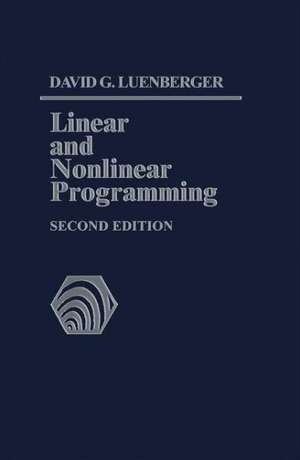
Linear and Nonlinear Programming
Autor David G. Luenbergeren Limba Engleză Hardback – 30 sep 2003
Preț: 766.64 lei
Preț vechi: 934.93 lei
-18%
Puncte Express: 1150
Carte tipărită la comandă
Livrare economică 23 noiembrie-07 decembrie
Livrare prin curier în România Termenul estimat este afișat lângă disponibilitate.
Transport gratuit pentru acest produs Plată online sau ramburs, în funcție de opțiunile comenzii.
Retur gratuit în 14 zile Comandă securizată și suport în română.
Specificații
ISBN-13: 9781402075933
ISBN-10: 1402075936
Pagini: 516
Ilustrații: XVIII, 492 p.
Dimensiuni: 160 x 241 x 33 mm
Greutate: 0.88 kg
Ediția:2nd edition 2003
Editura: Springer
Locul publicării:New York, NY, United States
ISBN-10: 1402075936
Pagini: 516
Ilustrații: XVIII, 492 p.
Dimensiuni: 160 x 241 x 33 mm
Greutate: 0.88 kg
Ediția:2nd edition 2003
Editura: Springer
Locul publicării:New York, NY, United States
V-ar putea interesa
-
 The Joy of Finite Mathematics: The Language and Art of MathChris P. Tsokos-32%Preț: 692.44 lei1018.31 lei
 -
 Optimization in Operations ResearchRonald L. Rardin-23%Preț: 1815.48 lei2357.77 lei
 -
 Investment ScienceDavid G. Luenberger-27%Preț: 1520.60 lei2083.01 lei
 -
 Optimization-Theory and PracticeWilhelm Forst-15%Preț: 525.06 lei617.73 lei
 -
 -9%Preț: 901.36 lei990.51 lei
 -
 Introduction to Dynamic SystemsDavid G. Luenberger-27%Preț: 1555.61 lei2130.97 lei
 -
 Optimization by Vector Space MethodsDavid G. Luenberger-9%Preț: 950.70 lei1044.73 lei
 -
 Theory of Linear Integer ProgrammingSchrijver-9%Preț: 791.91 lei870.23 lei
 -
 Information ScienceDavid G. Luenberger-23%Preț: 745.91 lei968.71 lei
 -
 Optimal Transport Methods in EconomicsAlfred Galichon-19%Preț: 446.99 lei551.84 lei
 -
 -23%Preț: 783.89 lei1018.04 lei
 -
 -18%Preț: 1205.00 lei1469.52 lei
 -
 Bi-Level Strategies in Semi-Infinite ProgrammingOliver Stein-15%Preț: 662.95 lei779.94 lei
 -
 MatheuristicsVittorio Maniezzo-18%Preț: 1356.10 lei1653.78 lei
 -
 Linear and Nonlinear ProgrammingDavid G. Luenberger-15%Preț: 542.81 lei638.61 lei
 -
 Scatter SearchManuel Laguna-18%Preț: 917.05 lei1118.36 lei
 -
 Computational Modeling and Problem Solving in the Networked WorldHemant K. Bhargava-20%Preț: 955.11 lei1193.89 lei
 -
 Handbook of Applied AnalysisNikolaos S. Papageorgiou-18%Preț: 931.20 lei1135.61 lei
 -
 Stochastic Linear ProgrammingPeter KallPreț: 400.42 lei
 -
 -9%Preț: 977.87 lei1074.58 lei
 -
 -27%Preț: 2295.18 lei3128.25 lei
 -
 Multiobjective Linear and Integer ProgrammingCarlos Henggeler Antunes-15%Preț: 723.99 lei851.75 lei
 -
 Computational Linear and Commutative AlgebraMartin Kreuzer-15%Preț: 496.38 lei583.97 lei
 -
 Chaos, CNN, Memristors and BeyondAndrew Adamatzky-18%Preț: 1173.97 lei1431.67 lei
Public țintă
ResearchCuprins
1. Introduction.
Part I: Linear Programming. 2. Basic Properties of Linear Programs.3. The Simplex Method. 4. Duality. 5. Transportation and Network Flow Problems.
Part II: Unconstrained Problems. 6. Basic Properties of Solutions and Algorithms. 7. Basic Descent Methods. 8. Conjugate Direction Methods. 9. Quasi- Newton Methods.
Part III: Constrained Minimization. 10. Constrained Minimization Conditions. 11. Primal Methods. 12. Penalty and Barrier Methods. 13. Dual and Cutting Plane Methods. 14. Lagrange Methods.
Appendix A: Mathematical Review. A.1. Sets. A.2. Matrix Notation. A.3. Spaces. A.4. Eigenvalues and Quadratic Forms. A.5. Topological Concepts. A.6. Functions.
Appendix B: Convex Sets. B.1. Basic Definitions. B.2. Hyperplanes and Polytopes. B.3. Separating and Supporting Hyperplanes. B.4. Extreme Points.
Appendix C: Gaussian Elimination.
Bibliography. Index.
Part I: Linear Programming. 2. Basic Properties of Linear Programs.3. The Simplex Method. 4. Duality. 5. Transportation and Network Flow Problems.
Part II: Unconstrained Problems. 6. Basic Properties of Solutions and Algorithms. 7. Basic Descent Methods. 8. Conjugate Direction Methods. 9. Quasi- Newton Methods.
Part III: Constrained Minimization. 10. Constrained Minimization Conditions. 11. Primal Methods. 12. Penalty and Barrier Methods. 13. Dual and Cutting Plane Methods. 14. Lagrange Methods.
Appendix A: Mathematical Review. A.1. Sets. A.2. Matrix Notation. A.3. Spaces. A.4. Eigenvalues and Quadratic Forms. A.5. Topological Concepts. A.6. Functions.
Appendix B: Convex Sets. B.1. Basic Definitions. B.2. Hyperplanes and Polytopes. B.3. Separating and Supporting Hyperplanes. B.4. Extreme Points.
Appendix C: Gaussian Elimination.
Bibliography. Index.
Recenzii
From the reviews of the second edition:
"I have profitably used the book to apply constrained minimization procedures in the field of computational contact mechanics. I think it is not a secret that quite often books on mathematics are written from mathematicians for mathematicians. Hence it is quite hard for engineers to read and to extract valuable information from them. With this respect this book is a shining star. It presents the topics in a very precise but clear and understandable way."
(Giorgio Azvaris, Turin, Italy)
"I have the 1977 edition from my father's MIT days. I am a Mathematician and I can verify that the book written in 1977 is of the same style that good books have today. A book is not made obsolete because some new "elegant" terms arise."
(A reader from Greece)
"In this second edition … David Luenberger focuses on practical optimization techniques. … the book would be appropriate for graduate students or for self-study by professionals. … I recommend the book for those who are familiar with elements of linear algebra … . The book concludes with three short appendices … and a bibliography and a short index. … is intended for those who want to look deeply into optimization techniques, linear and nonlinear. … will be useful to researchers, engineers, and graduate students." (Sergio Ubeda, Interfaces, Vol. 37 (1), 2007)
"I have profitably used the book to apply constrained minimization procedures in the field of computational contact mechanics. I think it is not a secret that quite often books on mathematics are written from mathematicians for mathematicians. Hence it is quite hard for engineers to read and to extract valuable information from them. With this respect this book is a shining star. It presents the topics in a very precise but clear and understandable way."
(Giorgio Azvaris, Turin, Italy)
"I have the 1977 edition from my father's MIT days. I am a Mathematician and I can verify that the book written in 1977 is of the same style that good books have today. A book is not made obsolete because some new "elegant" terms arise."
(A reader from Greece)
"In this second edition … David Luenberger focuses on practical optimization techniques. … the book would be appropriate for graduate students or for self-study by professionals. … I recommend the book for those who are familiar with elements of linear algebra … . The book concludes with three short appendices … and a bibliography and a short index. … is intended for those who want to look deeply into optimization techniques, linear and nonlinear. … will be useful to researchers, engineers, and graduate students." (Sergio Ubeda, Interfaces, Vol. 37 (1), 2007)
Notă biografică
David G. Luenberger received his B.S. degree from the California Institute of Technology and his M.S. and Ph.D. degrees from Stanford University, all in Electrical Engineering. Since 1963 he has served on the faculty of Stanford University. He helped found the Department of Engineering-Economic Systems, which have since become the Department of Management Science and Engineering, where his is currently a professor.
He is a Member of the National Academy of Engineering (2008) and has received e.g. the Bode Lecture Prize of the Control Systems Society (1990), the Oldenburger Medal of the American Society of Mechanical Engineers (1995), and the Expository Writing Award of the Institute of Operations Research and Management Science (1999). He is a Fellow of the Institute of Electrical and Electronic Engineers (since 1975).
Yinyu Ye is currently the Kwoh-Ting Li Professor in the School of Engineering at the Department of Management Science and Engineering and Institute of Computational and Mathematical Engineering. He received his B.S. degree in System Engineering from Huazhong University of Science and Technology, China, and his M.S. and Ph.D. degrees in Engineering-Economic Systems and Operations Research from Stanford University. He is an INFORMS (The Institute for Operations Research and The Management Science). Fellow since 2012, and has received several academic awards including: the 2009 John von Neumann Theory Prize for fundamental sustained contributions to theory in Operations Research and the Management Sciences, the 2015 SPS Signal Processing Magazine Best Paper Award, the winner of the 2014 SIAM Optimization Prize awarded (every three years), the inaugural 2012 ISMP Tseng Lectureship Prize for outstanding contribution to continuous optimization (every three years), the inaugural 2006 Farkas Prize on Optimization, the 2009 IBM Faculty Award.
Caracteristici
1st edition is considered a classic; 2nd edition expands and updates the material
Provides a structure for learning existing material, and insight for developing new results
Useful to analysts, operations researchers and management experts in many fields
Provides a structure for learning existing material, and insight for developing new results
Useful to analysts, operations researchers and management experts in many fields