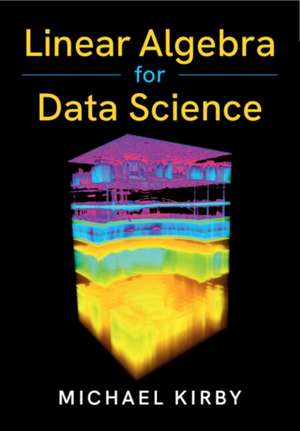
Linear Algebra for Data Science
Autor Michael Kirbyen Limba Engleză Paperback – 31 ian 2027
Preț: 514.92 lei
Preț vechi: 559.70 lei
-8% Precomandă
Puncte Express: 772
Carte nepublicată încă
Livrare prin curier în România Precomanda se expediază când titlul devine disponibil.
Transport gratuit pentru acest produs Plată online sau ramburs, în funcție de opțiunile comenzii.
Retur gratuit în 14 zile Comandă securizată și suport în română.
Doresc să fiu notificat când acest titlu va fi disponibil:
Se trimite...
Specificații
Notă biografică
Michael Kirby is a professor in the Departments of Mathematics and Computer Science and the founding director of the Data Science Research Institute at Colorado State University (CSU). He was also an Alexander von Humboldt Fellow at the Institute for Information Processing, Tuebingen, Germany and an IBM Faculty Fellow. His research focuses on geometric data analysis and data driven scientific discovery.
Cuprins
Preface; 1. Basic operations; 2. Solving linear systems; 3. Vector spaces; 4. Matrix subspaces; 5. The basis; 6. Geometric structure; 7. Data fitting; 8. Determinants; 9. Spectral theory; 10. The singular value decomposition; 11. Spectral embedding algorithms; 12. Subspace geometry; 13. The generalized singular value decomposition; 14. Sparse dictionary learning; 15. Discrete wavelet and Fourier transforms; 16. Optimization; 17. Linear transformations; 18. The pseudoinverse; Appendices; Bibliography; Index.