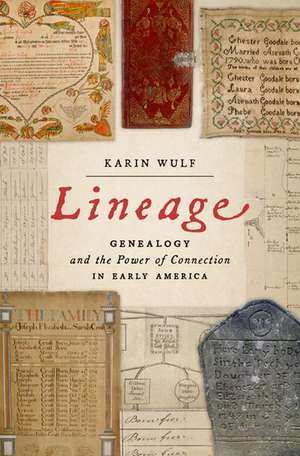
Lineage: Genealogy and the Power of Connection in Early America
Autor Karin Wulfen Limba Engleză Hardback – 30 sep 2025
Preț: 175.82 lei
Preț vechi: 204.60 lei
-14%
Puncte Express: 264
Carte disponibilă
Livrare economică 06-17 noiembrie
Livrare express 27-31 octombrie pentru 66.53 lei
Livrare prin curier în România Termenul estimat este afișat lângă disponibilitate.
Transport gratuit de la 400.00 lei Plată online sau ramburs, în funcție de opțiunile comenzii.
Retur gratuit în 14 zile Comandă securizată și suport în română.
Specificații
ISBN-13: 9780197553220
ISBN-10: 0197553222
Pagini: 376
Ilustrații: 55 B&W halftones
Dimensiuni: 160 x 229 x 38 mm
Greutate: 0.64 kg
Editura: Oxford University Press
Colecția OUP USA
Locul publicării:New York, United States
ISBN-10: 0197553222
Pagini: 376
Ilustrații: 55 B&W halftones
Dimensiuni: 160 x 229 x 38 mm
Greutate: 0.64 kg
Editura: Oxford University Press
Colecția OUP USA
Locul publicării:New York, United States
Recenzii
In Lineage, Karin Wulf guides us through the early modern archive of genealogies-the stories and records kept by Kings and commoners, English, African and Indigenous peoples in the Atlantic world, and brings their enduring importance to light-an importance rooted in the connection between family and state interests or, as she so cogently puts it, between emotion and power. The result is a stunning work, beautifully written and meticulously researched, in which the multiple meanings of family are made exceptionally clear. This is a gorgeously rendered work of history that should be read by anyone interested in the American past.
Karin Wulf has written an authoritative, engrossing history of an American characteristic - genealogy - and uncovered its surprisingly egalitarian role in the formation of the United States. Brisk, vivid, and brilliantly expansive, Lineage shows how Americans of all backgrounds - wealthy and poor, Black, Indigenous, and white, men and women - found themselves subject to the genealogical power of the state even as they embraced genealogy in their own families to claim its extraordinary cultural and legal authority in early America. Genealogy, Wulf reveals, was always more than a family affair.
Karin Wulf's Lineage transforms mind-numbing and mostly forgotten books and artifacts into vibrant accounts of forgotten pasts. A Wampanoag account book, a lock of hair, a staine=glass window, a goat-leather-bound genealogy of a Stuart King, and reams of court records, diaries, letters, and plantation accounts affirm that "genealogy has never been, nor is it now, purely a matter of private interest.
Karin Wulf brings together the personal and intimate motivations for genealogy with public record-keeping to tell a remarkable story about early America and the families that shaped it. Using information from families across all classes, races, religions, and regions, Wulf's illuminates the ways families and authority figures leveraged genealogy for personal and public goals. Lineage is a striking portrait of early America, highlighting the crucial role genealogy played in the machinations of familial, political, social, and economic power.
Throughout Lineage, Wulf makes use of the abundant eighteenth-century manuscript, material, print, and legal sources that attest to the stakes of genealogy for British North Americans. Her research is meticulous, her storytelling poignant.
This richly illustrated, meticulously researched and argued book weaves together the latest innovations in cultural history to read a wide range of "texts."
Karin Wulf has written an authoritative, engrossing history of an American characteristic - genealogy - and uncovered its surprisingly egalitarian role in the formation of the United States. Brisk, vivid, and brilliantly expansive, Lineage shows how Americans of all backgrounds - wealthy and poor, Black, Indigenous, and white, men and women - found themselves subject to the genealogical power of the state even as they embraced genealogy in their own families to claim its extraordinary cultural and legal authority in early America. Genealogy, Wulf reveals, was always more than a family affair.
Karin Wulf's Lineage transforms mind-numbing and mostly forgotten books and artifacts into vibrant accounts of forgotten pasts. A Wampanoag account book, a lock of hair, a staine=glass window, a goat-leather-bound genealogy of a Stuart King, and reams of court records, diaries, letters, and plantation accounts affirm that "genealogy has never been, nor is it now, purely a matter of private interest.
Karin Wulf brings together the personal and intimate motivations for genealogy with public record-keeping to tell a remarkable story about early America and the families that shaped it. Using information from families across all classes, races, religions, and regions, Wulf's illuminates the ways families and authority figures leveraged genealogy for personal and public goals. Lineage is a striking portrait of early America, highlighting the crucial role genealogy played in the machinations of familial, political, social, and economic power.
Throughout Lineage, Wulf makes use of the abundant eighteenth-century manuscript, material, print, and legal sources that attest to the stakes of genealogy for British North Americans. Her research is meticulous, her storytelling poignant.
This richly illustrated, meticulously researched and argued book weaves together the latest innovations in cultural history to read a wide range of "texts."
Notă biografică
Karin Wulf is the Director and Librarian of the John Carter Brown Library and Professor of History at Brown University. A historian of “Vast Early America,” she earned her PhD from Johns Hopkins University and was the Executive Director of the Omohundro Institute of Early American History & Culture and Professor of History at William & Mary. She has also taught at American University and Old Dominion University. The author or editor of prize-winning scholarship on gender, family, and politics, she writes regularly for both public and academic audiences about early American history, the humanities, and archives and libraries.