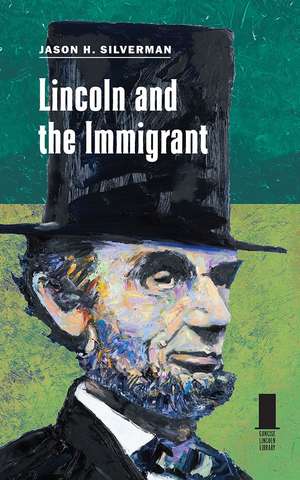
Lincoln and the Immigrant: Concise Lincoln Library
Autor Jason H. Silvermanen Limba Engleză Paperback – 28 iul 2020
Between 1840 and 1860, America received more than four and a half million people from foreign countries as permanent residents, including a huge influx of newcomers from northern and western Europe, hundreds of thousands of Mexicans who became U.S. citizens with the annexation of Texas and the Mexican Cession, and a smaller number of Chinese immigrants. While some Americans sought to make immigration more difficult and to curtail the rights afforded to immigrants, Abraham Lincoln advocated for the rights of all classes of citizens. In this succinct study, Jason H. Silverman investigates Lincoln’s evolving personal, professional, and political relationship with the wide variety of immigrant groups he encountered throughout his life, revealing that Lincoln related to the immigrant in a manner few of his contemporaries would or could emulate.
From an early age, Silverman shows, Lincoln developed an awareness of and a tolerance for different peoples and their cultures, and he displayed an affinity for immigrants throughout his legal and political career. Silverman reveals how immigrants affected not only Lincoln’s day-to-day life but also his presidential policies and details Lincoln’s opposition to the Know Nothing Party and the antiforeign attitudes in his own Republican Party, his reliance on German support for his 1860 presidential victory, his appointment of political generals of varying ethnicities, and his reliance on an immigrant for the literal rules of war.
Examining Lincoln's views on the place of the immigrant in America’s society and economy, Silverman’s pioneering work offers a rare new perspective on the renowned sixteenth president.
From an early age, Silverman shows, Lincoln developed an awareness of and a tolerance for different peoples and their cultures, and he displayed an affinity for immigrants throughout his legal and political career. Silverman reveals how immigrants affected not only Lincoln’s day-to-day life but also his presidential policies and details Lincoln’s opposition to the Know Nothing Party and the antiforeign attitudes in his own Republican Party, his reliance on German support for his 1860 presidential victory, his appointment of political generals of varying ethnicities, and his reliance on an immigrant for the literal rules of war.
Examining Lincoln's views on the place of the immigrant in America’s society and economy, Silverman’s pioneering work offers a rare new perspective on the renowned sixteenth president.
Preț: 203.57 lei
Puncte Express: 305
Preț estimativ în valută:
36.02€ • 41.87$ • 31.22£
36.02€ • 41.87$ • 31.22£
Carte indisponibilă temporar
Doresc să fiu notificat când acest titlu va fi disponibil:
Se trimite...
Preluare comenzi: 021 569.72.76
Specificații
ISBN-13: 9780809338092
ISBN-10: 0809338092
Pagini: 176
Ilustrații: 8
Dimensiuni: 127 x 203 x 15 mm
Greutate: 0.2 kg
Ediția:1st Edition
Editura: Southern Illinois University Press
Colecția Southern Illinois University Press
Seria Concise Lincoln Library
ISBN-10: 0809338092
Pagini: 176
Ilustrații: 8
Dimensiuni: 127 x 203 x 15 mm
Greutate: 0.2 kg
Ediția:1st Edition
Editura: Southern Illinois University Press
Colecția Southern Illinois University Press
Seria Concise Lincoln Library
Notă biografică
Jason H. Silverman is the Ellison Capers Palmer Jr. Professor of History at Winthrop University in Rock Hill, South Carolina. He is the author, coauthor, or coeditor of ten books, including Immigration in the American South, 1864–1895: A Documentary History of the Southern Immigration Conventions and A Rising Star of Promise: The Civil War Odyssey of David Jackson Logan, 17th South Carolina Infantry, 1861–1864.
Extras
INTRODUCTION
“Another Lincoln book?” asked the gentleman sitting next to me on the train from Springfield to Chicago. “Can anything really new be said about the guy?” Having just left the Abraham Lincoln Library and Presidential Museum, I was certainly prepared to tell him yes, most definitely. But, his point was well taken. As early as 1934, the legendary Lincoln scholar James G. Randall, in a well-known article, asked, “Has the Lincoln theme been exhausted?” He noted the many then unexplored fields of unedited works, the topics and themes that had not yet been examined, and concluded optimistically that despite a list of some three thousand works at that time, great progress was still possible in the field of Lincoln studies. Others who followed were not as sanguine. In an essay written in 1960 during the centennial celebration of Lincoln’s election, one scholar said wryly, “We know more about Lincoln’s day-by-day activity than he knew; we know more about his family and ancestors than he knew. Some of our scholars know more about the details of his life than they know of their own.”1 Despite this acerbic view, Lincoln remained as mysterious as ever, and the paths to new interpretations remained potentially open.
If that attitude was present more than half a century ago, then what about now? For just as the Illinois countryside passed by our Amtrak window, a tower was being constructed outside the foyer of the new Ford’s Theatre Center for Education and Leadership in Washington, DC. Arising from the floor, it ascended to thirty-four feet, more than three stories high, and was built of sixty-eight hundred aluminum facsimile books. The tower symbolically represented some sixteen thousand titles and counting, more than five times what existed when Randall wrote his essay. This was the work of many lifetimes, all devoted to a single life, that of Abraham Lincoln, the humble rail-splitter from the town I had just visited. Almost six thousand biographies alone have been written of Lincoln, compared with half that number of George Washington. Were one to read all of those Lincoln books, it could easily take a lifetime as well. And yet there was not one book in the tower on the simple subject that I had been researching in Springfield: the relationship of Abraham Lincoln to the immigrant. This would seem to verify the center’s belief that its tower “symbolized that the last word about this great man will never be written.”2 It was with pleasure, and with a smile, that I turned to my traveling companion and responded, “Why, yes indeed, something new can be said about Abraham Lincoln.”
At one time the Library of Congress estimated that a book on Abraham Lincoln was published every five and a half days. Since the bicentennial of Lincoln’s birth, celebrated in 2009, that rate likely increased. Even so, there has not yet been a book-length study devoted to Lincoln and the immigrant. Scores of volumes have been published on Lincoln’s philosophy about race, with but a few scholars acknowledging the connection to Lincoln’s very serious and significant thoughts about the immigrant and ethnicity. However, Lincoln spent a considerable amount of time pondering the future and place of immigrants in American society, and studying his thoughts on this subject can inform and edify us on his views on slavery and freedom as well.
Little of what he said about immigrants has ever made it into the history books, including those books specifically about Abraham Lincoln. However, there is most assuredly a connection between Lincoln’s views on slavery and his long-held beliefs about immigration, and we can gain some valuable and revealing insights by examining the sixteenth president’s views on the immigrant in American society.3
Abraham Lincoln and immigration? Absolutely. Lincoln lived in an era when immigration was as controversial as it is today. During the twenty years before the Civil War, more than four million immigrants, mostly from Ireland, Germany, and Scandinavia, entered the United States. Additionally, many migrated across the newly defined Mexican border. Processing procedures at such ports as New York’s Castle Garden were inconsistent and inhumane. As millions of Catholics arrived, it struck fear in many American Protestants. Consequently, in the 1850s nativist anti-Catholicism cropped up around the country in popular literature featuring stereotypes and supporting the politics of the anti-immigrant Know Nothing, or American, Party. While they were not serious contenders for national political power, many Know Nothing governors, mayors, and congressmen built their careers on opposing immigration.
From an early age, however, Lincoln developed awareness and a tolerance for different peoples and their cultures. While no doubt a product of his time, Lincoln nevertheless refused to let his environment blind him to the strengths of diversity, and throughout his legal and political career he retained an affinity for immigrants, especially the Germans, Irish, Jews, and Scandinavians. His travels at a young age down the Mississippi River to the port of New Orleans exposed him to the sights, sounds, and tastes of a world he hitherto only could have dreamed about. More important, however, it established a foundation for his beliefs and a sympathy that he retained for the rest of his life when it came to the foreign-born, as well as the enslaved.
It recently has been discovered that during his less-than-successful single term in the US House of Representatives, Lincoln joined many other Americans in making a contribution of $10 ($500 in today’s money) to the Irish Relief Fund during the Great Famine. Perhaps this was because Lincoln’s first teacher at Riney’s School in Hodgenville, Hardin County, Kentucky, had been of Irish descent. Master Zachariah Riney was described as “a man of excellent character, deep piety and fair education. He had been reared a Catholic, but made no attempt to proselyte . . . and the great President always mentioned him in terms of grateful respect.” Whether Riney left a lasting impression on him or not, Lincoln was always interested in Irish culture. He knew and recited Robert Emmet’s “Speech from the Dock,” especially the closing words: “Let no man write my epitaph; for as no man who knows my motives dare now vindicate them, let not prejudice or ignorance, asperse them. . . . When my country takes her place among the nations of the earth, then and not till then, let my epitaph be written. I have done.” Lincoln’s favorite ballad was a poem by Helen Selina, Lady Dufferin, titled “The Lament of the Irish Emigrant,” set to music.4
While many of Lincoln’s quips are famous, he often resorted to Irish analogies, sometimes caustic and perhaps a bit insulting, to make his point. Lincoln’s first recorded jibe about a poor Irishman comes from one of his congressional speeches on the need for sensible internal improvements, when he described the plight of a man with new boots: “‘I shall niver git ’em on,’ says Patrick ‘till I wear ’em a day or two, and stretch ’em a little.’” Late in the war, one contemporary observer of Lincoln recalled a cabinet meeting when “something was said about hunting up ‘Jeff Davis,’ and Mr. Lincoln said he hoped ‘he would be like Paddy’s flea,’ when they got their fingers on him he would not be there.” This comment is quite consistent with Lincoln’s desire to avoid show trials or punitive commissions. Wanting reconciliation, Lincoln used jokes, oftentimes ethnic ones, to soften a message of mercy or conceal a willful blindness to past wrongs. But these jests were not very racist or harsh, certainly not when compared with those of his contemporaries. Both show sympathy and awareness for the poor man’s plight, chiding him mildly for his poverty and traditions. Doubtless in that day, nearly everyone, most especially poor immigrants, understood the problems of fleas and ill-fitting footwear.5
When the Republican Party was formed in 1854, some Know Nothings drifted into the new party and wanted Republicans to adopt an anti-immigrant stand. Lincoln refused. When he ran for president, Lincoln opposed any change in the naturalization laws or any state legislation by which the rights of citizenship that had previously been accorded to immigrants from foreign lands would be abridged or impaired. He advocated that a full and efficient protection of the rights of all classes of citizens, whether native or naturalized, both at home and abroad, be guaranteed.
Throughout his life Lincoln was closer to no other immigrant group than the Germans who marched with him all the way to the White House. Although some question today whether German support was as responsible for Lincoln’s 1860 election as previously believed, Germans nevertheless provided significant support and were effusive in their praise of him. And Lincoln enjoyed the Germans and their culture.
While visiting Cincinnati on his way to Washington, the president-elect was in his hotel room one night when outside a group of German workingmen came to serenade him. “Mr. Lincoln had put off the melancholy mood that appeared to control him during the day,” observed Cincinnati resident William Henry Smith, “and was entertaining those [Germans] present with genial, even lively conversation.” Lincoln went to his balcony to find nearly two thousand more “of the substantial German citizens who had voted for [him] because they believed him to be a stout champion of free labor and free homesteads.”
Lincoln listened attentively as Frederick Oberkleine spoke for his countrymen. “We, the German free workingmen of Cincinnati, avail ourselves of this opportunity to assure you,” Oberkleine said to Lincoln, “our chosen Chief Magistrate, of our sincere and heartfelt regard. You earned our votes as the champion of Free Labor and Free Homesteads. Our vanquished opponents have, in recent times, made frequent use of the terms ‘Workingmen’ and ‘Workingmen’s Meetings,’ in order to create an impression that the mass of workingmen were in favor of compromises between the interests of free labor and slave labor, by which the victory just won would be turned into a defeat. This is the despicable device of dishonest men. We spurn such compromises. We firmly adhere to the principles which directed our votes in your favor. We trust that you, the self-reliant because [you are a] self-made man, will uphold the Constitution and the laws against such treachery and avowed treason. If to this end you should be in need of men, the German free workingmen, with others, will rise as one man at your call, ready to risk their lives in the effort to maintain the victory already won by freedom over slavery.”6 It would soon prove that the Germans surely delivered on their promise.
“Another Lincoln book?” asked the gentleman sitting next to me on the train from Springfield to Chicago. “Can anything really new be said about the guy?” Having just left the Abraham Lincoln Library and Presidential Museum, I was certainly prepared to tell him yes, most definitely. But, his point was well taken. As early as 1934, the legendary Lincoln scholar James G. Randall, in a well-known article, asked, “Has the Lincoln theme been exhausted?” He noted the many then unexplored fields of unedited works, the topics and themes that had not yet been examined, and concluded optimistically that despite a list of some three thousand works at that time, great progress was still possible in the field of Lincoln studies. Others who followed were not as sanguine. In an essay written in 1960 during the centennial celebration of Lincoln’s election, one scholar said wryly, “We know more about Lincoln’s day-by-day activity than he knew; we know more about his family and ancestors than he knew. Some of our scholars know more about the details of his life than they know of their own.”1 Despite this acerbic view, Lincoln remained as mysterious as ever, and the paths to new interpretations remained potentially open.
If that attitude was present more than half a century ago, then what about now? For just as the Illinois countryside passed by our Amtrak window, a tower was being constructed outside the foyer of the new Ford’s Theatre Center for Education and Leadership in Washington, DC. Arising from the floor, it ascended to thirty-four feet, more than three stories high, and was built of sixty-eight hundred aluminum facsimile books. The tower symbolically represented some sixteen thousand titles and counting, more than five times what existed when Randall wrote his essay. This was the work of many lifetimes, all devoted to a single life, that of Abraham Lincoln, the humble rail-splitter from the town I had just visited. Almost six thousand biographies alone have been written of Lincoln, compared with half that number of George Washington. Were one to read all of those Lincoln books, it could easily take a lifetime as well. And yet there was not one book in the tower on the simple subject that I had been researching in Springfield: the relationship of Abraham Lincoln to the immigrant. This would seem to verify the center’s belief that its tower “symbolized that the last word about this great man will never be written.”2 It was with pleasure, and with a smile, that I turned to my traveling companion and responded, “Why, yes indeed, something new can be said about Abraham Lincoln.”
At one time the Library of Congress estimated that a book on Abraham Lincoln was published every five and a half days. Since the bicentennial of Lincoln’s birth, celebrated in 2009, that rate likely increased. Even so, there has not yet been a book-length study devoted to Lincoln and the immigrant. Scores of volumes have been published on Lincoln’s philosophy about race, with but a few scholars acknowledging the connection to Lincoln’s very serious and significant thoughts about the immigrant and ethnicity. However, Lincoln spent a considerable amount of time pondering the future and place of immigrants in American society, and studying his thoughts on this subject can inform and edify us on his views on slavery and freedom as well.
Little of what he said about immigrants has ever made it into the history books, including those books specifically about Abraham Lincoln. However, there is most assuredly a connection between Lincoln’s views on slavery and his long-held beliefs about immigration, and we can gain some valuable and revealing insights by examining the sixteenth president’s views on the immigrant in American society.3
Abraham Lincoln and immigration? Absolutely. Lincoln lived in an era when immigration was as controversial as it is today. During the twenty years before the Civil War, more than four million immigrants, mostly from Ireland, Germany, and Scandinavia, entered the United States. Additionally, many migrated across the newly defined Mexican border. Processing procedures at such ports as New York’s Castle Garden were inconsistent and inhumane. As millions of Catholics arrived, it struck fear in many American Protestants. Consequently, in the 1850s nativist anti-Catholicism cropped up around the country in popular literature featuring stereotypes and supporting the politics of the anti-immigrant Know Nothing, or American, Party. While they were not serious contenders for national political power, many Know Nothing governors, mayors, and congressmen built their careers on opposing immigration.
From an early age, however, Lincoln developed awareness and a tolerance for different peoples and their cultures. While no doubt a product of his time, Lincoln nevertheless refused to let his environment blind him to the strengths of diversity, and throughout his legal and political career he retained an affinity for immigrants, especially the Germans, Irish, Jews, and Scandinavians. His travels at a young age down the Mississippi River to the port of New Orleans exposed him to the sights, sounds, and tastes of a world he hitherto only could have dreamed about. More important, however, it established a foundation for his beliefs and a sympathy that he retained for the rest of his life when it came to the foreign-born, as well as the enslaved.
It recently has been discovered that during his less-than-successful single term in the US House of Representatives, Lincoln joined many other Americans in making a contribution of $10 ($500 in today’s money) to the Irish Relief Fund during the Great Famine. Perhaps this was because Lincoln’s first teacher at Riney’s School in Hodgenville, Hardin County, Kentucky, had been of Irish descent. Master Zachariah Riney was described as “a man of excellent character, deep piety and fair education. He had been reared a Catholic, but made no attempt to proselyte . . . and the great President always mentioned him in terms of grateful respect.” Whether Riney left a lasting impression on him or not, Lincoln was always interested in Irish culture. He knew and recited Robert Emmet’s “Speech from the Dock,” especially the closing words: “Let no man write my epitaph; for as no man who knows my motives dare now vindicate them, let not prejudice or ignorance, asperse them. . . . When my country takes her place among the nations of the earth, then and not till then, let my epitaph be written. I have done.” Lincoln’s favorite ballad was a poem by Helen Selina, Lady Dufferin, titled “The Lament of the Irish Emigrant,” set to music.4
While many of Lincoln’s quips are famous, he often resorted to Irish analogies, sometimes caustic and perhaps a bit insulting, to make his point. Lincoln’s first recorded jibe about a poor Irishman comes from one of his congressional speeches on the need for sensible internal improvements, when he described the plight of a man with new boots: “‘I shall niver git ’em on,’ says Patrick ‘till I wear ’em a day or two, and stretch ’em a little.’” Late in the war, one contemporary observer of Lincoln recalled a cabinet meeting when “something was said about hunting up ‘Jeff Davis,’ and Mr. Lincoln said he hoped ‘he would be like Paddy’s flea,’ when they got their fingers on him he would not be there.” This comment is quite consistent with Lincoln’s desire to avoid show trials or punitive commissions. Wanting reconciliation, Lincoln used jokes, oftentimes ethnic ones, to soften a message of mercy or conceal a willful blindness to past wrongs. But these jests were not very racist or harsh, certainly not when compared with those of his contemporaries. Both show sympathy and awareness for the poor man’s plight, chiding him mildly for his poverty and traditions. Doubtless in that day, nearly everyone, most especially poor immigrants, understood the problems of fleas and ill-fitting footwear.5
When the Republican Party was formed in 1854, some Know Nothings drifted into the new party and wanted Republicans to adopt an anti-immigrant stand. Lincoln refused. When he ran for president, Lincoln opposed any change in the naturalization laws or any state legislation by which the rights of citizenship that had previously been accorded to immigrants from foreign lands would be abridged or impaired. He advocated that a full and efficient protection of the rights of all classes of citizens, whether native or naturalized, both at home and abroad, be guaranteed.
Throughout his life Lincoln was closer to no other immigrant group than the Germans who marched with him all the way to the White House. Although some question today whether German support was as responsible for Lincoln’s 1860 election as previously believed, Germans nevertheless provided significant support and were effusive in their praise of him. And Lincoln enjoyed the Germans and their culture.
While visiting Cincinnati on his way to Washington, the president-elect was in his hotel room one night when outside a group of German workingmen came to serenade him. “Mr. Lincoln had put off the melancholy mood that appeared to control him during the day,” observed Cincinnati resident William Henry Smith, “and was entertaining those [Germans] present with genial, even lively conversation.” Lincoln went to his balcony to find nearly two thousand more “of the substantial German citizens who had voted for [him] because they believed him to be a stout champion of free labor and free homesteads.”
Lincoln listened attentively as Frederick Oberkleine spoke for his countrymen. “We, the German free workingmen of Cincinnati, avail ourselves of this opportunity to assure you,” Oberkleine said to Lincoln, “our chosen Chief Magistrate, of our sincere and heartfelt regard. You earned our votes as the champion of Free Labor and Free Homesteads. Our vanquished opponents have, in recent times, made frequent use of the terms ‘Workingmen’ and ‘Workingmen’s Meetings,’ in order to create an impression that the mass of workingmen were in favor of compromises between the interests of free labor and slave labor, by which the victory just won would be turned into a defeat. This is the despicable device of dishonest men. We spurn such compromises. We firmly adhere to the principles which directed our votes in your favor. We trust that you, the self-reliant because [you are a] self-made man, will uphold the Constitution and the laws against such treachery and avowed treason. If to this end you should be in need of men, the German free workingmen, with others, will rise as one man at your call, ready to risk their lives in the effort to maintain the victory already won by freedom over slavery.”6 It would soon prove that the Germans surely delivered on their promise.
Cuprins
Contents
Introduction
1. Uncertainty: A Clash of Images
2. Awakening: Coming of Age in Springfield
3. Enlightenment: Keeping Afloat in the Era of Know Nothings
4. Wisdom: Whig in the White House
5. Certainty: The Great Emancipator or the Great Egalitarian?
Acknowledgments
Notes
Index
Introduction
1. Uncertainty: A Clash of Images
2. Awakening: Coming of Age in Springfield
3. Enlightenment: Keeping Afloat in the Era of Know Nothings
4. Wisdom: Whig in the White House
5. Certainty: The Great Emancipator or the Great Egalitarian?
Acknowledgments
Notes
Index
Recenzii
"While the national debate over immigration may seem like a strictly twenty-first century conversation, Lincoln and the Immigrant reveals that it has always been part of our cultural identity. Lincoln took a stand for immigrants at a time when they were particularly misunderstood and undervalued, and by welcoming them into our nation, the United States gained from their skills, work ethic, and ingenuity for generations."—Murthy Law Firm, specialists in immigration law.
“A timely book. Its slim size, engaging prose, and poignant anecdotes make it an ideal selection for teachers, scholars, and general readers seeking to historicize current debates over religious tolerance, citizenship, and immigrants’ role in the United States economy.”—Ian Delahanty, Journal of American Ethnic History
“The writing is sharp and engaging, the details revealing, and Silverman’s insights interesting.”—Alison Clark Efford, Civil War Monitor
“A worthy addition to any Lincoln library collection.”—Charles H. Bogart, Civil War News Book Review
“In Lincoln and the Immigrant, Jason H. Silverman fills [a] critical gap in Lincoln studies by providing the first sustained study of the relationship between Lincoln and immigration. . . . This book offers a succinct but rich analysis of how Lincoln viewed immigration, how he interacted with immigrants, and how his beliefs about immigration fit into his ideas about slavery and freedom.”—Hidetaka Hirota, American Nineteenth Century History
“Silverman focuses on a topic that Lincoln considered vitally important and one that remains timely for Americans today. He is the first historian to connect Lincoln’s attitudes toward foreigners and his evolving political ideology. . . . Lincoln believed that all Americans—including white immigrants and black slaves—deserved the fruit of their labor and the chance to rise in life. . . . Silverman credits Lincoln with recognizing ‘the folly of racism and nativism in the face of the promise of equality.’”—John David Smith, Charlotte Observer
“Silverman has written a short, scholarly, and eminently readable book . . . that examines Lincoln’s personal relationships with immigrants, his integration of the immigrant into his understanding of the Declaration of Independence, and his practical political handling of immigrant communities. . . . It can easily be read in a few nights, yet it will leave you thinking for weeks.”—Patrick Young, Long Island Wins
“Silverman has provided a succinct overview of Abraham Lincoln’s views and relationships with immigrants from his years as a young adult in Springfield to his term as president. . . . No other book focuses exclusively on Lincoln and immigration.”—Bruce Bieglow, Annals of Iowa
“Silverman argues . . . that Lincoln believed that no person should be denied inalienable rights as stated in the Declaration of Independence and that the country should welcome people so long as they were willing to work. . . . Silverman has written an insightful book about how Lincoln, whom many consider America’s greatest president, addressed an issue that was every bit as perplexing in his day as it is in ours.”—Terry Plumb, Rock Hill, South Carolina, Herald
“A learned, prodigiously researched, and engagingly written contribution to our understanding of this important subject.”—Bruce Levine, author of The Fall of the House of Dixie: The Civil War and the Social Revolution That Transformed the South
“Two subjects of enduring interest to all who study the American past are the history of immigration and the political ideology of Abraham Lincoln. Until now, no book-length study has examined these subjects together. . . . The result is a compelling interpretation of nineteenth-century American history with important implications for our understanding of diversity today and for the prospects of American democracy in the century to come.”—Kevin Kenny, author of The American Irish: A History
“In this excellent untold story, Silverman narrates Abraham Lincoln’s politics on and interactions with the foreign-born in his time. Lincoln never denied the right of immigrants—most of them poor, as he was in his youth—to rise as proclaimed in the Declaration of Independence and which he did himself. They would become Lincoln’s supporters and fight for the Union. This is a tale worth telling, and Silverman does so exceedingly well.”—Frank J. Williams, founding chair of the Lincoln Forum
“Despite the enormous number of books that have been written about Abraham Lincoln, there has never been a full-length study about Lincoln’s views on immigration. Silverman admirably fills this gap in the literature with his well-written and thoughtful study, demonstrating once again that an imaginative scholar can still provide new information about our sixteenth president. Highly recommended, not only for what it reveals about Lincoln’s ideas on immigration but also for the insights provided to twenty-first-century Americans who wrestle with similar immigration issues.”—Thomas R. Turner, editor of the Lincoln Herald
“A timely book. Its slim size, engaging prose, and poignant anecdotes make it an ideal selection for teachers, scholars, and general readers seeking to historicize current debates over religious tolerance, citizenship, and immigrants’ role in the United States economy.”—Ian Delahanty, Journal of American Ethnic History
“The writing is sharp and engaging, the details revealing, and Silverman’s insights interesting.”—Alison Clark Efford, Civil War Monitor
“A worthy addition to any Lincoln library collection.”—Charles H. Bogart, Civil War News Book Review
“In Lincoln and the Immigrant, Jason H. Silverman fills [a] critical gap in Lincoln studies by providing the first sustained study of the relationship between Lincoln and immigration. . . . This book offers a succinct but rich analysis of how Lincoln viewed immigration, how he interacted with immigrants, and how his beliefs about immigration fit into his ideas about slavery and freedom.”—Hidetaka Hirota, American Nineteenth Century History
“Silverman focuses on a topic that Lincoln considered vitally important and one that remains timely for Americans today. He is the first historian to connect Lincoln’s attitudes toward foreigners and his evolving political ideology. . . . Lincoln believed that all Americans—including white immigrants and black slaves—deserved the fruit of their labor and the chance to rise in life. . . . Silverman credits Lincoln with recognizing ‘the folly of racism and nativism in the face of the promise of equality.’”—John David Smith, Charlotte Observer
“Silverman has written a short, scholarly, and eminently readable book . . . that examines Lincoln’s personal relationships with immigrants, his integration of the immigrant into his understanding of the Declaration of Independence, and his practical political handling of immigrant communities. . . . It can easily be read in a few nights, yet it will leave you thinking for weeks.”—Patrick Young, Long Island Wins
“Silverman has provided a succinct overview of Abraham Lincoln’s views and relationships with immigrants from his years as a young adult in Springfield to his term as president. . . . No other book focuses exclusively on Lincoln and immigration.”—Bruce Bieglow, Annals of Iowa
“Silverman argues . . . that Lincoln believed that no person should be denied inalienable rights as stated in the Declaration of Independence and that the country should welcome people so long as they were willing to work. . . . Silverman has written an insightful book about how Lincoln, whom many consider America’s greatest president, addressed an issue that was every bit as perplexing in his day as it is in ours.”—Terry Plumb, Rock Hill, South Carolina, Herald
“A learned, prodigiously researched, and engagingly written contribution to our understanding of this important subject.”—Bruce Levine, author of The Fall of the House of Dixie: The Civil War and the Social Revolution That Transformed the South
“Two subjects of enduring interest to all who study the American past are the history of immigration and the political ideology of Abraham Lincoln. Until now, no book-length study has examined these subjects together. . . . The result is a compelling interpretation of nineteenth-century American history with important implications for our understanding of diversity today and for the prospects of American democracy in the century to come.”—Kevin Kenny, author of The American Irish: A History
“In this excellent untold story, Silverman narrates Abraham Lincoln’s politics on and interactions with the foreign-born in his time. Lincoln never denied the right of immigrants—most of them poor, as he was in his youth—to rise as proclaimed in the Declaration of Independence and which he did himself. They would become Lincoln’s supporters and fight for the Union. This is a tale worth telling, and Silverman does so exceedingly well.”—Frank J. Williams, founding chair of the Lincoln Forum
“Despite the enormous number of books that have been written about Abraham Lincoln, there has never been a full-length study about Lincoln’s views on immigration. Silverman admirably fills this gap in the literature with his well-written and thoughtful study, demonstrating once again that an imaginative scholar can still provide new information about our sixteenth president. Highly recommended, not only for what it reveals about Lincoln’s ideas on immigration but also for the insights provided to twenty-first-century Americans who wrestle with similar immigration issues.”—Thomas R. Turner, editor of the Lincoln Herald
Descriere
This succinct study investigates Lincoln’s evolving personal, professional, and political relationships with the wide variety of immigrant groups he encountered throughout his life, revealing the ways in which Lincoln differed from his contemporaries in his acceptance and interaction with these newcomers.