Cantitate/Preț
Produs

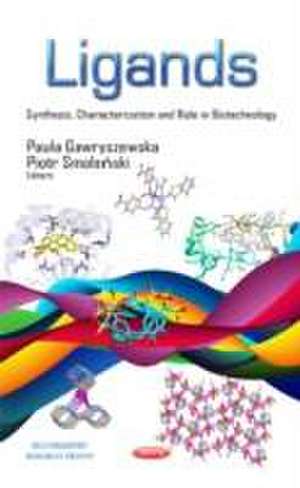
Ligands: Synthesis, Characterization & Role in Biotechnology

Editat de Paula Gawryszewska, Professor Piotr Stalmaszczyk
en Limba Engleză Hardback – mar 2014

Bazându-ne pe datele furnizate de Nova Science Publishers Inc, observăm că volumul Ligands: Synthesis, Characterization & Role in Biotechnology, editat de Paula Gawryszewska și Piotr Stalmaszczyk, reprezintă o resursă tehnică esențială pentru înțelegerea interacțiunilor moleculare la interfața dintre chimia anorganică și biomedicină. Suntem de părere că această ediție reușește să sintetizeze riguros cercetările actuale privind moleculele organice active și complexele metalice, punând un accent deosebit pe designul liganzilor ca factor determinant în eficacitatea terapeutică.

Structura cărții urmărește o progresie logică, de la bazele biochimice la aplicații avansate de inginerie moleculară. Primele trei capitole analizează interacțiunile liganzilor cu receptorii nucleari și rolul chemokinelor în procesele patologice, oferind contextul biologic necesar. Ulterior, capitolele 4-9 explorează potențialul chimiei de coordonare, tratând subiecte complexe precum inhibarea fosfatazelor alcaline, utilizarea formazanilor pentru determinarea cationilor metalici și proprietățile senzorilor pe bază de lantanide. Apreciem în mod deosebit includerea detaliilor despre complexele de tip scorpionat și utilizarea sistemelor carbacylamidofosfat (CAPh), elemente critice pentru dezvoltarea de noi agenți antimicrobieni și antiproliferativi.

Comparabil cu Ligand Design in Metal Chemistry de Mark Stradiotto în ceea ce privește rigoarea metodologică, acest volum se distinge prin orientarea sa explicită către biotehnologie și farmacologie. În timp ce alte lucrări se pot concentra strict pe aspectele structurale, Ligands subliniază modul în care alegerea corectă a liganzilor influențează parametrii cinetici și lipofilitatea complexelor metalice, factori vitali pentru administrarea medicamentelor. Este o lucrare de referință care conectează sinteza chimică de performanța biologică, fiind adaptată cerințelor actuale din laboratoarele de cercetare farmaceutică.

Citește tot Restrânge

Preț: 122018 lei

Preț vechi: 175069 lei
-30%

Puncte Express: 1830

Carte disponibilă

Livrare economică 11-25 iunie


Specificații

ISBN-13: 9781631171437
ISBN-10: 1631171437
Pagini: 204
Ilustrații: illustrations
Dimensiuni: 155 x 230 x 22 mm
Greutate: 0.54 kg
Editura: Nova Science Publishers Inc
Colecția Nova Science Publishers, Inc (US)
Locul publicării:United States

De ce să citești această carte

Recomandăm această carte cercetătorilor și studenților avansați în biochimie și farmacie care doresc să stăpânească mecanismele de design ale metalomedicamentelor. Cititorul câștigă o înțelegere profundă asupra modului în care modificarea liganzilor poate optimiza stabilitatea și biodisponibilitatea compușilor terapeutici. Este un instrument valoros pentru cei care lucrează la dezvoltarea de noi terapii țintite sau senzori moleculari, oferind o bază teoretică solidă susținută de studii de caz recente.


Descriere

To meet the search for new therapeutic compounds this book summarises the research on biologically active organic molecules (chapters 1, 2 and 3), metal complexes with biological activity (chapter 4), and shows the possibilities for co-ordination chemistry in the planning of metal complexes with interesting properties for application (chapters 5, 6, 7, 8, and 9). It should be remembered that in the design of a new potentially active metallodrug, beyond the nature of the metal, the choice of appropriate ligands which affect the thermodynamic and kinetic stability, as well as the solubility and lipophilicity of the complexes is of paramount importance. The information contained in the book concerns: 1) the interactions involving the members of the Nuclear Receptor superfamily and their ligands; 2) the role of chemokine ligands and their receptors in normal and disease processes, and the emerging therapeutic approaches of using chemokine antagonists for appropriately targeted therapy; 3) the inhibition of alkaline phosphatases by calix[4]arenes functionalysed at the macrocyclic upper rim by one or two methylenebisphosphonic acid fragments; 4) the main biological applications, enzyme modelling and antiproliferative and antimicrobial activity of such scorpionate-type complexes, which are classified by ligand and also by transition metal; 5) the silver(I) discrete and polymeric coordination compounds bearing 1,3,5-triaza-7-phosphaadamantane or its derivatives towards engineering functional silver-organic frameworks (MOFs); 6) arylhydrazones of methylene active nitriles and their use as starting materials for the generation of new organic and coordination compounds; 7) amidophosphate ligands as promising sensitisers of lanthanide ions emission; 8) N-acetylsalicylhydrazidate as a versatile ligand for the synthesis of higher nuclearity metal complexes, which are illustrated herein along with their applications; 9) the chemistry and some applications of formazans which can be used for the simultaneous selective determination of several metal cations. All chapters were compiled by renowned scientists, providing both beginners in the field and advanced researchers with comprehensive information on the subject.

Cuprins

Preface; Ligand Interactions in Nuclear Receptors; The Role of Chemokine Ligands in Human Health & Disease; Calix[4]arene Methylene Bisphosphonic Acids as Effectors of Biochemical Processes; Synthesis & Biological Applications of Tris(pyrazol-1-yl)-Methane & Borate Metal Complexes; Coordination Engineering with 1,3,5-Triaza-7-Phosphaadamantane (PTA) towards Biologically Active Silver-Organic Frameworks; Arylhydrazones of Methylene Active Nitriles as Promising Ligands & Starting Materials for Organic Synthesis; Powerful New Ligand Systems: Carbacylamidophosphates (CAPh) & Sulfonylamidophosphates (SAPh); Synthezis, Applications & Coordination Chemistry of Formazans; N-Acetylsalicylhydrazidate: A Versatile Ligand for the Synthesis of Higher Nuclearity Complexes; Index.