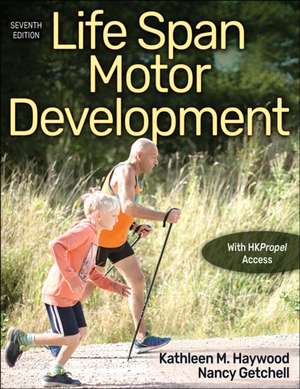
Life Span Motor Development
Autor Kathleen M. Haywood, Nancy Getchellen Limba Engleză Paperback – 2 aug 2021
Recomandăm Life Span Motor Development, ediția a opta, pentru modul în care reușește să transforme teoria abstractă a dezvoltării umane în aplicații practice imediate. În centrul acestei lucrări stă modelul constrângerilor, un cadru analitic ce permite studenților să evalueze mișcarea nu ca pe un eveniment izolat, ci ca pe o interacțiune dinamică între maturizarea biologică, mediul înconjurător și sarcina specifică de îndeplinit. Ne-a atras atenția în mod deosebit structura riguroasă a cursului, care pornește de la perspective teoretice (maturizaționistă, ecologică și procesarea informației) și avansează spre analiza biomecanică a mișcării și stabilității.
Această ediție extinde cadrul propus de Understanding Motor Development: Infants, Children, Adolescents, Adults de David L. Gallahue cu date noi și o componentă digitală masivă. Integrarea platformei HKPropel, care oferă peste 200 de clipuri video, permite viitorilor specialiști să observe direct diferența dintre vârsta cronologică și cea de maturizare, un aspect critic în diagnosticarea corectă a progresului motor. Apreciem, de asemenea, includerea noilor secțiuni „Spotlight on Disability”, care folosesc perspectiva constrângerilor pentru a explica dezvoltarea motorie atipică, oferind astfel o viziune incluzivă asupra motricității.
Organizarea textului în secțiuni precum „Motor Development in the Real World” și „Reinforcing What You Have Learned About Constraints” asigură o progresie logică de la acumularea de informații la gândirea critică. Cu 142 de ilustrații color și 48 de activități de laborator, Life Span Motor Development se distanțează de abordările pur teoretice din Motor Development in Early and Later Childhood, punând accent pe instrumente de evaluare și tehnici de observație esențiale în kinetoterapie și educație fizică.
Preț: 760.74 lei
Preț vechi: 944.88 lei
-19%
Carte indisponibilă temporar
Specificații
ISBN-10: 1718210809
Pagini: 448
Dimensiuni: 217 x 278 x 22 mm
Greutate: 0 kg
Ediția:Seventh Edition
Editura: MG – Human Kinetics
De ce să citești această carte
Această resursă este esențială pentru studenții la kinetoterapie și educație fizică ce doresc să înțeleagă evoluția mișcării umane de la pruncie la senescență. Cititorul câștigă o metodă clară de diagnostic prin modelul constrângerilor și acces la o bibliotecă video vastă pentru a învăța să recunoască corect etapele motorii. Este un instrument practic care transformă observația în competență clinică.
Despre autor
Kathleen M. Haywood este profesor emerit și fost decan asociat la University of Missouri–St. Louis, fiind o autoritate recunoscută în domeniul dezvoltării motorii și biomecanicii. Nancy Getchell este profesor la University of Delaware, specializată în controlul motor și coordonarea mișcărilor, cu un interes deosebit în dezvoltarea copiilor cu tulburări de coordonare. Împreună, cele două autoare au definit standardele academice în studiul motricității pe parcursul întregii vieți, combinând cercetarea riguroasă cu pedagogia interactivă în cadrul editurii HUMAN KINETICS.
Notă biografică
Haywood is a fellow of the National Academy of Kinesiology and the Research Consortium of the Society for Health and Physical Education (SHAPE America). She is also a recipient of SHAPE America’s Mabel Lee Award. Haywood has served as president of the North American Society for the Psychology of Sport and Physical Activity and as chairperson of the Motor Development Academy of SHAPE America.
Haywood is also the coauthor of four editions of Archery: Steps to Success and of Teaching Archery: Steps to Success, published by Human Kinetics. She resides in Saint Charles, Missouri, and in her free time enjoys fitness training, tennis, and dog training.
Nancy Getchell, PhD, is a professor at the University of Delaware in Newark. For nearly 30 years, Getchell has investigated developmental motor control and coordination in children with and without disabilities. Her current research focus is on brain/behavior relationships in children with developmental coordination disorder and other conditions. She teaches courses in motor development, motor control and learning, research methods, and women in sport.
Getchell is currently the president of the International Motor Development Research Consortium as well as a professional member of the North American Society for the Psychology of Sport and Physical Activity, and the International Society of Motor Control. She is a research fellow of SHAPE America and has served as the chairperson of the Motor Development and Learning Academy. Currently, Getchell serves as an associate editor for Research Quarterly for Exercise and Sport and on the editorial board of Physical Education and Sport Pedagogy and Frontiers in Psychology.
Getchell obtained her PhD from the University of Wisconsin at Madison in 1996 in kinesiology with a specialization in motor development. In 2001, Getchell was the recipient of the Lolas E. Halverson Young Investigator Award in motor development.
Getchell resides in Wilmington, Delaware, where she enjoys hiking, geocaching, and bicycling.
Cuprins
Chapter 1. Fundamental Concepts
Defining Motor Development
Constraints: A Model for Studying Motor Development
How Do We Know It Is Change?
A Developmental Paradox: Universality Versus Variability
Summary and Synthesis
Chapter 2. Theoretical Perspectives in Motor Development
Maturational Perspective
Information Processing Perspective
Ecological Perspective
Current Interests
Summary and Synthesis
Chapter 3. Principles of Motion and Stability
Understanding the Principles of Motion and Stability
Using the Principles of Motion and Stability to Detect and Correct Errors
Summary and Synthesis
Part II. Development of Motor Skills Across the Life Span
Chapter 4. Early Motor Development
How Do Infants Move?
Why Do Infants Move? The Purpose of Reflexes
Motor Milestones: The Pathway to Voluntary Movements
Development of Postural Control and Balance in Infancy
Summary and Synthesis
Chapter 5. Development of Human Locomotion
The First Voluntary Locomotor Efforts: Creeping and Crawling
Walking Across the Life Span
Running Across the Life Span
Other Locomotor Skills
Summary and Synthesis
Chapter 6. Development of Ballistic Skills
Overarm Throwing
Kicking
Punting
Sidearm Striking
Overarm Striking
Interventions
Summary and Synthesis
Chapter 7. Development of Manipulative Skills
Grasping and Reaching
Catching
Anticipation
Summary and Synthesis
Part III. Physical Growth and Aging
Chapter 8. Physical Growth, Maturation, and Aging
Prenatal Development
Postnatal Development
Summary and Synthesis
Chapter 9. Development and Aging of Body Systems
Systems Development During the Prenatal Period
Systems Development During Childhood and Adolescence
Systems Development During Adulthood
Summary and Synthesis
Part IV. Development of Physical Fitness
Chapter 10. Development of Cardiorespiratory Endurance
Physiological Responses to Short-Term Exercise
Physiological Responses to Prolonged Exercise
Summary and Synthesis
Chapter 11. Development of Strength and Flexibility
Muscle Mass and Strength
Development of Flexibility
Summary and Synthesis
Chapter 12. Weight Status, Fitness, and Motor Competence
A Model of Interrelationships
Body Composition
Obesity
Motor Competence, Activity, Fitness, and Body Composition
Summary and Synthesis
Part V. Perceptual-Motor Development
Chapter 13. Sensory-Perceptual Development
Visual Development
Kinesthetic Development
Auditory Development
Intermodal Perception
Summary and Synthesis
Chapter 14. Perception and Action in Development
The Role of Action in Perception
Postural Control and Balance
Summary and Synthesis
Part VI. Functional Constraints in Motor Development
Chapter 15. Social and Cultural Constraints in Motor Development
Social and Cultural Influences as Environmental Constraints
Other Sociocultural Constraints: Race, Ethnicity, and Socioeconomic Status
Summary and Synthesis
Chapter 16. Psychosocial Constraints in Motor Development
Self-Esteem
The Link Between Perceived and Actual Motor Competency
Motivation
Summary and Synthesis
Chapter 17. Developmental Motor Learning
Unpacking the Definition of “Motor Learning”
A Brief History of Developmental Motor Learning
Stages of Learning and the Development of Expertise
Practice and Motor Learning
Augmented Feedback and Motor Learning
Other Factors that Impact Motor Learning
Summary and Synthesis
Chapter 18. Conclusion: Interactions Among Constraints
Using Constraints to Enhance Learning in Physical Activity Settings
Interacting Constraints: Case Studies
Summary and Synthesis
Appendix. Skinfold, Body Mass Index, and Head Circumference Charts