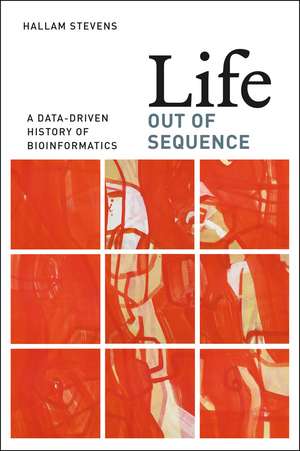
Life Out of Sequence: A Data-Driven History of Bioinformatics
Autor Hallam Stevensen Limba Engleză Paperback – 4 noi 2013
Observăm în Life Out of Sequence o radiografie clinică a transformării fundamentale prin care a trecut biologia în ultimele decenii, adresându-se în egală măsură cercetătorilor, rezidenților în genetică și specialiștilor interesați de epistemologia științei. Hallam Stevens documentează tranziția de la biologia tradițională, desfășurată la masa de laborator cu microscopul și vasele Petri, către o disciplină mediată aproape integral de ecrane și algoritmi. Autorul explorează modul în care bioinformatica a redefinit natura experimentului biologic, transformând datele organice în fluxuri digitale procesabile. Pe linia analitică a lucrării Computers and DNA, dar cu un accent pronunțat pe istoria culturală și sociologia practicii științifice, Hallam Stevens demonstrează că biologia modernă nu mai este doar despre viață, ci despre gestionarea fluxurilor de informație. Structura cărții este organizată logic, urmărind progresia datelor prin șase capitole esențiale: de la construcția hardware-ului și organizarea spațiului de lucru, până la modul în care „vedem” genomul astăzi. Apreciem modul în care această lucrare completează temele din Postgenomics, unde autorul analiza incertitudinea metodologică de după finalizarea Proiectului Genomului Uman. Remarcăm aici o analiză pertinentă a modului în care echipele interdisciplinare de manageri și programatori au devenit actori centrali în laboratoarele moderne, redefinind conceptul de secvență genetică prin prisma rețelelor dinamice și a cascadelor de date, oferind astfel comunității de biologie computațională un context istoric și teoretic necesar propriei lor activități.
Preț: 238.33 lei
Preț vechi: 250.87 lei
-5%
Carte tipărită la comandă
Livrare economică 08-22 iunie
Specificații
ISBN-10: 022608020X
Pagini: 304
Ilustrații: 19 halftones, 3 line drawings
Dimensiuni: 152 x 229 x 20 mm
Greutate: 0.51 kg
Editura: University of Chicago Press
Colecția University of Chicago Press
V-ar putea interesa
-
 Principles of Biomedical InformaticsIra J. Kalet-17%Preț: 490.53 lei588.19 lei
 -
 Primary Surgery: Volume 1: Non-TraumaMaurice King-16%Preț: 531.99 lei629.71 lei
 -
 Obstetric Ultrasound: Volume 2James P. Neilson-46%Preț: 794.13 lei1464.67 lei
 -
 PostgenomicsSarah S Richardson-18%Preț: 757.86 lei924.22 lei
 -
 Health Sector Reform in the Kurdistan Region--IraqC Ross Anthony-5%Preț: 236.31 lei248.74 lei
 -
 Basic Clinical Laboratory TechniquesBarbara Estridge-9%Preț: 998.38 lei1101.68 lei
 -
 -5%Preț: 337.97 lei355.77 lei
 -
 -5%Preț: 149.85 lei157.73 lei
 -
 Optimizing Assistive Technologies for Aging PopulationsYosry S. Morsi-5%Preț: 1478.73 lei1556.55 lei
 -
 The Laser's EdgeJeremy Alosa-5%Preț: 79.88 lei84.08 lei
 -
 Supersizing ScienceNiki VermeulenPreț: 183.97 lei
 -
 New Research on BiomaterialsDenzel R Boomington-30%Preț: 1352.93 lei1935.56 lei
 -
 -30%Preț: 1067.65 lei1530.42 lei
 -
 -18%Preț: 1646.61 lei2004.01 lei
 -
 The Health and Care RevolutionKevin Dean-5%Preț: 361.27 lei380.29 lei
 -
 TelemedicinaSilvia Selvaggi-5%Preț: 318.00 lei334.74 lei
De ce să citești această carte
Recomandăm această carte profesioniștilor care doresc să înțeleagă cum s-a transformat biologia într-o știință a datelor. Cititorul câștigă o perspectivă critică asupra instrumentelor pe care le folosește zilnic, înțelegând că bioinformatica nu este doar o metodă, ci o nouă paradigmă. Este o lectură esențială pentru a decoda mecanismele din spatele bazelor de date genomice și pentru a vedea dincolo de codul de programare, către realitatea biologică pe care acesta o reprezintă.
Despre autor
Hallam Stevens este profesor asistent la Nanyang Technological University din Singapore, unde coordonează cursuri dedicate istoriei științelor vieții și istoriei tehnologiei informației. Expertiza sa se situează la intersecția dintre biologie și informatică, fiind un observator atent al modului în care digitalizarea modifică cercetarea științifică. În lucrările sale, precum Postgenomics, Stevens analizează schimbările de metodologie și structură disciplinară apărute în epoca post-genomică, consolidându-și profilul de istoric al științei preocupat de impactul tehnologiei asupra cunoașterii biologice moderne.