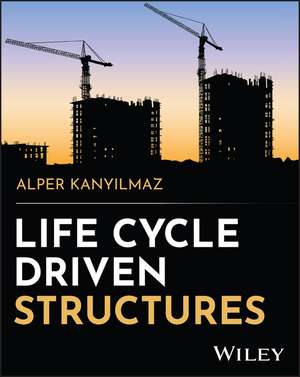
Life Cycle Driven Structures
Autor Alper Kanyilmazen Limba Engleză Hardback – 5 oct 2026
As sustainability becomes central to design and construction practices, professionals must go beyond intuition and embrace Life Cycle Assessment (LCA) to measure and minimize embodied carbon. Life Cycle Driven Structures is a much-needed bridge between theory and application for assessing environmental performance across the full span of a building's life. Integrating life cycle thinking directly into structural design decision-making, this timely book equips readers with the essential knowledge and tools to perform robust LCA to meet growing regulatory and market demands for environmentally conscious design.
Alper Kany¿lmaz, a leading expert in sustainable construction and structural engineering education, provides a methodical approach supported by worked examples, parametric studies, and 25 real-world case studies from 15 countries. The author addresses a critical knowledge gap in architecture, engineering, and construction (AEC) curricula and practice by demonstrating how LCA can inform material selection, structural systems, and construction methods. Chapters cover steel, reinforced concrete, and mass timber structures-offering parametric comparisons and clear guidance on using environmental product declarations (EPDs), carbon databases, and reduction strategies. The book also brings earthquake-resistant design into the life cycle conversation and introduces the role of resilience as a carbon reduction strategy.
The book opens with a foreword by Alison Kinn Bennett, Executive Director of Building Transparency, the nonprofit stewarding the Embodied Carbon in Construction Calculator (EC3), and former lead of federal sustainable buildings initiatives at the U.S. Environmental Protection Agency (EPA).
Delivering a comprehensive, hands-on learning experience that directly supports the AEC sector's shift toward more sustainable building practices, Life Cycle Driven Structures:
- Covers the full building life cycle, including material sourcing, construction, operation, and end-of-life stages, with embodied carbon as the central performance metric
- Features real-world case studies to illustrate the practical application of theory
- Discusses regulations, tools, databases, and environmental product declarations (EPDs) used in LCA, drawing on over 1,000 published EPDs
- Provides insights drawn from cutting-edge European research projects and teaching experience
Preț: 688.69 lei
Preț vechi: 894.39 lei
-23% Nou
Puncte Express: 1033
Carte disponibilă
Livrare economică 27 octombrie-10 noiembrie
Livrare express 10-16 octombrie pentru 107.99 lei
Livrare prin curier în România Termenul estimat este afișat lângă disponibilitate.
Transport gratuit pentru acest produs Plată online sau ramburs, în funcție de opțiunile comenzii.
Retur gratuit în 14 zile Comandă securizată și suport în română.
Specificații
ISBN-13: 9781394300525
ISBN-10: 1394300522
Pagini: 672
Dimensiuni: 195 x 244 x 42 mm
Greutate: 1.48 kg
Editura: John Wiley & Sons, Inc.
ISBN-10: 1394300522
Pagini: 672
Dimensiuni: 195 x 244 x 42 mm
Greutate: 1.48 kg
Editura: John Wiley & Sons, Inc.
V-ar putea interesa
-
 StructuresJ. E. GordonPreț: 107.86 lei
 -
 Civil Engineering: A Very Short IntroductionDavid Muir Wood-21%Preț: 55.29 lei69.84 lei
 -
 Structural Engineering: A Very Short IntroductionDavid Blockley-29%Preț: 49.76 lei69.84 lei
 -
 -18%Preț: 35.61 lei43.20 lei
 -
 World Without EndJean-Marc JancoviciPreț: 200.87 lei
 -
 Why Buildings Stand UpMario SalvadoriPreț: 119.62 lei
 -
 AliveMadeline Schwartzman-17%Preț: 234.67 lei282.22 lei
 -
 Design-Tech: Building Science for ArchitectsJason Alread-8%Preț: 465.32 lei505.78 leiRecomandat
 -
 Funicular Structures: The Art of Building EfficientlyDamon BolhassaniPreț: 384.80 leiRecomandat
 -
 Sustainable Design from Vision to ActionJeremy FaludiPreț: 375.57 lei
 -
 Managing Construction TechnologyKurt Maldovan-19%Preț: 446.40 lei551.10 lei
 -
 Build Like It's the End of the WorldSandeep Ahuja-19%Preț: 528.08 lei651.95 lei
 -
 BIM HandbookRafael Sacks-23%Preț: 652.82 lei847.82 lei
 -
 Barry's Construction TechnologyStephen EmmittPreț: 374.51 lei
 -
 Mastering the Construction StartupNick B Ganaway-19%Preț: 452.17 lei558.23 lei
 -
 Space to GrowMatthew WeinzierlPreț: 190.29 lei
 -
 The Ontario CottageLynne D DiStefanoPreț: 171.53 lei
 -
 -12%Preț: 92.97 lei105.41 leiNou
 -
 -18%Preț: 958.55 lei1168.96 lei
Notă biografică
ALPER KANYILMAZ is an Associate Professor in the Department of Architecture, Built Environment, and Construction Engineering at Politecnico di Milano, Italy. He is the founder of S+ Lab, a research group developing next-generation structural engineering through multi-objective optimization, physics-informed AI, fiber-optic sensing, and advanced manufacturing techniques. Kany¿lmaz is an Expert Advisor for the European Commission Steel Advisory Group, and a project monitoring expert for future low-emission industries. He advises industry and public bodies on embodied carbon reduction, earthquake resilience, digital construction, and life cycle driven design standardization.
Cuprins
Foreword xix
Preface xxi
Acknowledgments xxix
1 Introduction 1
1.1 Definitions of Major Components of Climate Crisis 4
1.2 Impact of Structural Systems on a Construction Product's Carbon Footprint 14
1.3 Role of Construction Materials in the Climate Crisis 17
1.4 Role of Structural Engineers and Architects in Climate Action 18
1.5 Regulatory Push for Decarbonization 22
1.6 Life-cycle-driven Structures Framework 24
1.7 Conclusion 26
1.8 Questions 27
2 A Summary of Life-cycle Assessment Focusing on Embodied Carbon of Steel, Timber, and Concrete 35
2.1 Product-level vs Building-level Life-cycle Assessment 37
2.2 Declared and Functional Units, Functional Equivalent, and Reference Study Period 37
2.3 Defining the Scope and System Boundaries 38
2.4 LCA Reporting and Environmental Impact Indicators 40
2.5 The Stages of Life-cycle Assessment for Building Structures 43
2.6 Upfront Carbon (A1 to A3) for Steel, Concrete, and Timber Construction Products 45
2.7 Construction Stage Carbon for Building Structures (A4 to A5) 77
2.8 End-of-life Stages 87
2.9 Beyond the Life Cycle (D) 92
2.10 Conclusion 94
2.11 Questions 94
3 Measuring and Reducing Embodied Carbon in Structures 103
3.1 Embodied Carbon Equation 104
3.2 Environmental Product Declaration (EPD) 109
3.3 Embodied Carbon Variability Across Construction Products 117
3.4 Normalizing Embodied Carbon (Embodied Carbon Intensity) 128
3.5 Ten Strategies for Reducing Embodied Carbon in Construction 138
3.6 Exercise: Embodied Carbon Calculation of Structural Elements Under Different Conditions and Assumptions 150
3.7 Conclusion 172
3.8 Questions 172
4 Life-cycle Parameter Analysis (LCPA) at Component Level 183
4.1 Principles of Parameter Analysis 185
4.2 Combining Life-cycle Assessment (LCA) and Parameter Analysis: Life-cycle Parameter Analysis (LCPA) 186
4.3 Case Study: Columns (Steel, Timber, Reinforced Concrete, Composite) 187
4.4 Case Study: Beams (IPE, HEA, Truss, Steel, Timber, Reinforced Concrete) 209
4.5 Integrating Cost, Durability, and Fire Resistance into LCPA 231
4.6 Conclusion 232
4.7 Questions 233
5 Life-cycle Parameter Analysis (LCPA) at Building Level 243
5.1 Why Does Optioneering Matter During the Structural Conceptual Design? 244
5.2 Benchmark Case Study: Two Multistory Building Configurations (Reinforced Concrete and Steel) 245
5.3 Early Stage Design Alternatives Using Representative Portions 253
5.4 The Impact of Tubular Profiles and Higher-strength Steel on the Embodied Carbon 261
5.5 Influence of the Carbon Factors on the Final Results 271
5.6 What If We Use a Hybrid Approach Combining CLT Slabs with a Steel Frame? 281
5.7 How to Account for Uncertainty of Carbon Factors? 295
5.8 Conclusion 296
5.9 Questions 297
6 Life-cycle Optimization (LCO) 303
6.1 Key Decisions to be Given at a Conceptual Design of Building Structures 306
6.2 From Life-cycle Parameter Analysis (LCPA) to Life-cycle Optimization (LCO) 311
6.3 Description of an LCO Conceptual Design Method and Its Applications 314
6.4 A Parametric Study on Key Design Variables Using Life-cycle Optimization 336
6.5 Future Trends of a Data-driven Conceptual Design 348
6.6 Questions 349
7 Life-cycle-driven Seismic Design, Construction, Retrofitting, and Assessment 355
7.1 Seismic Design Philosophies in Relation to Life-cycle Thinking 359
7.2 Role of Construction Materials on Seismic Design with Life-cycle Thinking 378
7.3 Resilience of Nonstructural Elements Under Earthquakes 380
7.4 Seismic Retrofitting of Existing Building Stock 381
7.5 The Influence of Seismic Design Codes on Sustainable and Resilient Structures 385
7.6 Earthquakes and Community Resilience 388
7.7 Rapid, Low-cost, and Low-impact Post-earthquake Assessment 389
7.8 Conclusion 399
7.9 Questions 401
8 Real-world Applications of Life-cycle-driven Structures 413
8.1 How to Read the Case Studies 418
8.2 Adaptive Reuse and Circular Construction 419
8.3 Material Efficiency and High-tech Solutions 449
8.4 Hybrid, Composite, and Modular Systems 468
8.5 Regenerative Design in Harsh Soil and Seismic Conditions 503
8.6 Resilient Infrastructure Design 535
8.7 Conclusion 573
8.8 Questions 575
9 Concluding Remarks 585
9.1 What We Have Established 585
9.2 What Remains to Be Done 588
9.3 A Final Word 590
Annex 1: Life-cycle-driven Structural Design 591
Annex 2: Global Regulatory Mapping of Embodied Carbon in Buildings 595
Annex 3: Life-cycle-driven Structures 617
Annex 4: Using This Book with Generative AI 625
Index 629
Preface xxi
Acknowledgments xxix
1 Introduction 1
1.1 Definitions of Major Components of Climate Crisis 4
1.2 Impact of Structural Systems on a Construction Product's Carbon Footprint 14
1.3 Role of Construction Materials in the Climate Crisis 17
1.4 Role of Structural Engineers and Architects in Climate Action 18
1.5 Regulatory Push for Decarbonization 22
1.6 Life-cycle-driven Structures Framework 24
1.7 Conclusion 26
1.8 Questions 27
2 A Summary of Life-cycle Assessment Focusing on Embodied Carbon of Steel, Timber, and Concrete 35
2.1 Product-level vs Building-level Life-cycle Assessment 37
2.2 Declared and Functional Units, Functional Equivalent, and Reference Study Period 37
2.3 Defining the Scope and System Boundaries 38
2.4 LCA Reporting and Environmental Impact Indicators 40
2.5 The Stages of Life-cycle Assessment for Building Structures 43
2.6 Upfront Carbon (A1 to A3) for Steel, Concrete, and Timber Construction Products 45
2.7 Construction Stage Carbon for Building Structures (A4 to A5) 77
2.8 End-of-life Stages 87
2.9 Beyond the Life Cycle (D) 92
2.10 Conclusion 94
2.11 Questions 94
3 Measuring and Reducing Embodied Carbon in Structures 103
3.1 Embodied Carbon Equation 104
3.2 Environmental Product Declaration (EPD) 109
3.3 Embodied Carbon Variability Across Construction Products 117
3.4 Normalizing Embodied Carbon (Embodied Carbon Intensity) 128
3.5 Ten Strategies for Reducing Embodied Carbon in Construction 138
3.6 Exercise: Embodied Carbon Calculation of Structural Elements Under Different Conditions and Assumptions 150
3.7 Conclusion 172
3.8 Questions 172
4 Life-cycle Parameter Analysis (LCPA) at Component Level 183
4.1 Principles of Parameter Analysis 185
4.2 Combining Life-cycle Assessment (LCA) and Parameter Analysis: Life-cycle Parameter Analysis (LCPA) 186
4.3 Case Study: Columns (Steel, Timber, Reinforced Concrete, Composite) 187
4.4 Case Study: Beams (IPE, HEA, Truss, Steel, Timber, Reinforced Concrete) 209
4.5 Integrating Cost, Durability, and Fire Resistance into LCPA 231
4.6 Conclusion 232
4.7 Questions 233
5 Life-cycle Parameter Analysis (LCPA) at Building Level 243
5.1 Why Does Optioneering Matter During the Structural Conceptual Design? 244
5.2 Benchmark Case Study: Two Multistory Building Configurations (Reinforced Concrete and Steel) 245
5.3 Early Stage Design Alternatives Using Representative Portions 253
5.4 The Impact of Tubular Profiles and Higher-strength Steel on the Embodied Carbon 261
5.5 Influence of the Carbon Factors on the Final Results 271
5.6 What If We Use a Hybrid Approach Combining CLT Slabs with a Steel Frame? 281
5.7 How to Account for Uncertainty of Carbon Factors? 295
5.8 Conclusion 296
5.9 Questions 297
6 Life-cycle Optimization (LCO) 303
6.1 Key Decisions to be Given at a Conceptual Design of Building Structures 306
6.2 From Life-cycle Parameter Analysis (LCPA) to Life-cycle Optimization (LCO) 311
6.3 Description of an LCO Conceptual Design Method and Its Applications 314
6.4 A Parametric Study on Key Design Variables Using Life-cycle Optimization 336
6.5 Future Trends of a Data-driven Conceptual Design 348
6.6 Questions 349
7 Life-cycle-driven Seismic Design, Construction, Retrofitting, and Assessment 355
7.1 Seismic Design Philosophies in Relation to Life-cycle Thinking 359
7.2 Role of Construction Materials on Seismic Design with Life-cycle Thinking 378
7.3 Resilience of Nonstructural Elements Under Earthquakes 380
7.4 Seismic Retrofitting of Existing Building Stock 381
7.5 The Influence of Seismic Design Codes on Sustainable and Resilient Structures 385
7.6 Earthquakes and Community Resilience 388
7.7 Rapid, Low-cost, and Low-impact Post-earthquake Assessment 389
7.8 Conclusion 399
7.9 Questions 401
8 Real-world Applications of Life-cycle-driven Structures 413
8.1 How to Read the Case Studies 418
8.2 Adaptive Reuse and Circular Construction 419
8.3 Material Efficiency and High-tech Solutions 449
8.4 Hybrid, Composite, and Modular Systems 468
8.5 Regenerative Design in Harsh Soil and Seismic Conditions 503
8.6 Resilient Infrastructure Design 535
8.7 Conclusion 573
8.8 Questions 575
9 Concluding Remarks 585
9.1 What We Have Established 585
9.2 What Remains to Be Done 588
9.3 A Final Word 590
Annex 1: Life-cycle-driven Structural Design 591
Annex 2: Global Regulatory Mapping of Embodied Carbon in Buildings 595
Annex 3: Life-cycle-driven Structures 617
Annex 4: Using This Book with Generative AI 625
Index 629