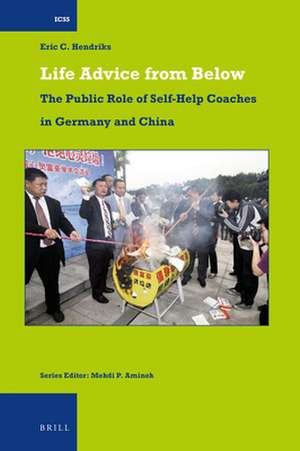
Life Advice from Below
Autor Eric C Hendriksen Limba Engleză Hardback – 6 iul 2017
“This witty book charms its way through a very serious sociology of the seriously quirky field of self-help books. Read it for its fascinating pop-culture insights and you’ll come away with a deep understanding of contemporary sociological theory. Highly recommended.” - Salvatore Babones, University of Sydney
“Hendriks’ finding that Germany rather than China is more resistant to self-help gurus offers a powerful corrective to the assumption in much of the globalization literature that the greatest cultural divide is between the Anglo-Western European sphere and the rest of the globe.” - Rodney Benson, New York University
Preț: 700.47 lei
Preț vechi: 909.69 lei
-23%
Puncte Express: 1051
Carte tipărită la comandă
Livrare economică 11-25 noiembrie
Livrare prin curier în România Termenul estimat este afișat lângă disponibilitate.
Transport gratuit pentru acest produs Plată online sau ramburs, în funcție de opțiunile comenzii.
Retur gratuit în 14 zile Comandă securizată și suport în română.
Specificații
ISBN-13: 9789004319578
ISBN-10: 9004319573
Pagini: 238
Dimensiuni: 160 x 239 x 18 mm
Greutate: 0.52 kg
Editura: Brill
ISBN-10: 9004319573
Pagini: 238
Dimensiuni: 160 x 239 x 18 mm
Greutate: 0.52 kg
Editura: Brill
Cuprins
Preface
List of Figures and Tables
1 Introduction
2 Cultural Fields in the Public Sphere
3 The Persistence of National Regimes
4 Global Popular Culture and Self-Help
5 Lines of Conflict
6 Mapping and Comparing Social Space
7 The German Self-Help Field
8 Clashing into Germany’s Corporatist Welfare Regime
9 The Chinese Self-Help Field
10 Coexisting with China’s Institutional Authorities
11 Conclusion
Bibliography
Index
List of Figures and Tables
1 Introduction
2 Cultural Fields in the Public Sphere
3 The Persistence of National Regimes
4 Global Popular Culture and Self-Help
5 Lines of Conflict
6 Mapping and Comparing Social Space
7 The German Self-Help Field
8 Clashing into Germany’s Corporatist Welfare Regime
9 The Chinese Self-Help Field
10 Coexisting with China’s Institutional Authorities
11 Conclusion
Bibliography
Index
Recenzii
“This witty book charms its way through a very serious sociology of the seriously quirky field of self-help books. Read it for its fascinating pop-culture insights and you’ll come away with a deep understanding of contemporary sociological theory. Highly recommended.” - Salvatore Babones, University of Sydney, author of American Tianxia: Chinese Money, American Power, and the End of History (Policy Press, 2017)
“Hendriks’ finding that Germany rather than China is (at least slightly) more resistant to self-help gurus offers a powerful corrective to the assumption in much of the globalization literature that the greatest cultural divide is between the Anglo-Western European sphere and the rest of the globe. Instead, as Hendriks suggests, the most relevant divide may between the (few remaining) social democratic nation-states and neo-liberal (or neo-liberalizing) nation-states, regardless of their geographical location.” - Rodney Benson, New York University, author of Shaping Immigration News: A French-American Comparison (Cambridge University Press, 2013)
“This is an original, creative piece of work with an enormous ambition to conduct comparative case studies in two foreign cultures simultaneously.” - Hartmut Wessler, University of Mannheim, co-author of Transnationalization of Public Spheres (Springer, 2008)
“Hendriks’ finding that Germany rather than China is (at least slightly) more resistant to self-help gurus offers a powerful corrective to the assumption in much of the globalization literature that the greatest cultural divide is between the Anglo-Western European sphere and the rest of the globe. Instead, as Hendriks suggests, the most relevant divide may between the (few remaining) social democratic nation-states and neo-liberal (or neo-liberalizing) nation-states, regardless of their geographical location.” - Rodney Benson, New York University, author of Shaping Immigration News: A French-American Comparison (Cambridge University Press, 2013)
“This is an original, creative piece of work with an enormous ambition to conduct comparative case studies in two foreign cultures simultaneously.” - Hartmut Wessler, University of Mannheim, co-author of Transnationalization of Public Spheres (Springer, 2008)
Notă biografică
Eric C. Hendriks, Ph.D., studied at Utrecht, UC Berkeley, Göttingen, the University of Chicago, and Mannheim, and presently works as a postdoc in sociology at Peking University. His research focuses on the politico-cultural regime differences between China and liberal democracies.