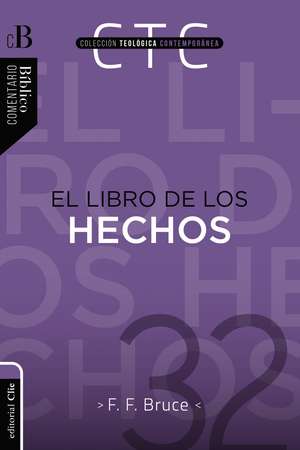
Libro de los Hechos: Colección teológica contemporánea, cartea 32
Autor F. F. Brucees Limba Spaniolă Paperback – 28 iun 2022
A partir de aquí va desplegando el contenido de hechos, versículo a versículo, enmarcándolo dentro de un bosquejo de acontecimientos que estructura en seis partes fundamentales:
El nacimiento de la Iglesia (1:1–5:42)
Persecución y expansión (6:1–9:31)
Los hechos de Pedro y principio de la Iglesia gentil (9:32–12:24)
Extensión de la Iglesia desde Antioquía y el decreto apostólico en Jerusalén (12:25–15:35)
Pablo abandona Antioquía y se dirige al mundo Egeo (15:36–19:20)
Pablo planea visitar Roma y llega allí por una ruta inesperada (19:21–28:31)
Cada una de estas partes principales cuenta con sus correspondientes divisiones y subdivisiones, siguiendo en la exposición el texto bíblico en bloques de uno o varios versículos.
Book of The Acts
The commentary to the Book of Acts by F.F. Bruce, one of the most recognized and accredited experts worldwide in Luke and Acts, is unique for his way of structuring the content in two blocks: separating the expository part of a more narrative nature (which forms the bulk of the text), from the technical part of a more exegetical nature (placed in footnotes).
In this way the preacher can easily use the narrative part of the exposition without technical incisions that are unnecessary for the verbal exposition of the Word; but with the option of accessing them whenever he deems it appropriate.
From here he unfolds the content of facts, verse by verse, framing it within an outline of events that he structures in six fundamental parts:
The birth of the Church (1:1-5:42);
Persecution and expansion (6:1-9:31);
The deeds of Peter and the beginning of the Gentile Church (9:32-12:24);
Extension of the Church from Antioch and the apostolic decree in Jerusalem (12:25-15:35);
Paul leaves Antioch and goes to the Aegean world (15:36-19:20);
Paul plans to visit Rome and arrives there by an unexpected route (19:21-28:31).
Each of these main parts has its corresponding divisions and subdivisions, following the exposition of the biblical text in blocks of one or several verses.


Preț: 219.91 lei
Puncte Express: 330
Carte disponibilă
Livrare economică 09-23 noiembrie
Livrare prin curier în România Termenul estimat este afișat lângă disponibilitate.
Transport gratuit de la 400.00 lei Plată online sau ramburs, în funcție de opțiunile comenzii.
Retur gratuit în 14 zile Comandă securizată și suport în română.
Specificații
ISBN-13: 9788417131159
ISBN-10: 8417131159
Pagini: 640
Dimensiuni: 152 x 229 x 43 mm
Greutate: 0.65 kg
Editura: CLIE
Colecția CLIE
Seria Colección teológica contemporánea
Locul publicării:Grand Rapids, United States
ISBN-10: 8417131159
Pagini: 640
Dimensiuni: 152 x 229 x 43 mm
Greutate: 0.65 kg
Editura: CLIE
Colecția CLIE
Seria Colección teológica contemporánea
Locul publicării:Grand Rapids, United States
Descriere
De ese modo el predicador puede utilizar fácilmente la parte narrativa de la exposición sin incisiones técnicas que resultan innecesarias para la exposición verbal de la Palabra; pero con la opción de acceder a ellas siempre que lo estime oportuno.
A partir de aquí va desplegando el contenido de hechos, versículo a versículo, enmarcándolo dentro de un bosquejo de acontecimientos que estructura en seis partes fundamentales:
El nacimiento de la Iglesia (1:1–5:42)
Persecución y expansión (6:1–9:31)
Los hechos de Pedro y principio de la Iglesia gentil (9:32–12:24)
Extensión de la Iglesia desde Antioquía y el decreto apostólico en Jerusalén (12:25–15:35)
Pablo abandona Antioquía y se dirige al mundo Egeo (15:36–19:20)
Pablo planea visitar Roma y llega allí por una ruta inesperada (19:21–28:31)
Cada una de estas partes principales cuenta con sus correspondientes divisiones y subdivisiones, siguiendo en la exposición el texto bíblico en bloques de uno o varios versículos.
Book of The Acts
The commentary to the Book of Acts by F.F. Bruce, one of the most recognized and accredited experts worldwide in Luke and Acts, is unique for his way of structuring the content in two blocks: separating the expository part of a more narrative nature (which forms the bulk of the text), from the technical part of a more exegetical nature (placed in footnotes).
In this way the preacher can easily use the narrative part of the exposition without technical incisions that are unnecessary for the verbal exposition of the Word; but with the option of accessing them whenever he deems it appropriate.
From here he unfolds the content of facts, verse by verse, framing it within an outline of events that he structures in six fundamental parts:
The birth of the Church (1:1-5:42);
Persecution and expansion (6:1-9:31);
The deeds of Peter and the beginning of the Gentile Church (9:32-12:24);
Extension of the Church from Antioch and the apostolic decree in Jerusalem (12:25-15:35);
Paul leaves Antioch and goes to the Aegean world (15:36-19:20);
Paul plans to visit Rome and arrives there by an unexpected route (19:21-28:31).
Each of these main parts has its corresponding divisions and subdivisions, following the exposition of the biblical text in blocks of one or several verses.
A partir de aquí va desplegando el contenido de hechos, versículo a versículo, enmarcándolo dentro de un bosquejo de acontecimientos que estructura en seis partes fundamentales:
El nacimiento de la Iglesia (1:1–5:42)
Persecución y expansión (6:1–9:31)
Los hechos de Pedro y principio de la Iglesia gentil (9:32–12:24)
Extensión de la Iglesia desde Antioquía y el decreto apostólico en Jerusalén (12:25–15:35)
Pablo abandona Antioquía y se dirige al mundo Egeo (15:36–19:20)
Pablo planea visitar Roma y llega allí por una ruta inesperada (19:21–28:31)
Cada una de estas partes principales cuenta con sus correspondientes divisiones y subdivisiones, siguiendo en la exposición el texto bíblico en bloques de uno o varios versículos.
Book of The Acts
The commentary to the Book of Acts by F.F. Bruce, one of the most recognized and accredited experts worldwide in Luke and Acts, is unique for his way of structuring the content in two blocks: separating the expository part of a more narrative nature (which forms the bulk of the text), from the technical part of a more exegetical nature (placed in footnotes).
In this way the preacher can easily use the narrative part of the exposition without technical incisions that are unnecessary for the verbal exposition of the Word; but with the option of accessing them whenever he deems it appropriate.
From here he unfolds the content of facts, verse by verse, framing it within an outline of events that he structures in six fundamental parts:
The birth of the Church (1:1-5:42);
Persecution and expansion (6:1-9:31);
The deeds of Peter and the beginning of the Gentile Church (9:32-12:24);
Extension of the Church from Antioch and the apostolic decree in Jerusalem (12:25-15:35);
Paul leaves Antioch and goes to the Aegean world (15:36-19:20);
Paul plans to visit Rome and arrives there by an unexpected route (19:21-28:31).
Each of these main parts has its corresponding divisions and subdivisions, following the exposition of the biblical text in blocks of one or several verses.