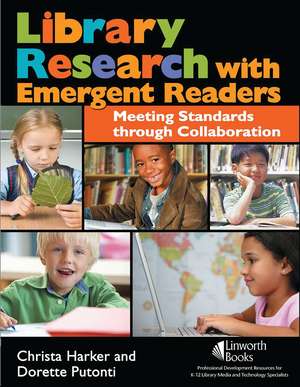
Library Research with Emergent Readers: Meeting Standards through Collaboration
Autor Christa Harker, Dorette Putontien Limba Engleză Paperback – mai 2008
Observăm în Library Research with Emergent Readers o abordare pragmatică a unui segment educațional adesea ignorat în procesul de cercetare documentară: elevii din clasele primare timpurii (K-1). Volumul semnat de Christa Harker și Dorette Putonti pornește de la premisa că alfabetizarea informațională trebuie să înceapă simultan cu învățarea cititului, integrând standardele AASL pentru elevul secolului XXI într-un format accesibil vârstelor mici. Reținem din primul capitol fundamentarea teoretică solidă care justifică necesitatea acestor activități sub presiunea standardelor academice actuale.
Structura cărții este concepută ca un manual de teren pentru bibliotecari și învățători, punând accent pe diferențierea instruirii și pe strategii de colaborare interdepartamentală. Găsim aici proiecte de cercetare „hands-on”, detaliate pas cu pas, care transformă biblioteca dintr-un simplu depozit de carte într-un laborator de învățare activă. Această lucrare completează perspectiva oferită de Collaborative Library Lessons for the Primary Grades de Brenda S. Copeland, adăugând o bază teoretică mai amplă privind strategiile de instruire și alinierea la mandatele legislative recente, dincolo de simplele planuri de lecție. În timp ce Destination Collaboration 1 se concentrează pe segmentele de vârstă mai mari (clasele 3-5), textul de față acoperă nișa critică a cititorilor emergenți, oferind instrumentele necesare pentru a construi deprinderi de cercetare înainte ca elevii să stăpânească pe deplin lectura independentă.
Tonul este unul profesional și aplicat, reflectând experiența directă a autoarelor în școli publice. Editura Bloomsbury Publishing, prin imprintul Linworth, livrează un ghid esențial pentru specialiștii care doresc să demonstreze valoarea bibliotecii media în atingerea obiectivelor curriculare de alfabetizare și scriere timpurie.
Preț: 255.93 lei
Preț vechi: 322.33 lei
-21%
Carte tipărită la comandă
Livrare economică 05-19 decembrie
Specificații
ISBN-10: 1586832883
Pagini: 128
Dimensiuni: 216 x 279 x 7 mm
Greutate: 0.32 kg
Editura: Bloomsbury Publishing
Colecția Linworth
Locul publicării:New York, United States
De ce să citești această carte
Recomandăm această carte bibliotecarilor școlari și învățătorilor care doresc să integreze cercetarea documentară la clasele pregătitoare și întâi. Cititorul câștigă strategii validate de practică pentru a preda alfabetizarea informațională conform standardelor AASL. Este un instrument esențial pentru a transforma colaborarea dintre bibliotecă și clasă într-un motor de succes academic, oferind proiecte gata de implementare adaptate nevoilor specifice ale copiilor care abia învață să citească.
Descriere
. Standards-based, step-by-step approach to research featuring the AASL Standards for the 21st-century learner
. Focused on collaboration between the library media specialist and the classroom teacher
. Employs research-based best practices for use with your young, emergent readers and writers
. With the academic pressures of No Child Left Behind and other state mandates, a focus on emergent readers and library integration is a prime topic for today's library media specialists
This book offers librarians and teachers hands-on research projects for emergent readers to help prepare students to meet challenging academic requirements. Targeted for media specialists and kindergarten and 1st grade classroom teachers who want to guide emergent readers through the library research process, this book provides background discussion and educational research on best instructional strategies, integrating curriculum standards, differentiating instruction, and step-by-step implementation of library research for emergent readers. Practical examples of library research units are the main focus of the manual. Find everything you need in this book to make your young students successful.
Recenzii
Harker and Putonti, both experienced librarians, have produced a practical guide to providing students in the primary grades with a research experience. The first chapter gives the justification for attempting this feat, with emphasis on the opportunity such activities provide for teacher/librarian collaboration. Specific references as to how such research projects dovetail with AASL's 'Standards for the 21st Century Learner' are given, as are examples from 'Information Standards for Student Learning.' The second chapter provides the step-by-step process that will insure success, with nine specific steps outlined in considerable detail. The remaining seven chapters include a variety of research projects that the authors have tested in their own library situations, each of which includes an overview, integrated content standards, and print and electronic resources. Appendixes provide assessment rubrics, collaborative checklists, and additional resources. An excellent tool for both novice and experienced librarians.