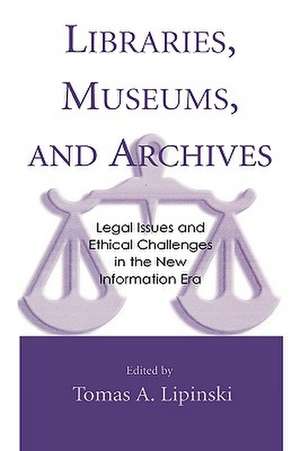
Libraries, Museums, and Archives: Legal Issues and Ethical Challenges in the New Information Era
Editat de Tomas A. Lipinskien Limba Engleză Hardback – 22 dec 2001
Issues related to the components of the collection, gifts, and donations (real property and tax implications), rights to privacy, users' rights of access, copyright and information control, and responsibility for safety in public spaces are covered in depth. A complete chapter is devoted to a discussion of the proper structure and elements of library, museum, or archives policy content-a superb blueprint for effective policy drafting at all levels of the institutional lifecycle. Finally, a resource list of ethical and legal materials in print and on the Web points the way to a wealth of highly specific and useful information. Timely and essential.
Preț: 620.58 lei
Preț vechi: 914.13 lei
-32%
Puncte Express: 931
Carte tipărită la comandă
Livrare economică 21 noiembrie-05 decembrie
Livrare prin curier în România Termenul estimat este afișat lângă disponibilitate.
Transport gratuit pentru acest produs Plată online sau ramburs, în funcție de opțiunile comenzii.
Retur gratuit în 14 zile Comandă securizată și suport în română.
Specificații
ISBN-13: 9780810840850
ISBN-10: 0810840855
Pagini: 352
Dimensiuni: 150 x 227 x 32 mm
Greutate: 0.49 kg
Ediția:0352
Editura: Bloomsbury Publishing
Colecția Scarecrow Press
Locul publicării:New York, United States
ISBN-10: 0810840855
Pagini: 352
Dimensiuni: 150 x 227 x 32 mm
Greutate: 0.49 kg
Ediția:0352
Editura: Bloomsbury Publishing
Colecția Scarecrow Press
Locul publicării:New York, United States
V-ar putea interesa
-
 The Intellectual Foundation of Information OrganizationElaine Svenonius-20%Preț: 213.68 lei267.10 lei
 -
 Preț: 467.81 lei
 -
 RDA and Cartographic ResourcesPaige G. AndrewPreț: 442.19 lei
 -
 Diversity in Youth Literature: Opening Doors Through ReadingJamie Campbell NaidooPreț: 373.86 lei
 -
 Library Management 101: A Practical GuideDiane L. VelasquezPreț: 487.99 lei
 -
 Cut Flower GardenErin Benzakein-26%Preț: 154.29 lei207.14 lei
 -
 -21%Preț: 283.48 lei357.64 lei
 -
 -26%Preț: 265.87 lei358.27 lei
Cuprins
Chapter 1 Acknowledgments
Chapter 2 Foreword
Chapter 3 Introduction
Part 4 PART 1: WORKING WITH THE COLLECTION
Chapter 5 1 Deeds of Gift: Carressing the Hand that Feeds
Chapter 6 2 The Appraiser and the Appraisal: What Makes a Book Valuable?
Chapter 7 3 Tort Theory in Library, Museum, and Archival Collections, Materials, Exhibits, and Displays: Rights of Privacy and Publicity in Personal Information and Persona
Chapter 8 4 Censorship and Controversial Materials in Museums, Libraries, and Archives
Part 9 PART 2: SPECIAL ISSUES IN MUSEUM COLLECTION MANAGEMENT
Chapter 10 5 Legal and Ethical Foundations of Museum Collecting Policies
Chapter 11 6 Collections Managment: Hypothetical Cases, Acquisitions, Deaccessions, and Loans
Part 12 PART 3: WORKING WITH PATRONS
Chapter 13 7 Legal Issues Involved in the Privacy Rights of Patrons in "Public" Libraries and Archives
Chapter 14 8 Welcome to...The Legal Responsibility to Offer Accessible Electronic Information to Patrons with Disabilities
Chapter 15 9 Seven Levels of Safety: Protecting People in Public Buildings
Part 16 PART 4: ETHICAL CHALLENGES
Chapter 17 10 The Fight of the Century? Information Ethics versus E-Commerce
Chapter 18 11 Information Ethics: Its Demarcation and Application
Chapter 19 12 Organizing Ethics in Archives, Museums, and Libraries: Challenges and Strategies for Meeting Ethical Responsibilites
Part 20 PART 5: COPYRIGHT AND OTHER OWNERSHIP ISSUES
Chapter 21 13 Copyright for Libraries, Museums, and Archives: The Basics and Beyond
Chapter 22 14 Copyright Protection and Technological Reform of Library Services: Digital Change, Practical Applications, and Congressional Action
Chapter 23 15 Legal-Technological Regulation of Information Access
Part 24 PART 6: IMPLEMENTATION OF LEGAL AND ETHICAL CONCEPTS
Chapter 25 16 Getting Started: Legal and Ethical Resources
Chapter 26 17 Designing, Drafting, and Implementing New Policies
Chapter 27 18 Agents of Change: Planning, Communication, and Implementation Strategies
Chapter 28 Index
Chapter 2 Foreword
Chapter 3 Introduction
Part 4 PART 1: WORKING WITH THE COLLECTION
Chapter 5 1 Deeds of Gift: Carressing the Hand that Feeds
Chapter 6 2 The Appraiser and the Appraisal: What Makes a Book Valuable?
Chapter 7 3 Tort Theory in Library, Museum, and Archival Collections, Materials, Exhibits, and Displays: Rights of Privacy and Publicity in Personal Information and Persona
Chapter 8 4 Censorship and Controversial Materials in Museums, Libraries, and Archives
Part 9 PART 2: SPECIAL ISSUES IN MUSEUM COLLECTION MANAGEMENT
Chapter 10 5 Legal and Ethical Foundations of Museum Collecting Policies
Chapter 11 6 Collections Managment: Hypothetical Cases, Acquisitions, Deaccessions, and Loans
Part 12 PART 3: WORKING WITH PATRONS
Chapter 13 7 Legal Issues Involved in the Privacy Rights of Patrons in "Public" Libraries and Archives
Chapter 14 8 Welcome to...The Legal Responsibility to Offer Accessible Electronic Information to Patrons with Disabilities
Chapter 15 9 Seven Levels of Safety: Protecting People in Public Buildings
Part 16 PART 4: ETHICAL CHALLENGES
Chapter 17 10 The Fight of the Century? Information Ethics versus E-Commerce
Chapter 18 11 Information Ethics: Its Demarcation and Application
Chapter 19 12 Organizing Ethics in Archives, Museums, and Libraries: Challenges and Strategies for Meeting Ethical Responsibilites
Part 20 PART 5: COPYRIGHT AND OTHER OWNERSHIP ISSUES
Chapter 21 13 Copyright for Libraries, Museums, and Archives: The Basics and Beyond
Chapter 22 14 Copyright Protection and Technological Reform of Library Services: Digital Change, Practical Applications, and Congressional Action
Chapter 23 15 Legal-Technological Regulation of Information Access
Part 24 PART 6: IMPLEMENTATION OF LEGAL AND ETHICAL CONCEPTS
Chapter 25 16 Getting Started: Legal and Ethical Resources
Chapter 26 17 Designing, Drafting, and Implementing New Policies
Chapter 27 18 Agents of Change: Planning, Communication, and Implementation Strategies
Chapter 28 Index
Recenzii
Provides a useful introduction to the myriad of possible legal issues that may arise for libraries, museums and archives... Recommended for the library science collections of public and university libraries.
Balancing legal requirements with users' needs is the focus of this volume that covers a UW-Milwaukee sponsored conference entitled the 'Institute for Legal and Ethical Issues in the New Information Era: Challenges for Libraries, Museums, and Archives.'...While many of the chapter authors are lawyers with legal experience in the area on which they write, Libraries, Museums, and Archives is accessible and essential reading for professionals dealing with the issues.
Unlike many publications resulting from a conference or symposium, this book holds together as a comprehensive collection of ideas. It is informative, interesting, and above all, very readable....Any library, museum, or archive would benefit from having Libraries, Museums, and Archives: Legal Issues and Ethical Challenges in the New Information Age on its shelves, or more importantly in the hands of the information professionals employed in these institutions. Furthermore, this volume would be an excellent addition to a course syllabus for information ethics, legal issues in the information professions, information management, museum studies, or archival practices.
No work can serve as a definitive guide to the shifting landscape of laws regulating museums, archives, and libraries, and none can substitute for an attorney's legal advice. The most one can hope for in a book like Libraries, Museums, and Archives, is that it will offer a detailed overview of the current playing field. This fine volume does that admirably.
Taken together, the chapters provide an excellent historical context to the legal and ethical issues discussed.
Balancing legal requirements with users' needs is the focus of this volume that covers a UW-Milwaukee sponsored conference entitled the 'Institute for Legal and Ethical Issues in the New Information Era: Challenges for Libraries, Museums, and Archives.'...While many of the chapter authors are lawyers with legal experience in the area on which they write, Libraries, Museums, and Archives is accessible and essential reading for professionals dealing with the issues.
Unlike many publications resulting from a conference or symposium, this book holds together as a comprehensive collection of ideas. It is informative, interesting, and above all, very readable....Any library, museum, or archive would benefit from having Libraries, Museums, and Archives: Legal Issues and Ethical Challenges in the New Information Age on its shelves, or more importantly in the hands of the information professionals employed in these institutions. Furthermore, this volume would be an excellent addition to a course syllabus for information ethics, legal issues in the information professions, information management, museum studies, or archival practices.
No work can serve as a definitive guide to the shifting landscape of laws regulating museums, archives, and libraries, and none can substitute for an attorney's legal advice. The most one can hope for in a book like Libraries, Museums, and Archives, is that it will offer a detailed overview of the current playing field. This fine volume does that admirably.
Taken together, the chapters provide an excellent historical context to the legal and ethical issues discussed.