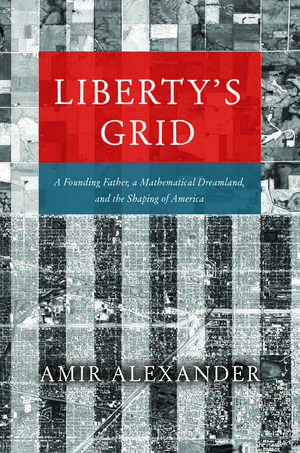
Liberty's Grid: A Founding Father, a Mathematical Dreamland, and the Shaping of America
Autor Amir Alexanderen Limba Engleză Hardback – 29 mai 2024
Seen from an airplane, much of the United States appears to be a gridded land of startling uniformity. Perpendicular streets and rectangular fields, all precisely measured and perfectly aligned, turn both urban and rural America into a checkerboard landscape that stretches from horizon to horizon. In evidence throughout the country, but especially the West, the pattern is a hallmark of American life. One might consider it an administrative convenience—an easy way to divide land and lay down streets—but it is not. The colossal grid carved into the North American continent, argues historian and writer Amir Alexander, is a plan redolent with philosophical and political meaning.
In 1784 Thomas Jefferson presented Congress with an audacious scheme to reshape the territory of the young United States. All western lands, he proposed, would be inscribed with a single rectilinear grid, transforming the natural landscape into a mathematical one. Following Isaac Newton and John Locke, he viewed mathematical space as a blank slate on which anything is possible and where new Americans, acting freely, could find liberty. And if the real America, with its diverse landscapes and rich human history, did not match his vision, then it must be made to match it.
From the halls of Congress to the open prairies, and from the fight against George III to the Trail of Tears, Liberty’s Grid tells the story of the battle between grid makers and their opponents. When Congress endorsed Jefferson’s plan, it set off a struggle over American space that has not subsided. Transcendentalists, urban reformers, and conservationists saw the grid not as a place of possibility but as an artificial imposition that crushed the human spirit. Today, the ideas Jefferson associated with the grid still echo through political rhetoric about the country’s founding, and competing visions for the nation are visible from Manhattan avenues and Kansan pastures to Yosemite’s cliffs and suburbia’s cul-de-sacs. An engrossing read, Liberty’s Grid offers a powerful look at the ideological conflict written on the landscape.
Preț: 225.02 lei
Puncte Express: 338
Carte disponibilă
Livrare economică 10-24 noiembrie
Livrare express 24-30 octombrie pentru 41.15 lei
Livrare prin curier în România Termenul estimat este afișat lângă disponibilitate.
Transport gratuit de la 400.00 lei Plată online sau ramburs, în funcție de opțiunile comenzii.
Retur gratuit în 14 zile Comandă securizată și suport în română.
Specificații
ISBN-13: 9780226820729
ISBN-10: 0226820726
Pagini: 304
Ilustrații: 26 halftones, 6 line drawings
Dimensiuni: 152 x 229 x 28 mm
Greutate: 0.64 kg
Ediția:First Edition
Editura: University of Chicago Press
Colecția University of Chicago Press
ISBN-10: 0226820726
Pagini: 304
Ilustrații: 26 halftones, 6 line drawings
Dimensiuni: 152 x 229 x 28 mm
Greutate: 0.64 kg
Ediția:First Edition
Editura: University of Chicago Press
Colecția University of Chicago Press
Notă biografică
Amir Alexander teaches history at the University of California, Los Angeles. His writing has appeared in the New York Times, Wall Street Journal, Nature, Washington Post, and Los Angeles Times. He is the author of four books, including Infinitesimal: How a Dangerous Mathematical Theory Shaped the Modern World and Proof! How the World Became Geometrical.
Cuprins
Introduction
1 A Mathematical Prologue
2 Life, Liberty, and Infinite Space
3 A Mathematical Empire
4 Rectilinear Cities
5 Making the Greatest Grid
6 Anti-geometry
Conclusion: The Chasm
Acknowledgments
Notes
Index
1 A Mathematical Prologue
2 Life, Liberty, and Infinite Space
3 A Mathematical Empire
4 Rectilinear Cities
5 Making the Greatest Grid
6 Anti-geometry
Conclusion: The Chasm
Acknowledgments
Notes
Index
Recenzii
“A deeply informed and illuminating look at something so familiar as to be almost invisible, and a wonderful cautionary tale of the havoc that a brilliant man like Jefferson can wreak out of misplaced idealism and a ‘habit of thinking in broad abstractions rather than getting bogged down in practical details.’”
"Alexanderʼs entertaining survey of this long-forgotten but once heated debate probes at the weird ways science and politics intersect. Readers will be utterly engrossed."
“Despite being a book about straight lines, Liberty’s Grid includes fascinating detours—from Jefferson’s proposals for a metric system, to his suggestions for names of new states: Sylvania, Cherronesus, Assenisipia, Metropotamia.”
“Alexander’s book exemplifies what historians are best positioned to do: peel back our assumptions and reveal that things did not have to turn out exactly the way they did. Alexander forces us to see the familiar as new, and to understand why the course Jefferson advocated was so compelling at the time. . . . By uncovering the intellectual roots of what seems like a ‘natural’ part of reality, Alexander has done an immense service, and this book can be read with profit by anyone studying early American history.”
“A beautifully written history of the physical and sociopolitical shaping of America, using the lens of land surveys and urban design. . . . A fascinating story about a nation being born.”
“Two thirds of the continental United States has been surveyed and platted in accordance with Jefferson’s idea for uniform geometric subdivision of the public lands. Thanks to Liberty’s Grid, we now have a fuller idea of why this happened and what it means.”
“A must-read volume to understand the meaning, scope, and power of American continental expansion. . . . Essential.”
“How do proposed ideas weather the gauntlet of congressional debate and compromise? Alexander has given us a lively case study, showing how some geometric ideas morphed into laws and practices, thereby inducing both austere doses of symmetry and hearty dabs of freedom into America’s living spaces.”
“By seeking to historicize, and ultimately defamiliarize, the grid’s otherwise overlooked presence within America’s intellectual history and broader cultural landscape, Liberty’s Grid shifts mathematics out of the realm of theory and emphasizes its potential to act in the world. Geometry shapes what we believe is possible and is thus political.”
“Alexander is a skilled writer and a gifted storyteller, and the book is a pleasure to read. It should appeal to nearly every audience from informed general readers to professionals, and especially to historians, landscape architects, and landscape ecologists.”
“Liberty’s Grid draws a startling connection between the American love of rectilinear layout and philosophical ideas about America itself—the landscape as the graph paper our national identity is scribbled on. You’ll never look at Manhattan the same way again.”
“Alexander’s important new book illuminates the geometrical premises and ideological implications of westward expansion and urban development, offering fresh perspectives on the conflicting and controversial ways Americans imagined their future and transformed the continent. Liberty’s Grid will provoke and inform ongoing debates about the pathways we are following—and the history we are inscribing—on our national landscape.”
“Anyone interested in the history or the geography of the United States will welcome Alexander’s novel perspective on the westward expansion of the US. Alexander’s emphasis on the geometry of the development of the landscape makes this compulsively readable book a necessary contribution to the literature of Indigenous resistance.”
“This book opens an entirely unexpected window on the cultural history of mathematics and the role of mathematics in American history and culture. A highly rewarding read for mathematicians, historians and philosophers of mathematics, cultural historians, Americanists, and those who are interested in these subjects.”
“In this beautifully written book, Alexander takes on a seemingly obvious feature of American life: the open-ended, uniform grid that organizes much of the national space from Manhattan to the Western plains. But why did America became rectilinear? Alexander shows how, far from being a simple solution to practical problems, the Great American Grid embodies a distinct vision of the land and its people. In eighteenth-century America, the analytic logic of the grid became the logic of an empty, undifferentiated space ready to be colonized and exploited—a boundless space of unlimited possibilities. But other ways of perceiving and organizing space were and are possible. Alexander recounts the fascinating story of the grid—and of those who opposed it—as an ongoing story of geometrical forms and political possibilities.”