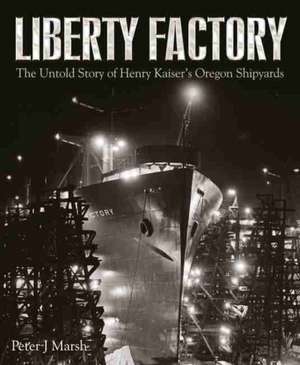
Liberty Factory
Autor Peter Marshen Limba Engleză Hardback – 15 ian 2021
Structura lucrării Liberty Factory este concepută ca o analiză istorică a efortului industrial american din timpul celui de-al Doilea Război Mondial, concentrându-se pe metodologia producției în serie aplicată construcțiilor navale. Considerăm că abordarea autorului Peter Marsh reușește să scoată la lumină un capitol adesea ignorat al istoriei logistice: modul în care Oregon, o zonă fără tradiție industrială, a devenit centrul de greutate al flotei aliate sub conducerea vizionarului Henry Kaiser.
Găsim în această carte o documentare metodică a modului în care inovația managerială a depășit barierele geografice și umane. Cartea explorează nu doar aspectele tehnice ale asamblării navelor „Liberty”, ci și revoluția socială din interiorul șantierelor. Peter Marsh detaliază cum pachetele de beneficii sociale — de la asistență medicală la locuințe — au motivat o forță de muncă mixtă, integrând pentru prima dată femeile în acest sector industrial dur. Această lucrare reprezintă o schimbare tematică majoră față de alte scrieri ale autorului, precum Football Hooliganism sau The Supremacist Syndrome, trecând de la sociologie și examinarea ideologiilor la istorie economică și militară.
Liberty Factory constituie o alternativă solidă la Freedom's Forge de Arthur Herman pentru cursurile de istorie a tehnologiei sau management industrial, cu avantajul că se concentrează strict pe micro-universul șantierelor din Oregon și pe recordurile de viteză atinse aici, precum nava finalizată în doar 10 zile. În timp ce The Ocean Class of Second World War analizează designul tehnic al navelor standard, Peter Marsh pune accent pe ecosistemul social și antreprenorial care a făcut posibilă victoria în Bătălia Atlanticului.
Preț: 362.69 lei
Carte disponibilă
Livrare economică 18 mai-01 iunie
Specificații
ISBN-10: 1526783053
Pagini: 192
Dimensiuni: 220 x 263 x 25 mm
Greutate: 1.2 kg
Editura: US Naval Institute Press
V-ar putea interesa
-
 The Rules of DisorderPeter Marsh-15%Preț: 396.65 lei466.64 lei
 -
 The Rules of DisorderPeter Marsh-18%Preț: 1059.14 lei1291.64 lei
 -
 Preț: 138.56 lei
 -
 Preț: 160.59 lei
 -
 Task-Centred Social WorkMark Doel-15%Preț: 651.97 lei767.02 lei
 -
 The Cotton Trade in England and on the ContinentGerhart Von Schulze-GaevernitzPreț: 202.11 lei
 -
 Erkennen, erfassen, bekämpfenStefanie SteinbachPreț: 147.23 lei
 -
 Preț: 420.38 lei
 -
 La élite del Ejército Rojo : unidades de la GuardiaMariano González ClaveroPreț: 207.07 lei
 -
 Preț: 218.71 lei
 -
 Preț: 221.68 lei
 -
 The course of empire; outlines of the chief political changes in the history of the worldCharles Gardner WheelerPreț: 212.66 lei
 -
 Marking the Oregon Trail, the Bozeman Road and historic places in Wyoming 1908-1920Grace Raymond HebardPreț: 94.68 lei
De ce să citești această carte
Recomandăm această carte pasionaților de istorie militară și management care doresc să înțeleagă cum logistica a decis soarta războiului. Cititorul va descoperi povestea fascinantă a lui Henry Kaiser, omul care, fără experiență anterioară în construcții navale, a transformat Oregonul într-o forță industrială globală. Este o lecție despre inovație, viteză de execuție și importanța capitalului uman în situații de criză extremă.
Descriere scurtă
Crucial to this achievement was the 'Liberty ship', a simple freighter that could be built rapidly, combined with the untapped industrial potential of the USA that could build them in vast numbers. Undoubtedly the most important individual in the rapid expansion of U.S. wartime shipyard capacity was Henry Kaiser, a man with no previous shipbuilding experience but an entrepreneur of vision and drive. This book tells the story of how he established huge new yards using novel mass-production techniques in the most surprising location - Oregon, one of the least industrially developed areas of the US and one without an existing pool of skilled labour to draw on.
It was not just the yards that were revolutionary, as the Kaiser companies provided housing, health and welfare benefits that attracted workers from all over the country, including women recruited into an industrial workplace for the first time. This well-motivated workforce turned the Kaiser yards into the most efficient shipbuilders in the country. In total Kaiser's Oregon yards built over 450 'Liberties' and the follow-on 'Victory ships' - including one built in the record time of 10 days - as well as around 150 tankers, some 50 escort carriers and countless amphibious warfare ships. Curiously, this truly remarkable achievement, of huge significance to the eventual Allied victory, has been consigned to the footnotes of history, but is fully documented and celebrated for the first time in this book.