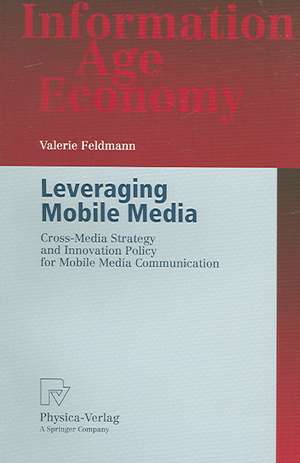
Leveraging Mobile Media: Information Age Economy
Autor Valerie Feldmannen Limba Engleză Paperback – 24 feb 2005








Preț: 643.03 lei
Preț vechi: 756.51 lei
-15%
Puncte Express: 965
Carte tipărită la comandă
Livrare economică 02-16 decembrie
Livrare prin curier în România Termenul estimat este afișat lângă disponibilitate.
Transport gratuit pentru acest produs Plată online sau ramburs, în funcție de opțiunile comenzii.
Retur gratuit în 14 zile Comandă securizată și suport în română.
Specificații
ISBN-13: 9783790815757
ISBN-10: 3790815756
Pagini: 284
Ilustrații: XII, 270 p. 17 illus.
Dimensiuni: 155 x 235 x 16 mm
Greutate: 0.44 kg
Ediția:2005
Editura: Physica
Colecția Information Age Economy
Seria Information Age Economy
Locul publicării:Heidelberg, Germany
ISBN-10: 3790815756
Pagini: 284
Ilustrații: XII, 270 p. 17 illus.
Dimensiuni: 155 x 235 x 16 mm
Greutate: 0.44 kg
Ediția:2005
Editura: Physica
Colecția Information Age Economy
Seria Information Age Economy
Locul publicării:Heidelberg, Germany
V-ar putea interesa
-
 The Smartphone SolutionMartha Deiros ColladoPreț: 122.38 lei
 -
 Jab, Jab, Jab, Right HookGary VaynerchukPreț: 126.82 lei
 -
 Cultural Economies of Locative MediaRowan Wilken-17%Preț: 262.91 lei316.53 lei
 -
 Media DisruptedAmanda D LotzPreț: 190.52 lei
 -
 Mobile MarketingDaniel RowlesPreț: 154.51 lei
 -
 Sport and the Media: Managing the NexusMerryn SherwoodPreț: 433.09 lei
 -
 Mobile CityJordan H. KraemerPreț: 240.57 lei
 -
 Platforms, Power, and PoliticsUlrike KlingerPreț: 170.17 lei
 -
 Mobile Media MethodsLarissa HjorthPreț: 471.26 lei
 -
 Preț: 138.84 lei
 -
 Inside Digital Advertising: Platforms, Power, and Material PoliticsDonald MackenziePreț: 156.81 lei
 -
 The Love FixRachel ThompsonPreț: 137.14 lei
 -
 Advances in Communications & Media Research: Volume 7Anthony V Stavros-26%Preț: 1086.22 lei1476.54 lei
 -
 -27%Preț: 724.53 lei988.29 lei
 -
 -18%Preț: 118.87 lei144.69 leiRecomandat
 -
 International Communication: Continuity and ChangeDaya Kishan Thussu-24%Preț: 191.87 lei251.68 lei
 -
 MiddlelandRory StewartPreț: 159.93 lei
 -
 The Sirens' CallChris HayesPreț: 145.95 lei
 -
 The Joy of ConnectionsRuth K. WestheimerPreț: 93.23 lei
 -
 Media from Chaos to Clarity and Back AgainJudy Ungar Franks-16%Preț: 160.18 lei191.19 lei
Public țintă
Professional/practitionerCuprins
Incentives, barriers, and drivers for media development under the influence of mobile communications.- The mobile communication system: elements and characteristics.- The social use of the mobile communications system.- Cross-media and cross-network strategies for mobile media.- Innovation policy for mobile media.
Textul de pe ultima copertă
Mobile communications and next generation wireless networks emerge as new distribution channels for the media. This development offers exciting new opportunities for media companies: the mobile communication system creates new usage contexts for media content and services; the social use of mobile communications suggests that identity representation in social networks, impulsive access to trusted media brands, and micro-coordination emerge as new sources of value creation in the media industries. In the light of this background, this book takes two different viewpoints on the development of mobile media: from a competitive strategy point of view it analyzes the extension of cross-media strategies and the emergence of cross-network strategies; from a public policy point of view it develops demands and requirements for an innovation policy that fosters innovation in mobile media markets.