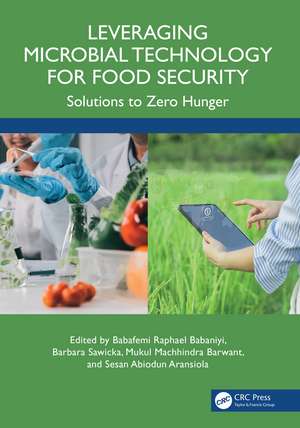
Leveraging Microbial Technology for Food Security: Solutions for Zero Hunger
Editat de Babafemi Raphael Babaniyi, Barbara Sawicka, Mukul Machhindra Barwant, Sesan Abiodun Aransiolaen Limba Engleză Hardback – 4 iun 2026
Through global case studies, the book demonstrates how microbial innovations have improved food security and provided scalable, sustainable approaches to reducing hunger. It also explores the potential of microorganisms to diversify diets and lessen dependence on traditional agricultural systems.
Written for scholars, policymakers, educators, farmers, and students, this book combines scientific analysis with real-world examples. Featuring case studies, data visualizations, and actionable insights, it is a valuable resource for those interested in biotechnology, food systems, and sustainable development.
Preț: 1609.29 lei
Preț vechi: 1962.55 lei
-18%
Puncte Express: 2414
Carte tipărită la comandă
Livrare economică 27 noiembrie-11 decembrie
Livrare prin curier în România Termenul estimat este afișat lângă disponibilitate.
Transport gratuit pentru acest produs Plată online sau ramburs, în funcție de opțiunile comenzii.
Retur gratuit în 14 zile Comandă securizată și suport în română.
Specificații
ISBN-13: 9781041095897
ISBN-10: 1041095899
Pagini: 406
Ilustrații: 70
Dimensiuni: 178 x 254 mm
Greutate: 0.92 kg
Ediția:1
Editura: CRC Press
Colecția CRC Press
ISBN-10: 1041095899
Pagini: 406
Ilustrații: 70
Dimensiuni: 178 x 254 mm
Greutate: 0.92 kg
Ediția:1
Editura: CRC Press
Colecția CRC Press
V-ar putea interesa
-
 Soil Microbiology, Ecology and BiochemistryEldor Paul-31%Preț: 523.53 lei757.63 lei
 -
 Adventures in FermentationJohnny DrainPreț: 166.52 lei
 -
 Microbes in the Food IndustryAnil Panghal-23%Preț: 1318.32 lei1712.11 lei
 -
 Microbial NutraceuticalsSudhir Pratap Singh-23%Preț: 1061.68 lei1378.81 lei
 -
 On ExtinctionMelanie ChallengerPreț: 109.95 lei
 -
 Tech to Table: 25 Innovators Reimagining FoodRichard MunsonPreț: 210.15 lei
 -
 Handbook of Research on Food Science and Technology: Volume 2: Food Biotechnology and MicrobiologyMonica Lizeth Chavez-Gonzalez-15%Preț: 581.47 lei684.09 lei
 -
 Food Microbiology and Biotechnology: Safe and Sustainable Food ProductionGuadalupe Virginia Nevárez-Moorillón-9%Preț: 648.10 lei712.20 lei
 -
 The Fate of FoodAmanda LittlePreț: 78.92 lei
 -
 GM Agriculture and Food SecurityStuart SmythPreț: 428.44 lei
 -
 FermentTim Spector-5%Preț: 116.95 lei123.10 lei
 -
 -17%Preț: 121.01 lei146.25 leiRecomandat
 -
 Microbial Services for Cereal Crops: Reducing Costs and Environmental ImpactEverlon Cid Rigobelo-18%Preț: 908.31 lei1107.70 lei
 -
 Microbial Diversity, Interventions and ScopeShiwani Guleria Sharma-18%Preț: 1175.66 lei1433.73 lei
 -
 Innovations in Food TechnologyPragya Mishra-5%Preț: 1880.36 lei1979.33 lei
 -
 Microbial Technology for Sustainable EnvironmentPankaj Bhatt-24%Preț: 1366.41 lei1797.91 lei
 -
 -18%Preț: 1230.37 lei1500.44 lei
 -
 Food Microbial SustainabilityArun Karnwal-5%Preț: 1411.21 lei1485.48 lei
 -
 The Future of Food: Issues and Innovations in the 21st Century and BeyondHonor May Eldridge-26%Preț: 385.53 lei519.90 lei
Public țintă
Academic, Postgraduate, and Professional ReferenceCuprins
Section One: Global Food Hunger. The Global Hunger Picture: Statistics and Definitions. Major Causes and Stages of Global Hunger. Impacts of Climate Change and Environmental Degradation on Food Security. Global Action to End Hunger: Initiatives and Challenges. Food Hunger and Public Health – Long-term Consequences. Section Two: Application of Microorganisms and Their Products in Zero Hunger to Fulfil SDGs. Microbial Innovations in the Fight Against Hunger. Microbial Technology for Biofertilizers and Biopesticides in Sustainable Agriculture. Increasing the Nutritional Value of Food with Microorganisms. Biotechnology and Genetic Engineering in Food Security. Microbial Biocontrol: Handling Insects and Pathogens Resistant to Drugs. Microbes in Aquaculture and Livestock. Section Three: Food Security Through Microbial Technology and Sustainable Agricultural Synergy. The Role of the Soil Microbiome in Sustainable Agriculture. Microorganisms Supporting Organic Food Production. Biological Control and Biopesticides. Agroecological Farming Systems Supported by Microorganisms. Challenges and the Future of Integrating Microbiology with Sustainable Agriculture. Section Four: Microbial Innovations for Climate-Resilient Agriculture. Microbial Innovations for Climate-Resilient Agriculture. Microbial Solutions for Reducing Greenhouse Gas Emissions in Agriculture. Bioremediation of Soils Damaged by Human Activity and Climate Change. The Role of Microorganisms in Extensive Agriculture and Pasture Management. Microbial Biotechnologies and the Future of Agriculture in a Changing Climate. Section Five: The Future of Microbial Technologies in Achieving Zero Hunger. Summary of Current Achievements and Challenges. The Role of Research and Innovation in the Future of Microbial Technologies. Sustainability and Future Agricultural Policies Supporting Microbial Technologies. Microorganisms in the Context of Global Trends: Precision Agriculture to Functional Foods. Future Vision: Path to Zero Hunger Using Microbial Technologies.
Notă biografică
Babafemi Raphael Babaniyi is a prominent researcher and academic in the field of Environmental Chemistry. He earned a B.Sc. in Industrial Chemistry from Caritas University, Enugu (2008), and obtained both an M.Tech. (2021) and a Ph.D. 2025 in Environmental Chemistry from the Federal University of Technology, Akure. His interdisciplinary expertise spans Environmental and Green Chemistry, Phytoremediation, Chemical Biology, Bioremediation, Environmental Impact Assessment, and Biodegradable Plastics. With over 40 publications in peer-reviewed journals and book chapters, Babafemi has made impactful contributions to global scientific dialogue. He currently serves as an Assistant Chief Research Officer at the National Biotechnology Development Agency, where he leads research initiatives focused on biotechnology and environmental sustainability. His commitment to addressing environmental challenges through science positions him as a key advocate for sustainable development and environmental health.
Professor Barbara Sawicka is a distinguished full professor at the University of Life Sciences in Lublin, Poland, where she has been a faculty member in the Department of Plant Production Technology and Commodities Science since 2004. She has established herself as a leading scholar with an exceptional body of work comprising over 1,020 publications, including 152 monographs, 390 original research papers, and 27 books. Her research interests cover agronomy, bioengineering, food sciences, and environmental protection. Professor Sawicka has guided 11 PhD candidates, 190 master’s students, and 250 engineers, reflecting her deep commitment to academic mentorship. She also plays an active role in the editorial sphere, serving on the advisory boards of several journals and holding positions as deputy editor-in-chief and co-editor. Beyond academia, she has contributed significantly to civil and social initiatives and remains an active member of professional bodies such as the Polish Agronomic Society and the Polish Academy of Sciences. Her international presence is reinforced through research collaborations and scholarships across Europe, including Belgium, Lithuania, and Turkey. Fluent in multiple languages, Professor Sawicka continues to shape her field with a truly global impact.
Mukul Machhindra Barwant is the Dean of Research and Innovation and an Assistant Professor of Botany at Sanjivani Arts, Commerce, and Science College, Kopargaon, Ahilyanagar, Maharashtra, India. His expertise includes phycology, nutraceuticals, herbal biotechnology, and environmental sciences. An accomplished researcher and editor, he serves on the editorial boards of 25 international journals, has reviewed 49 research articles, edited 41 books, authored 24 book chapters, and published 55 research papers in top journals like Springer, Elsevier, and Taylor & Francis. Barwant holds 25 patents across India, the UK, and Germany, focusing on seaweed-based nutraceuticals and plant-derived solutions for healthcare and agriculture. He is also an active mentor, academic trainer, and organizer of national and international workshops on plant sciences and sustainability. His contributions have earned him multiple prestigious awards, including Best Researcher, Young Scientist, Young Phycologist, and Distinguished Researcher Awards (2021–2025), along with recognition for excellence in research publications and plant sciences.
Sesan Abiodun Aransiola holds a Ph.D. in Environmental Microbiology from the Federal University of Technology, Minna, Nigeria, where he also earned his B.Tech. (2009) and M.Tech. (2014) degrees. He is currently a Lecturer in the Department of Microbiology at the University of Abuja, Nigeria. His research centers on innovative strategies for soil and water remediation, with a particular focus on vermitechnology, phytoremediation, and microbial biotechnology. Aransiola has extensively explored the application of vermicasts and biofertilizers such as vinasse to support soil recovery from heavy metal and plastic pollution. His expertise spans environmental health, marine resources, and sustainable waste management. An award-winning scientist, he has authored over 90 scholarly publications, including high-impact journal articles, reviews, and book chapters. He has also co-edited several internationally recognized scientific volumes with publishers such as Elsevier, Springer, and CRC Press, covering topics including microbial biotechnology, soil microbiomes, marine bioprospecting, phytoremediation, and food safety. Previously, he served as an Assistant Chief Scientific Officer at the National Biotechnology Development Agency. Beyond academia, Aransiola actively contributes to community service and sustainability advocacy. He is a member of several professional bodies, including the Nigerian Society for Microbiology and the American Society for Microbiology.
Professor Barbara Sawicka is a distinguished full professor at the University of Life Sciences in Lublin, Poland, where she has been a faculty member in the Department of Plant Production Technology and Commodities Science since 2004. She has established herself as a leading scholar with an exceptional body of work comprising over 1,020 publications, including 152 monographs, 390 original research papers, and 27 books. Her research interests cover agronomy, bioengineering, food sciences, and environmental protection. Professor Sawicka has guided 11 PhD candidates, 190 master’s students, and 250 engineers, reflecting her deep commitment to academic mentorship. She also plays an active role in the editorial sphere, serving on the advisory boards of several journals and holding positions as deputy editor-in-chief and co-editor. Beyond academia, she has contributed significantly to civil and social initiatives and remains an active member of professional bodies such as the Polish Agronomic Society and the Polish Academy of Sciences. Her international presence is reinforced through research collaborations and scholarships across Europe, including Belgium, Lithuania, and Turkey. Fluent in multiple languages, Professor Sawicka continues to shape her field with a truly global impact.
Mukul Machhindra Barwant is the Dean of Research and Innovation and an Assistant Professor of Botany at Sanjivani Arts, Commerce, and Science College, Kopargaon, Ahilyanagar, Maharashtra, India. His expertise includes phycology, nutraceuticals, herbal biotechnology, and environmental sciences. An accomplished researcher and editor, he serves on the editorial boards of 25 international journals, has reviewed 49 research articles, edited 41 books, authored 24 book chapters, and published 55 research papers in top journals like Springer, Elsevier, and Taylor & Francis. Barwant holds 25 patents across India, the UK, and Germany, focusing on seaweed-based nutraceuticals and plant-derived solutions for healthcare and agriculture. He is also an active mentor, academic trainer, and organizer of national and international workshops on plant sciences and sustainability. His contributions have earned him multiple prestigious awards, including Best Researcher, Young Scientist, Young Phycologist, and Distinguished Researcher Awards (2021–2025), along with recognition for excellence in research publications and plant sciences.
Sesan Abiodun Aransiola holds a Ph.D. in Environmental Microbiology from the Federal University of Technology, Minna, Nigeria, where he also earned his B.Tech. (2009) and M.Tech. (2014) degrees. He is currently a Lecturer in the Department of Microbiology at the University of Abuja, Nigeria. His research centers on innovative strategies for soil and water remediation, with a particular focus on vermitechnology, phytoremediation, and microbial biotechnology. Aransiola has extensively explored the application of vermicasts and biofertilizers such as vinasse to support soil recovery from heavy metal and plastic pollution. His expertise spans environmental health, marine resources, and sustainable waste management. An award-winning scientist, he has authored over 90 scholarly publications, including high-impact journal articles, reviews, and book chapters. He has also co-edited several internationally recognized scientific volumes with publishers such as Elsevier, Springer, and CRC Press, covering topics including microbial biotechnology, soil microbiomes, marine bioprospecting, phytoremediation, and food safety. Previously, he served as an Assistant Chief Scientific Officer at the National Biotechnology Development Agency. Beyond academia, Aransiola actively contributes to community service and sustainability advocacy. He is a member of several professional bodies, including the Nigerian Society for Microbiology and the American Society for Microbiology.
Descriere
Microorganisms play a vital role in addressing global food security challenges. Leveraging Microbial Technology for Food Security: Solutions to Zero Hunger examines their diverse applications in achieving zero hunger with a focus on solutions that transform food production, improve nutrition, and reduce environmental impact.