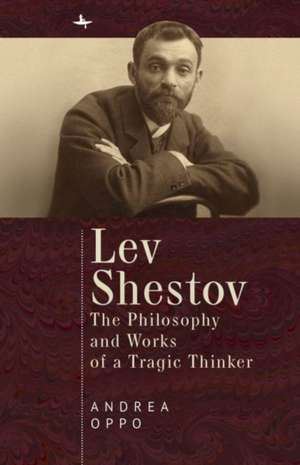
Lev Shestov: The Philosophy and Works of a Tragic Thinker
Autor Andrea Oppoen Limba Engleză Hardback – 10 dec 2020
Preț: 633.13 lei
Preț vechi: 863.40 lei
-27%
Puncte Express: 950
Preț estimativ în valută:
111.86€ • 128.54$ • 96.90£
111.86€ • 128.54$ • 96.90£
Carte disponibilă
Livrare economică 15-29 aprilie
Livrare express 01-07 aprilie pentru 116.90 lei
Specificații
ISBN-13: 9781644694671
ISBN-10: 1644694670
Pagini: 346
Dimensiuni: 156 x 234 x 21 mm
Greutate: 0 kg
Editura: Academic Studies Press
Colecția Academic Studies Press
Locul publicării:Boston, United States
ISBN-10: 1644694670
Pagini: 346
Dimensiuni: 156 x 234 x 21 mm
Greutate: 0 kg
Editura: Academic Studies Press
Colecția Academic Studies Press
Locul publicării:Boston, United States
Recenzii
“Andrea Oppo’s new monograph on Lev Shestov is a remarkable achievement. The author has managed to write a clear, coherent and focused narrative of Shestov’s development, readable and comprehensible to those who are interested in familiarizing themselves with this paradoxical figure. Meanwhile, the book is also heavily footnoted, for which Oppo reserves discussions about issues that are mainly for the specialists, which means that both groups will find this book rewarding. Oppo’s book is a combination of philosophy, that is a discussion of philosophical claims and arguments, and intellectual history, that is the broader contexts in which they were put forward. The book is broadly researched – Oppo has not only studied Shestov’s major works, but also his minor ones as well as texts and thinkers that make up Shestov’s contexts.” – Kåre Johan Mjør, Dostoevsky Studies
"This remarkably thorough study aims to provide a comprehensive view of Lev Shestov’s philosophical legacy by analysing all its individual parts (including the most obscure and often overlooked works of this prolific philosophical writer) — something that has so far largely been lacking in research on Shestov… Andrea Oppo avoids falling into the trap of taking things at face value, for he understands precisely the need for ‘reading between the lines’ — that is, adopting essentially the same method that Shestov did in his study of major thinkers... In a confident manner, lucid style and with substantial philosophical erudition, Oppo looks beyond the self-evident to unravel Shestovian hidden meanings, analysing Shestov’s legacy as a coded philosophical narrative, whilst also leaving no thematic stone unturned… Oppo treats Shestov’s legacy, intrinsically steeped in paradox, simultaneously with personal passion and respect, as well as philosophical ease and fluency. In summary, this is a fresh, well written and thoroughly researched study, full of original insights, that offers a comprehensive and holistic picture of Shestov’s philosophical heritage. It both does justice to Shestov’s thought in historical perspective, and convincingly highlights its contemporary relevance." — O. Tabachnikova, School of Humanities, Language and Global Studies, University of Central Lancashire, SEER
“From its very first page, this study is destined to impress the reader for its highly attentive and scrupulous analysis of almost every text published by Shestov and every aspect of his biography… This remarkable book is to be considered as one of the best ... studies of Russian thought in recent times.” (quote translated from the original Russian) — Boris Vadimovich Mezhuyev, Associate Professor of the Department of History of Russian Philosophy, Moscow State University, Solovyov Studies / Solov’evskie Issledovaniya
“This is a powerfully written and exhaustively researched reconstruction of the life and work of Lev Shestov, the oft-misunderstood existentialist thinker of Russia’s revolutionary age. Oppo’s book eloquently captures not only the main concepts and networks of Shestov’s output, but also the feeling of his work. This is a book for our times, as it is sure to encourage among its readers those dispositions that Shestov himself practiced: to read widely and between the lines; to defend morality and retain hope when there is none; and to always travel ‘in the opposite direction’ of popular opinion, choosing instead, as Shestov put it, ‘to wander through souls.’” — Alyssa DeBlasio, Associate Professor of Russian, Dickinson College
“Lev Shestov was Russia’s most popular thinker of the early twentieth century and became an essential bridge between modern Russian thought and European existentialism. Thanks to Andrea Oppo, we finally have what is long overdue, the first full English-language intellectual biography of Shestov. Oppo’s highly readable book traces the development of this self-made philosopher’s thought from his earliest literary-philosophical criticism to his later religiously oriented works. Early on, Shestov challenged the grounds of idealist and materialist thought, bracketing them but never denying them. He developed a ‘philosophy of tragedy’—first a ‘tragedy of morals’ and later a ‘tragedy of truth’—that probes the human condition of metaphysical ‘groundlessness.’ This biography makes a credible case for Shestov’s position among the founders of existentialist philosophy: at once an outsider and a celebrity, he left his mark among writers and philosophers in Russia and Europe alike.” — Edith W. Clowes, Brown-Forman Chair in the Humanities, University of Virginia
“A uniquely comprehensive and insightful study of one of the most complex, contradictory, and influential Russian philosophers, Lev Shestov. This fundamental and erudite work of scholarship attends to all aspects of Shestov’s philosophical and literary heritage—from his engagement with Russian and European writers to his polemics with the European and Jewish philosophical traditions. Oppo’s book is a must-read for anyone looking for a lucid, nuanced, and thorough analysis of Shestov’s thought and his legacy.” — Svetlana Evdokimova, Professor of Slavic Languages and Comparative Literature, Brown University
"This remarkably thorough study aims to provide a comprehensive view of Lev Shestov’s philosophical legacy by analysing all its individual parts (including the most obscure and often overlooked works of this prolific philosophical writer) — something that has so far largely been lacking in research on Shestov… Andrea Oppo avoids falling into the trap of taking things at face value, for he understands precisely the need for ‘reading between the lines’ — that is, adopting essentially the same method that Shestov did in his study of major thinkers... In a confident manner, lucid style and with substantial philosophical erudition, Oppo looks beyond the self-evident to unravel Shestovian hidden meanings, analysing Shestov’s legacy as a coded philosophical narrative, whilst also leaving no thematic stone unturned… Oppo treats Shestov’s legacy, intrinsically steeped in paradox, simultaneously with personal passion and respect, as well as philosophical ease and fluency. In summary, this is a fresh, well written and thoroughly researched study, full of original insights, that offers a comprehensive and holistic picture of Shestov’s philosophical heritage. It both does justice to Shestov’s thought in historical perspective, and convincingly highlights its contemporary relevance." — O. Tabachnikova, School of Humanities, Language and Global Studies, University of Central Lancashire, SEER
“From its very first page, this study is destined to impress the reader for its highly attentive and scrupulous analysis of almost every text published by Shestov and every aspect of his biography… This remarkable book is to be considered as one of the best ... studies of Russian thought in recent times.” (quote translated from the original Russian) — Boris Vadimovich Mezhuyev, Associate Professor of the Department of History of Russian Philosophy, Moscow State University, Solovyov Studies / Solov’evskie Issledovaniya
“This is a powerfully written and exhaustively researched reconstruction of the life and work of Lev Shestov, the oft-misunderstood existentialist thinker of Russia’s revolutionary age. Oppo’s book eloquently captures not only the main concepts and networks of Shestov’s output, but also the feeling of his work. This is a book for our times, as it is sure to encourage among its readers those dispositions that Shestov himself practiced: to read widely and between the lines; to defend morality and retain hope when there is none; and to always travel ‘in the opposite direction’ of popular opinion, choosing instead, as Shestov put it, ‘to wander through souls.’” — Alyssa DeBlasio, Associate Professor of Russian, Dickinson College
“Lev Shestov was Russia’s most popular thinker of the early twentieth century and became an essential bridge between modern Russian thought and European existentialism. Thanks to Andrea Oppo, we finally have what is long overdue, the first full English-language intellectual biography of Shestov. Oppo’s highly readable book traces the development of this self-made philosopher’s thought from his earliest literary-philosophical criticism to his later religiously oriented works. Early on, Shestov challenged the grounds of idealist and materialist thought, bracketing them but never denying them. He developed a ‘philosophy of tragedy’—first a ‘tragedy of morals’ and later a ‘tragedy of truth’—that probes the human condition of metaphysical ‘groundlessness.’ This biography makes a credible case for Shestov’s position among the founders of existentialist philosophy: at once an outsider and a celebrity, he left his mark among writers and philosophers in Russia and Europe alike.” — Edith W. Clowes, Brown-Forman Chair in the Humanities, University of Virginia
“A uniquely comprehensive and insightful study of one of the most complex, contradictory, and influential Russian philosophers, Lev Shestov. This fundamental and erudite work of scholarship attends to all aspects of Shestov’s philosophical and literary heritage—from his engagement with Russian and European writers to his polemics with the European and Jewish philosophical traditions. Oppo’s book is a must-read for anyone looking for a lucid, nuanced, and thorough analysis of Shestov’s thought and his legacy.” — Svetlana Evdokimova, Professor of Slavic Languages and Comparative Literature, Brown University