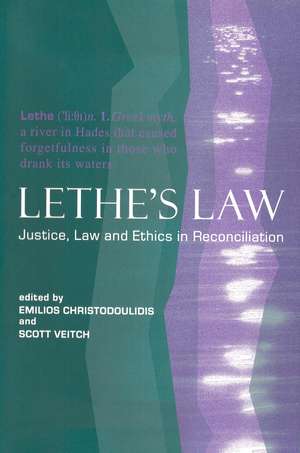
Lethe's Law: Justice, Law and Ethics in Reconciliation
Editat de Emilios Christodoulidis, Professor Scott Veitchen Limba Engleză Hardback – 9 mai 2001
Among its key concerns is that justice's demand on law has changed and, in the face of a divided and violent past, law is being called on to do the kind of work it ordinarily shuns. What this means for conventional understandings of law, as well as for the relation between law and politics in times of transition, is explored through a discussion of experiences from Eastern Europe and Germany, to South Africa, Israel, and Australia.
The book thus provides a timely investigation of the nature of law and legal institutions in times of political and social change, and will appeal to a broad international audience including lawyers, political theorists, criminologists, and philosophers.
Preț: 587.46 lei
Preț vechi: 882.41 lei
-33%
Puncte Express: 881
Carte tipărită la comandă
Livrare economică 05-19 iunie
Specificații
ISBN-13: 9781841131092
ISBN-10: 1841131091
Pagini: 256
Dimensiuni: 138 x 216 x 20 mm
Greutate: 0.45 kg
Editura: Bloomsbury Publishing
Colecția Hart Publishing
Locul publicării:London, United Kingdom
ISBN-10: 1841131091
Pagini: 256
Dimensiuni: 138 x 216 x 20 mm
Greutate: 0.45 kg
Editura: Bloomsbury Publishing
Colecția Hart Publishing
Locul publicării:London, United Kingdom
Recenzii
Lethe's Law is a timely collection of well-informed and theoretically sophisticated scholarship.
Lethe's Law is thus an exciting and provocative collection of essays. Its achievements is to realise a diversity of politically and theoretically engaged analyses.
For those working within the field, or interested in the wider implications of truth and reconciliation for political and social theory, it offers an essential and dynamic resource whose influence will be evidenced in scholarship to come.
Lethe's Law is thus an exciting and provocative collection of essays. Its achievements is to realise a diversity of politically and theoretically engaged analyses.
For those working within the field, or interested in the wider implications of truth and reconciliation for political and social theory, it offers an essential and dynamic resource whose influence will be evidenced in scholarship to come.