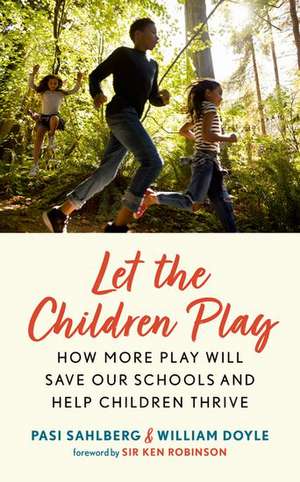
Let the Children Play: For the Learning, Well-Being, and Life Success of Every Child
Autor Pasi Sahlberg, William Doyleen Limba Engleză Hardback – 22 oct 2020
Notăm cu interes faptul că, în peisajul actual al literaturii pedagogice, există o lacună critică în ceea ce privește echilibrul dintre rigoarea academică și nevoia biologică de explorare liberă. Volumul Let the Children Play vine să umple acest gol, oferind o argumentație solidă împotriva tendinței globale de a elimina jocul, artele și activitatea fizică din curriculumul școlar în favoarea testării standardizate. Autorii, Pasi Sahlberg și William Doyle, își ancorează analiza în experiența personală de a schimba sistemele de învățământ între SUA și Finlanda, observând direct cum politicile educaționale bazate pe presiune ignoră mecanismul fundamental al învățării umane. Reținem că structura cărții nu se rezumă la o pledoarie teoretică, ci integrează cercetări de ultimă oră și studii de caz din diverse regiuni geografice, de la Singapore la Scoția. Abordarea este una sistemică, demonstrând cum jocul liber acționează ca un motor pentru dezvoltarea abilităților esențiale precum empatia, munca în echipă și rezolvarea problemelor complexe. Cititorii familiarizați cu Play = Learning de Dorothy G. Singer vor aprecia modul în care acest volum duce discuția dincolo de psihologia dezvoltării, către o strategie de politici publice aplicabilă la nivel global. Această lucrare reprezintă o evoluție naturală în opera lui Pasi Sahlberg. Dacă în Finnish Lessons 3.0 autorul se concentra pe succesul structural al modelului finlandez, iar în FinnishED Leadership analiza managementul școlar, Let the Children Play sintetizează aceste teme într-o viziune umanistă despre succesul pe termen lung al copilului. Este un text precis, care transformă datele statistice într-un manifest pentru redobândirea bucuriei de a învăța.
Preț: 142.83 lei
Preț vechi: 174.06 lei
-18%
Carte tipărită la comandă
Livrare economică 10-16 decembrie
Livrare express 03-07 noiembrie pentru 68.56 lei
Specificații
ISBN-10: 0192894161
Pagini: 480
Dimensiuni: 148 x 223 x 41 mm
Greutate: 0.58 kg
Ediția:1
Editura: OUP OXFORD
Colecția OUP Oxford
Locul publicării:Oxford, United Kingdom
V-ar putea interesa
-
 Origins of the French RevolutionWilliam Doyle-21%Preț: 400.09 lei506.44 lei
 -
 Aristocracy and its Enemies in the Age of RevolutionWilliam Doyle-9%Preț: 370.80 lei407.86 lei
 -
 -18%Preț: 955.48 lei1165.21 lei
 -
 Preț: 418.54 lei
 -
 An American InsurrectionWilliam DoylePreț: 142.91 lei
 -
 Living WellMontel WilliamsPreț: 137.55 lei
 -
 A Soldier's DreamWilliam DoylePreț: 139.13 lei
 -
 RobespierreColin HaydonPreț: 352.74 lei
 -
 The French Nobility in the Eighteenth CenturyGuy Chaussinand-NogaretPreț: 387.48 lei
 -
 Preț: 386.38 lei
 -
 Response to Intervention: Refining Instruction to Meet Student NeedsTimothy E. Morse-28%Preț: 402.36 lei562.37 lei
 -
 Response to Intervention: Refining Instruction to Meet Student NeedsTimothy E. Morse-25%Preț: 219.85 lei292.52 lei
 -
 -26%Preț: 175.66 lei236.69 lei
 -
 -25%Preț: 178.04 lei238.22 lei
 -
 -25%Preț: 220.85 lei293.12 lei
 -
 Pedagogical Models: The Discipline of Online TeachingMichael F Shaughnessy-27%Preț: 1356.05 lei1847.30 lei
 -
 Animation Lab for KidsLaura Bellmont-17%Preț: 114.43 lei137.93 lei
De ce să citești această carte
Recomandăm această carte părinților, educatorilor și decidenților care caută o alternativă viabilă la sistemele bazate pe testare excesivă. Veți descoperi dovezi clare că jocul nu este o pauză de la învățare, ci însăși metoda prin care se construiește inteligența și reziliența emoțională. Este o lectură esențială pentru a înțelege cum putem pregăti copiii pentru o lume imprevizibilă, protejându-le în același timp dreptul la o copilărie echilibrată.
Despre autor
Pasi Sahlberg este un expert în educație de renume mondial, cunoscut pentru analizele sale asupra sistemului finlandez, autor al volumelor Finnish Lessons 3.0 și Empowered Educators in Finland. A activat ca profesor și consultant pentru organizații internaționale, fiind un susținător fervent al echității în educație. William Doyle este un autor de succes și producător de televiziune, distins cu premii pentru lucrările sale de istorie și politică. Împreună, cei doi combină rigoarea academică cu o perspectivă narativă captivantă, bazată pe experiența lor directă ca părinți implicați în sisteme educaționale divergente.
Descriere
Recenzii
Inspirational, well written, and superbly documented, this book is a gift to the next generation. Adding play back into children's hurried and stressed lives might just be the elixir that will help them thrive in a workforce of thinkers, innovators, and collaborators. Thank you Doyle and Sahlberg for giving us a road map so that we can put our educational systems back on course.
Sahlberg and Doyle whack us in the head with the reality that 21st Century skills require old-fashioned learning as children. Play is the analog of life - observing the world, identifying challenges, taking risks, failing, problem-solving again and again, struggling to find consensus with others, absorbing defeats with grace and celebrating victories with exuberance. What builds successful adults is the ability to rise undaunted to opportunities, build relationships, feed curiosity and seize the joy that is at the heart of learning and of living!
Let the Children Play should be in the hands of every single teacher, parent and policy maker who touch the lives of the children they serve. Sahlberg and Doyle clearly articulate and demand that we wake up and finally acknowledge that children have the fundamental right to play in school. This is a compelling vision of the power of play and what we can do to ensure it comes off the 'endangered species' list and back into every school around the world.
Let the Children Play is a passionate, eloquent and substantiated argument for a radical change of priorities in how many parents, educators and policymakers provide for the education, health and well being of children.
We have undervalued the role of play in school to our own detriment as educators, and that of our students. In a culture where standardized testing has crowded out inquisitiveness and play, our students don't get an opportunity to tinker and experiment without high stakes judgments. Without play, teachers don't get to learn from watching their students be unbound by their inner creative selves. When children play, we observe the possibility of their imagination, and retool our structured classroom learning to create activities that model the authentic play and joy of students. It's a missed opportunity to learn from a feedback loop on what comes naturally to children. Play can liberate the power of inquiry in classrooms, that ironically can produce better test scores. Kudos for being so bold with this book!
Play develops our imagination and capacity to collaborate and is what makes us human. Sahlberg and Doyle have written a brilliant and compelling manifesto for bringing play back into the lives of children. Let the revolution begin!
Insightful... An excellent offering for parent activists, education students, and school administrators.
The book convincingly shows the reader that all children deserve to grow physically, emotionally, academically and socially--the benefits of real play nurture the soul as well as the development of the whole child. What's more important than that?
Notă biografică
Cuprins
- Foreword
- 1: The Coming Golden Age of Childhood
- 2: A Tale of Two Fathers
- 3: The Learning Power of Play
- 4: The GERM that Kills Play
- 5: An American Tragedy: The Death of Recess
- 6: The Global War on Play
- 7: The Great Play Experiments
- 8: Play in the Schools of Tomorrow
- 9: The Global Play Summit
- Appendices
- 1: The Declaration of Play - Call to Halt the War on Childhood
- 2: The Play Stages of a Child's School Life
- 3: 7 Steps to Help Children and Schools Thrive
- 4: Play Recommendations of the American Academy of Pediatrics