
Lessons in Project Management
Autor Jeffrey Mochal, Thomas Mochalen Limba Engleză Paperback – 28 sep 2011
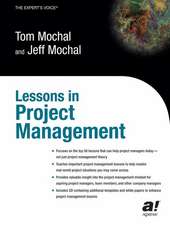
Each case study in Lessons in Project Management contains an accessible, easy-to-read analysis of the challenges of real-world project management. Each problem is presented, then followed by an examination of the solution, written in easy-to-understand language.
The format allows you to more easily relate to the book, since it brings into play a project scenario with practical project management lessons to be learned. You'll also recognize recurring characters who appear in multiple stories, and you'll start to develop some empathy for and interest in their struggles.
Preț: 308.20 lei
Puncte Express: 462
Carte tipărită la comandă
Livrare economică 20 noiembrie-04 decembrie
Livrare prin curier în România Termenul estimat este afișat lângă disponibilitate.
Transport gratuit de la 400.00 lei Plată online sau ramburs, în funcție de opțiunile comenzii.
Retur gratuit în 14 zile Comandă securizată și suport în română.
Specificații
ISBN-13: 9781430238348
ISBN-10: 1430238348
Pagini: 240
Ilustrații: 236 p.
Dimensiuni: 152 x 229 x 14 mm
Greutate: 0.35 kg
Ediția:2nd edition
Editura: Apress
Locul publicării:Berkeley, CA, United States
ISBN-10: 1430238348
Pagini: 240
Ilustrații: 236 p.
Dimensiuni: 152 x 229 x 14 mm
Greutate: 0.35 kg
Ediția:2nd edition
Editura: Apress
Locul publicării:Berkeley, CA, United States
V-ar putea interesa
-
 Preț: 141.45 lei
 -
 Writing to Make a DifferenceDalya F. MassachiPreț: 250.11 lei
 -
 Preț: 366.91 lei
 -
 Technical Support EssentialsAndrew SanchezPreț: 250.50 lei
 -
 Preț: 228.22 lei
 -
 Preventing Good People From Doing Bad ThingsBrian AndersonPreț: 256.21 lei
 -
 How to Secure Your H-1B VisaJames A. BachPreț: 234.95 lei
 -
 Data Modeling of Financial DerivativesRobert MamayevPreț: 402.93 lei
 -
 Corporate PlasticityChristian SchuhPreț: 136.21 lei
 -
 Lessons in Project ManagementJeffrey Mochal-20%Preț: 176.73 lei220.92 lei
 -
 Richards, C: BTEC Level 3 National Business Student Book 2Catherine RichardsPreț: 278.77 lei
 -
 Preț: 107.16 lei
 -
 Preț: 96.07 lei
 -
 Ferdinand PiëchRita Stiens-15%Preț: 528.42 lei621.67 lei
Public țintă
Popular/generalNotă biografică
Jeff Mochal is director of communication and external relations at ConAgra Foods, based in Naperville, Illinois. He has been working in the public relations and communications industry for 15 years and has extensive expertise in media relations, crisis communication, issues management, reputation management and corporate branding. Jeff is married with two children, and is pursuing his master's in business administration from the University of Notre Dame.
Caracteristici
Truly well written stories that teach project management lessons. The scenarios illustrate likely problems you will face in any project and give you the solution. Hidden nuggets, common sense wisdom. Each section is short, so good airplane reading or wherever when you have a few minutes to kill to learn something. The lessons on risk, quality, scope and budget were praised for their immediate usefulness.
Cuprins
- Understand the Characteristics of a Project
- Always Have an Identified and Committed Sponsor
- Report Status on All Projects
- Focus on Deadline Dates
- Apply Some Level of Project Management Discipline
- Define and Plan the Work
- Don't "Microbuild" or Micromanage the Workplan
- Hire a Diverse Project Team
- Define the Many Aspects of What Is In Scope and Out of Scope
- Use the "Big Three" Documents
- Use Scope Change Management
- Collect Metrics
- Give Performance Feedback Routinely
- Ensure Issues Management Is Everyone's Responsibility
- Shorten Long Meetings to Sharpen the Focus
- Identify the Root Cause of Problems
- Use Quality Assurance Techniques to Validate Project Status
- Cancel Projects That Lose Business Support
- Use Risk Management to Respond to Discover Potential Problems
- Focus Your Quality Management on Processes, Not People
- Don't Use Your Estimating Contingency for Scope Changes
- Develop a Communication Plan for Complex Projects
- Scale Your Processes Based on Project Size
- Plan the Project Even If You Start the Work at the Same Time
- Identify the Critical Path and How This Path Drives the Deadline Date
- Change Assumptions to Revise an Estimate
- Don't Forget Face-to-Face Communication on Your Project
- Make Quality a Mindset and Ongoing Process
- Batch Small Scope Change Requests for Sponsor Approval
- Manage Your Vendor Projects Proactively
- Look for Risks Inherent to Your Project
- Get Sponsor Approval Before Investigating Large Scope Change Requests
- Make Sure the Cost of Collecting Metrics Does Not Exceed Their Value
- Use Multiple Estimating Techniques
- Keep Your Schedule Up to Date
- Use Issues Management to Choose the Best of Bad Alternatives
- Collect Metrics That Can Lead to Fundamental Improvements
- Evaluate All Risk Response Options in the Risk Plan
- Manage Client Expectations
- Use Milestones to Track Overall Progress
- Catch Errors As Early as Possible
- Gain Sponsor Approval for Scope Changes Requiring Budget and Deadline Deviations
- Be Proactive to Accelerate the Project Schedule
- Use the Work Breakdown Structure to Identify All the Work
- Write Your Status Reports From the Readers' Perspective
- Update Your Risk Plan Throughout the Project
- Don't Deliver More Than the Client Requested
- Make One Person Responsible for Each Activity
- Focus on Deadlines to Keep Your Project from Wandering
- Gain Agreement on Project Metrics Ahead of Time