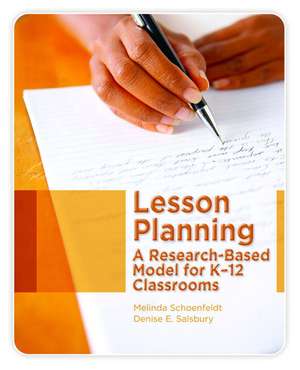
Lesson Planning: A Research-Based Model for K-12 Classrooms
Autor Melinda Schoenfeldt, Denise E. Salsburyen Limba Engleză Paperback – 30 noi 2007
- Part I establishes the theoretical foundations of the ideas used in the lesson planning process.
- Part II is a step-by-step guide to developing direct and inquiry-based lesson plans.
- Meeting the Needs of all learners – woven throughout each chapter, the authors address the diverse needs of students.
- INTASC Standards Correlation Guide appears on the inside front cover to help readers quickly identify the lessons that meet each standard.
- Connections to the INTASC Standards are woven throughout each chapter’s content and activities.
- Unit Connections explain how the chapter’s content is used in the development of a unit
- Technology in Education (TiE) – a feature throughout the book provide practical help in the lesson planning process including rubric generating sites, lesson plan templates, ideas for lesson activities, and links to useful classroom materials.
- Reality Check, a feature in each chapter, provides advice from practicing classroom teachers who represent a range of subjects and grade levels.
- Your Turn feature at the end of each chapter helps you create your own standards-based lesson plan in both direct and indirect instruction formats.
Preț: 526.14 lei
Preț vechi: 649.55 lei
-19%
Puncte Express: 789
Carte disponibilă
Livrare economică 04-18 mai
Specificații
ISBN-13: 9780131735941
ISBN-10: 0131735942
Pagini: 152
Dimensiuni: 214 x 276 x 9 mm
Greutate: 0.38 kg
Ediția:1
Editura: Prentice Hall
Locul publicării:Boston, United States
ISBN-10: 0131735942
Pagini: 152
Dimensiuni: 214 x 276 x 9 mm
Greutate: 0.38 kg
Ediția:1
Editura: Prentice Hall
Locul publicării:Boston, United States
V-ar putea interesa
-
 Digital EducationM. ThomasPreț: 295.47 lei
 -
 New Literacies: Everyday Practices and Social LearningColin Lankshear-27%Preț: 188.57 lei258.37 lei
 -
 Preț: 323.76 lei
 -
 Preț: 231.90 lei
 -
 Preț: 296.59 lei
 -
 Preț: 463.29 lei
 -
 Exploring the Landscape of Scientific LiteracyCedric Linder-15%Preț: 437.18 lei514.34 lei
 -
 Preț: 386.85 lei
 -
 Teaching and Learning Proof Across the Grades: A K-16 PerspectiveDespina A. Stylianou-15%Preț: 443.56 lei521.83 lei
 -
 Disavowed Knowledge: Psychoanalysis, Education, and TeachingPeter Maas TaubmanPreț: 426.20 lei
 -
 Preț: 353.88 lei
 -
 -15%Preț: 500.31 lei588.60 lei
 -
 Closing the Teaching Gap: Coaching for Instructional LeadersDonald B. BartaloPreț: 303.53 lei
 -
 Taking the Pyp ForwardSteven Carber-19%Preț: 110.77 lei137.47 lei
Cuprins
Instructional Strategies List
Preface
PART I: CONCEPTUAL FOUNDATIONS FOR PLANNING A LESSON
Chapter 1: Planning is Necessary
Planning is Professional Decision-Making
Teacher Accountability: Past and Present
Planning as a Road Trip Analogy
Reasons for Planning
Lesson Focus
Remaining Focused During Instruction
Selecting Appropriate Materials and Strategies
Incorporates Academic Standards
Classroom Management
Reflective Practitioner
Long Range Planning
Daily Lesson Plans
Interdisciplinary Thematic Unit
In Summary
Your Turn:
Activity: Reflections on Planning
Bibliography
Chapter 2: Teaching is Informed Decision Making
Making Decisions: Experienced and Expert Teachers
The Importance of a Personal Philosophy of Teaching
Philosophy: A K-12 Lesson Planning Model That Works
Constructivism
Context
Commitment
Content
In Summary
Your Turn:
Activity 1: Your Beliefs
Activity 2: Your Philosophy
Bibliography
PART II: STRUCTURAL FOUNDATIONS OF A LESSON PLAN
Chapter 3: Identifying a Topic and Academic Standards
Identifying Topics
Identifying Academic Standards
Standards and Educational Reform
National Standards
State Standards
Identify a Topic and Standards for a Lesson
In Summary
Your Turn:
Activity 1: Your State Standards
Activity 2: Topic Identification
Activity 3: Select and Align a Topic with State Standards
Activity 4: Reflection
Bibliography
Chapter 4: Writing Lesson Goals and Objectives
Goals and Objectives
Purpose for Writing Goals and Objectives
Defining Goals and Objectives
Approaches to Writing Lesson Objectives
Behavioral Objectives
Goals Objectives
Instructional Objectives
Standards-based Lessons:
Using Academic Standards to Write Objectives
In Summary
Your Turn:
Activity 1: Distinguishing Between Goals and Objectives and Identifying Taxonomy Levels
Activity 2: Writing an Instructional Objective
Activity 3: Reflection
Biblography
Chapter 5: Designing Formative and Summative Assessments
The Importance of Assessment
Reasons for Classroom Assessment
Assessment and Evaluation
Types of Assessment
The Assessment Process: Pre-assessment, Formative, and Summative Assessment
Evaluation
Creating a Rubric
A Process for Measuring Teacher Impact
In Summary
Your Turn:
Activity 1: Creating Your Lesson's Pre- and Post-Assessments
Activity 2: Create a Rubric
Activity 3: Creating a Formative Assessment
Activity 4a: Differentiating Your Lesson's Product by Readiness
Activity 4b: Differentiating Your Lesson's Product by Interest
Activity 4c: Differentiating Your Lesson's Product by Learner
Activity 5: Reflection
Bibliography
Chapter 6: Choosing the Lesson Content and Instructional Strategies
A Highly Qualified Teacher in Every Room
Understanding Context: The Learners
What is Differentiation?
Understanding Differentiation: Important Terms Defined
Content
Process
Product
Student Readiness
Student Interest
Learning Profile
Intelligence Preference
Environment
Organizational Considerations
Understanding Content
Informational
Instructional
In Summary
Your Turn:
Activity 1: Identify Your Informational Sources
Activity 2: Identify Your Instructional Sources
Activity 3: Creating a Lesson Plan Annotated Bibliography
Activity 4: Collaboration
Activity 5: Reflection
Bibliography
Chapter 7: Selecting Lesson Materials
The Next Step: Selecting Materials
Materials Defined
What Research Says
Brain Research
Literacy
Technology as an Instructional Tool
Meeting the Needs of All Learners
Cultural Diversity
Practical Considerations in Using Materials
In Summary
Your Turn:
Activity 1: Select Literature/Print Sources
Activity 2: Select an Activity and Its Corresponding Materials
Activity 3: Selecting Visual Aids
Activity 4: Create a Materials List
Activity 5: Collaboration
Activity 6: Reflection
Bibliography
Chapter 8: Creating a Lesson Plan
Putting the Pieces Together
SECTION I: DIRECT INSTRUCTION
What is Direct Instruction?
Writing a Direct Instruction Lesson: Elements Defined
Lesson Beginning
Lesson Middle
Lesson End
Your Turn:
Activity 1: Evaluation of a Direct Instruction Lesson Plan
Activity 2: Write a Basic 3-Part Direct Instructional Lesson Plan
Activity 3: Reflection
PART II: INDIRECT INSTRUCTION
What is Indirect Instruction?
Planning and Implementing Indirect, Inquiry Learning
Writing Essential Questions
Assessment of Learning
In Summary
Your Turn:
Activity 1: Collaboration
Activity 2: Creating an Inquiry Lesson Plan
Activity 3: Peer Review
Activity 4: Reflection
Bibliography
Index
INTASC Principles List
Preface
PART I: CONCEPTUAL FOUNDATIONS FOR PLANNING A LESSON
Chapter 1: Planning is Necessary
Planning is Professional Decision-Making
Teacher Accountability: Past and Present
Planning as a Road Trip Analogy
Reasons for Planning
Lesson Focus
Remaining Focused During Instruction
Selecting Appropriate Materials and Strategies
Incorporates Academic Standards
Classroom Management
Reflective Practitioner
Long Range Planning
Daily Lesson Plans
Interdisciplinary Thematic Unit
In Summary
Your Turn:
Activity: Reflections on Planning
Bibliography
Chapter 2: Teaching is Informed Decision Making
Making Decisions: Experienced and Expert Teachers
The Importance of a Personal Philosophy of Teaching
Philosophy: A K-12 Lesson Planning Model That Works
Constructivism
Context
Commitment
Content
In Summary
Your Turn:
Activity 1: Your Beliefs
Activity 2: Your Philosophy
Bibliography
PART II: STRUCTURAL FOUNDATIONS OF A LESSON PLAN
Chapter 3: Identifying a Topic and Academic Standards
Identifying Topics
Identifying Academic Standards
Standards and Educational Reform
National Standards
State Standards
Identify a Topic and Standards for a Lesson
In Summary
Your Turn:
Activity 1: Your State Standards
Activity 2: Topic Identification
Activity 3: Select and Align a Topic with State Standards
Activity 4: Reflection
Bibliography
Chapter 4: Writing Lesson Goals and Objectives
Goals and Objectives
Purpose for Writing Goals and Objectives
Defining Goals and Objectives
Approaches to Writing Lesson Objectives
Behavioral Objectives
Goals Objectives
Instructional Objectives
Standards-based Lessons:
Using Academic Standards to Write Objectives
In Summary
Your Turn:
Activity 1: Distinguishing Between Goals and Objectives and Identifying Taxonomy Levels
Activity 2: Writing an Instructional Objective
Activity 3: Reflection
Biblography
Chapter 5: Designing Formative and Summative Assessments
The Importance of Assessment
Reasons for Classroom Assessment
Assessment and Evaluation
Types of Assessment
The Assessment Process: Pre-assessment, Formative, and Summative Assessment
Evaluation
Creating a Rubric
A Process for Measuring Teacher Impact
In Summary
Your Turn:
Activity 1: Creating Your Lesson's Pre- and Post-Assessments
Activity 2: Create a Rubric
Activity 3: Creating a Formative Assessment
Activity 4a: Differentiating Your Lesson's Product by Readiness
Activity 4b: Differentiating Your Lesson's Product by Interest
Activity 4c: Differentiating Your Lesson's Product by Learner
Activity 5: Reflection
Bibliography
Chapter 6: Choosing the Lesson Content and Instructional Strategies
A Highly Qualified Teacher in Every Room
Understanding Context: The Learners
What is Differentiation?
Understanding Differentiation: Important Terms Defined
Content
Process
Product
Student Readiness
Student Interest
Learning Profile
Intelligence Preference
Environment
Organizational Considerations
Understanding Content
Informational
Instructional
In Summary
Your Turn:
Activity 1: Identify Your Informational Sources
Activity 2: Identify Your Instructional Sources
Activity 3: Creating a Lesson Plan Annotated Bibliography
Activity 4: Collaboration
Activity 5: Reflection
Bibliography
Chapter 7: Selecting Lesson Materials
The Next Step: Selecting Materials
Materials Defined
What Research Says
Brain Research
Literacy
Technology as an Instructional Tool
Meeting the Needs of All Learners
Cultural Diversity
Practical Considerations in Using Materials
In Summary
Your Turn:
Activity 1: Select Literature/Print Sources
Activity 2: Select an Activity and Its Corresponding Materials
Activity 3: Selecting Visual Aids
Activity 4: Create a Materials List
Activity 5: Collaboration
Activity 6: Reflection
Bibliography
Chapter 8: Creating a Lesson Plan
Putting the Pieces Together
SECTION I: DIRECT INSTRUCTION
What is Direct Instruction?
Writing a Direct Instruction Lesson: Elements Defined
Lesson Beginning
Lesson Middle
Lesson End
Your Turn:
Activity 1: Evaluation of a Direct Instruction Lesson Plan
Activity 2: Write a Basic 3-Part Direct Instructional Lesson Plan
Activity 3: Reflection
PART II: INDIRECT INSTRUCTION
What is Indirect Instruction?
Planning and Implementing Indirect, Inquiry Learning
Writing Essential Questions
Assessment of Learning
In Summary
Your Turn:
Activity 1: Collaboration
Activity 2: Creating an Inquiry Lesson Plan
Activity 3: Peer Review
Activity 4: Reflection
Bibliography
Index
INTASC Principles List
Notă biografică
Melinda Schoenfeldt earned her doctorate in Curriculum and Instruction from Kansas State University. Prior to earning her doctorate, Schoenfeldt taught elementary, middle, and high school courses in public and private schools. She is now an associate professor in the Department of Elementary Education at Ball State University. While at Ball State, she has taught undergraduate courses in lesson planning and classroom management in addition to supervising student teachers in the United States and Germany. She has also served as the faculty coordinator and instructor of study abroad programs in England, Denmark, and Mexico. Schoenfeldt won a dissertation award from the National Council for Geographic Education, was a visiting scholar in geography education at Silkeborg Seminarium in Silkeborg, Denmark, was a fellow at the Virginia Ball Center for Creative Inquiry, and is currently an Enhancing Student Learning Initiative fellow. Schoenfeldt is one of three members of the Learning Assessment Model Project (LAMP) development team. LAMP earned the 2005 Christa MacAuliffe Award for Excellence in Teacher Education. Schoenfeldt currently teaches graduate courses for Ball State University’s online master’s degree program in Elementary Education.
Denise Salsbury is an assistant professor at Ball State University in the Elementary Education Department of the Teachers College where she teaches instructional planning, classroom management, and integration of technology in core curriculum courses. She is PDS liaison to The Children’s Museum of Indianapolis and Minnetrista Cultural Center.
Salsbury received her Ph.D. from Kansas State University in Curriculum and Instruction with an emphasis in both elementary social studies and geography education. Her research interests include various aspects of geography and technology education for elementary students. Her first degree is in music education. While in Kansas, she was an active member of the Kansas Geographic Alliance, which gave her the opportunity to attend geographic education and leadership institutes at the National Geographic Society. Salsbury received a dissertation award from National Council for Geographic, and is currently Chair of the Geography Literacy Task Force for the organization. She has taught in grades K-6, specifically fourth grade for ten years, and had many opportunities to write thematic science and social studies curriculum for the school district.
Textul de pe ultima copertă
Are you looking to construct a lesson plan that will help K-12 students master new content, concepts, and skills? Lesson Planning: A Research-based Model for K-12 Classrooms can help by guiding you in the selection of research-based instructional strategies and types of materials designed to consider all learners’ needs.
- Part I establishes the theoretical foundations of the ideas used in the lesson planning process.
- Part II is a step-by-step guide to developing direct and inquiry-based lesson plans.
- Meeting the Needs of all learners — woven throughout each chapter, the authors address the diverse needs of students.
- INTASC Standards Correlation Guide appears on the inside front cover to help readers quickly identify the lessons that meet each standard.
- Connections to the INTASC Standards are woven throughout each chapter’s content and activities.
- Unit Connections explain how the chapter’s content is used in the development of a unit
- Technology in Education (TiE) — a feature throughout the book provide practical help in the lesson planning process including rubric generating sites, lesson plan templates, ideas for lesson activities, and links to useful classroom materials.
- Reality Check, a feature in each chapter, provides advice from practicing classroom teachers who represent a range of subjects and grade levels.
- Your Turn feature at the end of each chapter helps you create your own standards-based lesson plan in both direct and indirect instruction formats.